Wall Street rises as materials and crypto stocks offset continued bond sell-off
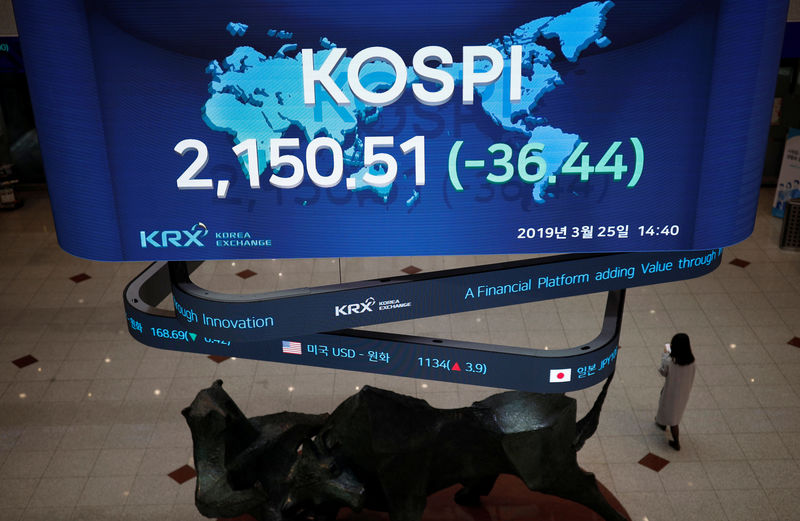
Investing.com -- South Korea’s benchmark stock index shed 3.8% last week and its 12-month forward price-to-earnings ratio fell to the lowest level since the Global Financial Crisis, Goldman Sachs said in a recent note, as foreign investors accelerated their exit from the market.
Foreign investors were net sellers of 19.87 billion Korean won worth of KOSPI shares in the week ending July 3, with technology stocks accounting for the bulk of outflows.
Year-to-date, foreign net selling on the KOSPI has reached 157.50 billion won. Domestic institutions and retail investors partially offset the selling, posting net purchases of 8.16 billion won and 11.12 billion won respectively.
The Banking, Securities and Leisure sectors outperformed during the week, while Technology, Insurance and Retail were the worst performers, declining 7.6%, 5.7% and 5.7% respectively relative to the broader market.
Despite the sell-off, earnings revisions moved higher. The KOSPI 12-month forward earnings per share was revised up 4.8%, with Leisure recording the strongest upward revision and Chemicals the steepest downgrade.
Goldman Sachs presented a stress-test scenario showing that even assuming a 33% earnings downgrade, in line with the median drawdown seen across six prior market troughs since 2008, and applying the median forward P/E at historical EPS bottoms of 11.4 times, the KOSPI would have implied upside potential versus its current level.
The analysts noted a potential KOSPI level of 8,750 under those stressed assumptions, derived from applying that trough multiple to earnings of 771, itself the product of current consensus NTM EPS of 1,150 cut by 33%.
The Korea Equity Risk Barometer, known as the GSSRKERB Index, fell to -1.5, which the broker described as "risk-adverse territory."
The analysts said the indicator is "a contrarian indicator especially under the conditions where significant market moves have already taken place," adding that it "indicates more constructive equity market returns on a forward-looking basis."
The KOSPI’s Relative Strength Index also fell to its lowest level since the end of March 2026, with the index breaking below its 50-day moving average.
The Korean won strengthened 0.3% against the U.S. dollar during the week, though it weakened 0.2% against both the Japanese yen and the euro.
The three-year Korea Treasury bond yield rose to 3.75%, while the 10-year yield climbed to 4.20%.
MSCI Korea fell 5.5% for the week and now trades at a 55% discount to MSCI AC World on a forward P/E basis.


