Wall Street rises as materials and crypto stocks offset continued bond sell-off
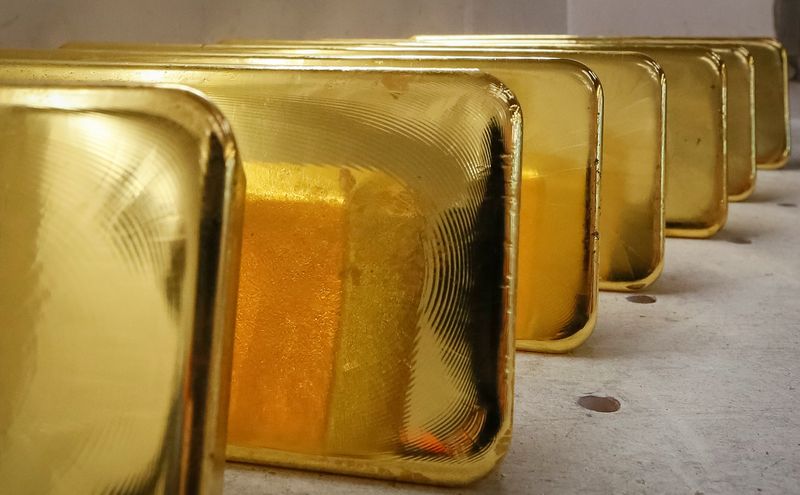
Investing.com -- Gold prices were higher on Friday after Iran said the critical Strait of Hormuz was open for commercial vehicles during an ongoing ceasefire between Israel and Lebanon.
The announcement gave a big boost to Middle East de-escalation and peace hopes, sending oil prices sliding and helping U.S. stocks end at a record high.
At 16:50 ET (20:50 GMT), spot gold XAU/USD was up 0.9% to $4,831.89/oz, while gold futures advanced 0.9% as well to $4,852.55/oz.
Get fresh insights into gold prices with InvestingPro - now 50% off
Vital chokepoint reopens, bolstering hopes
"In line with the ceasefire in Lebanon, the passage for all commercial vessels through Strait of Hormuz is declared completely open for the remaining period of ceasefire," Iran’s foreign minister Abbas Araghchi said on X.
Responding on Truth Social, Trump wrote: "IRAN HAS JUST ANNOUNCED THAT THE STRAIT OF IRAN IS FULLY OPEN AND READY FOR FULL PASSAGE. THANK YOU!" The president in a follow-up post clarified that while the strait was open, the U.S. blockade on vessels entering and exiting Iranian ports would remain in force.
Trump previously announced a 10-day ceasefire between Israel and Lebanon on Thursday. Israel’s continued attacks on Hezbollah targets in Lebanon had been a sticking point in the overall negotiations between Iran and the U.S.
Trump has also suggested that negotiations between Washington and Tehran may resume this weekend.
Washington and Tehran are “very close” to reaching a deal, Trump said, adding that Iran has agreed not to possess a nuclear weapon for more than 20 years. A desire to quell Iran’s nuclear ambitions has been cited Trump as a central reason for the war, which began with joint U.S. and Israeli strikes on Iran in late February.
In return, Iran has called for the removal of international sanctions.
Trump flagged that he would consider extending the ceasefire if Washington was close to an agreement with Tehran.
Citing officials familiar with the matter, Axios reported that Washington and Tehran are discussing a three-page plan to conclude the conflict, with one section of the proposal including the release by the U.S. of $20 billion in frozen Iranian funds in return for Iran agreeing to give up its enriched uranium. But Trump later in a phone interview with Bloomberg News said Iran had agreed to suspend its nuclear program indefinitely and will not receive any frozen funds from the U.S.
Oil slumps
The opening of the strait, though temporary, came as a major relief to market participants across asset classes, as the effective closure of the vital waterway through which a fifth of the world’s oil and gas flows led to the biggest supply disruption in history and sent oil prices soaring.
Oil prices slumped after Araghchi’s statement and remained deep in negative territory. Brent futures, the global benchmark, were last down 7.9%, well below the $90 a barrel threshold.
Reuters reported that significant differences still remained between the U.S. and Iran over reaching a deal to end the war, citing a senior Iranian official, who added that keeping the Strait of Hormuz open was "conditional on U.S. adherence to the terms of ceasefire."
Still, crude remains well above pre-conflict levels. A surge following the start of the Iran war in late February has in turn driven expectations for a spike in inflationary pressures in countries around the world.
Bets that central banks would respond to renewed inflation by hiking interest rates weighed on gold throughout much of the first month of the Iran war. Bullion tends to underperform in elevated rate environments.
At the same time, the U.S. dollar firmed, buoyed in part by the view that heavy energy exports would help immunize the U.S. economy from oil supply disruptions through the Strait of Hormuz. A stronger dollar can make gold more expensive for overseas buyers. A tracker of the U.S. dollar slumped on Friday’s after Araghchi’s announcement, then recovered some losses to trade flat.
Analysts have, however, suggested that the recent stream of statements around a possible detente may lose some market influence over time.
“Markets [...] seem to lack any sort of obvious catalyst at this point, which helps to explain the rather rangebound conditions that we have increasingly seen coming to dominate the foreign exchange, fixed income, and metals complexes,” said Michael Brown, Senior Research Strategist at Pepperstone, in a note.
Ambar Warrick and Scott Kanowsky contributed to this article


