Bitcoin price today: muted at $88k after soft US CPI data
By Will Dunham
WASHINGTON (Reuters) - Guided by ocean plankton fossils and climate models, scientists have calculated just how cold it got on Earth during the depths of the last Ice Age, when immense ice sheets covered large parts of North America, South America, Europe and Asia.
The average global temperature during the period known as the Last Glacial Maximum from roughly 23,000 to 19,000 years ago was about 46 degrees Fahrenheit (7.8 degrees Celsius), some 13 degrees Fahrenheit (7 Celsius) colder than 2019, the researchers said on Wednesday.
Certain regions were much cooler than the global average, they found. The polar regions cooled far more than the tropics, with the Arctic region 25 degrees Fahrenheit (14 degree Celsius) colder than the global average.
The researchers made their calculations with the aid of chemical measurements on tiny fossils of zooplankton and the preserved structures of fats from other types of plankton that change in response to water temperature - what they called a "temperature proxy."
This information was then plugged into climate model simulations to calculate average global temperatures.
"Past climates are the only information we have about what really happens when the Earth cools or warms to a large degree. So by studying them, we can better constrain what to expect in the future," said University of Arizona paleoclimatologist Jessica Tierney, lead author of the research published in the journal Nature.
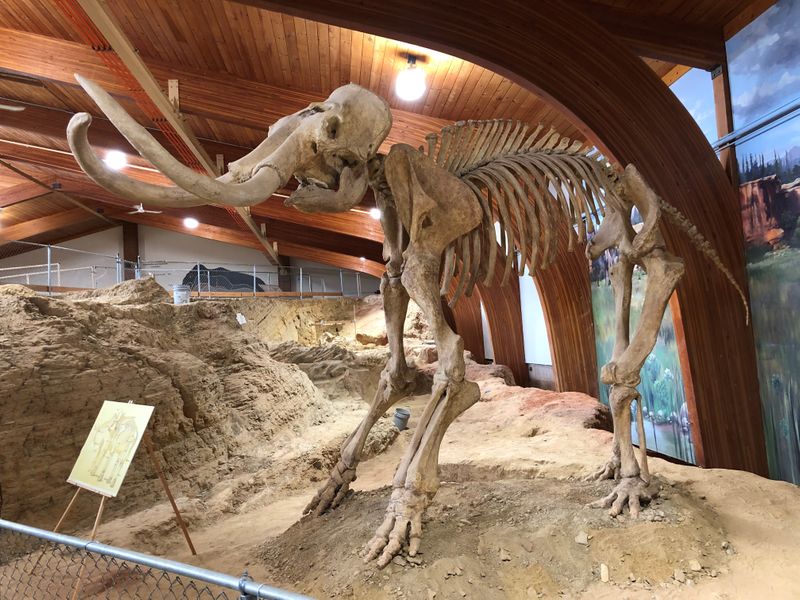
During the Ice Age, which lasted from about 115,000 to 11,000 years ago, large mammals well adapted to a cold climate such as the mammoths, mastodons, woolly rhinos and saber-toothed cats roamed the landscape.
Humans entered North America for the first time during the Ice Age, crossing a land bridge that once connected Siberia to Alaska with sea levels much lower than they are today.
Human hunting is believed to have contributed to mass extinctions globally of many species at the end of the Ice Age.
"What is interesting is that Alaska was not entirely covered with ice," Tierney said. "There was an ice-free corridor that allowed humans to travel across the Bering Strait, into Alaska. Central Alaska was actually not that much colder than today, so for Ice Age humans it might have been a relatively nice place to settle."