Micron surges after one of the biggest beats in U.S. semis history

Methodology for Chart 3 (Large, Sustained Rate Jumps Lead to Rising Unemployment)
To create Chart 3, we first calculated the change in interest rates for every 12 quarter period since 1945, which breaks down like this:
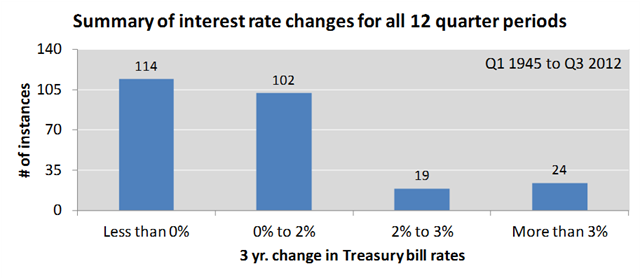
We then looked at unemployment rate changes over the following year, conditioned on the interest rate buckets above.
Regular readers know that our earlier article, “M.C. Escher and the Impossibility of the Establishment Economic View,” was based on a slightly different approach. For that article, we compared eight quarter rate changes to economic outcomes over the following two years. That doesn’t work for this article because we’re making projections on a year-by-year basis. Therefore, we shortened the second time period to a single year and lengthened the first time period to 12 quarters, preserving the four year window. Conclusions are essentially unchanged.
There are two ideas behind our choice of a four year window:
- Sustained interest rate trends are more impactful than one-off changes.
- It takes time for the effects of interest rate changes to work through the economy.
We also went back an extra eight years this time (to 1945 for interest rates and 1948 for unemployment), because we have more data for unemployment than for the indicators in our earlier article.
Methodology for Chart 5 (Budget Deficits with a Genuine Recession)
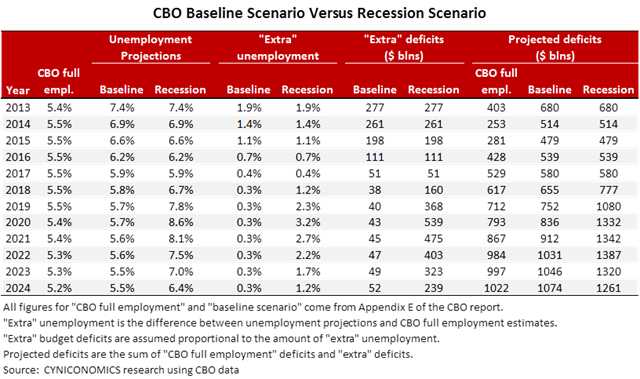
To create Chart 5, we estimated the budgetary effects of unemployment changes by first comparing the CBO’s “baseline” projections to its hypothetical “full employment” projections, shown in Appendix E of the CBO’s report. The difference is the budget deficit’s cyclical component, which we then scaled up based on the additional unemployment in our recession scenario. Basically, the budgetary effects of an unemployment rate increase of 0.25% should be roughly half the effects of an increase of 0.5%, roughly a quarter the effects of an increase of 1%, and so on.
(The proportionality isn’t precise because of other factors involved in the CBO’s estimates. However, if we had access to the CBO’s model then we’d also adjust these factors for the recession scenario. Generally, budget sensitivity to the unemployment rate should be a good proxy for sensitivity to other measures of resource utilization such as those based on GDP.)
Note also that the recession scenario converges to a higher long-term unemployment rate than the CBO baseline scenario (6.4% versus 5.5%).
Here are the figures we used: