Micron surges 16% after one of the biggest beats in U.S. semis history

Exit strategies for covered call writing are critical to the ultimate success we achieve when selling covered call options or cash-secured puts. One of the prime strategies associated with covered call writing when share price declines is the 20%/10% guideline. This strategy guides us when to close our short options position if share price declines based on a percentage of the original premium received and time within the contract. As an example, if we sold an option for $2.00, the guideline tells us to close it at $0.40 in the first half of the contract and at $0.20 in the latter part of the contract. So far, this is pretty straightforward. However, what if we have rolled out and up, perhaps incurring an option debit along with a buy-up in share value? How do we then establish our base premium to then use the 20%/10% guidelines? This article is a product of one of the best questions I have ever received from our members:
Question from Paul S
Alan,
I would appreciate some clarification relative to determining the sale price of a covered call position, which is needed to apply the 20%/10% guideline on an ongoing basis. In some in-the-money, roll-out-and-up situations (later date and higher strike price) where a net option debit results, some buy-up value is sometimes involved as well. Shouldn’t this buy-up value be algebraically included in determining the net sale price of the call thereby offsetting part or all of the debit value? Am I looking at this correctly?
Paul sure is, let’s explore.
Let’s set up a hypothetical trade to review the question and establish a clear baseline
Initial trade
Buy BCI at $28.00
- Sell $30.00 call at $1.00
- Initial return = 3.6%
- Upside potential = 7.1%
- Price as expiration nears = $33.00
Rolling out-and-up to the $35.00 strike: “What Now” tab of Ellman Calculator
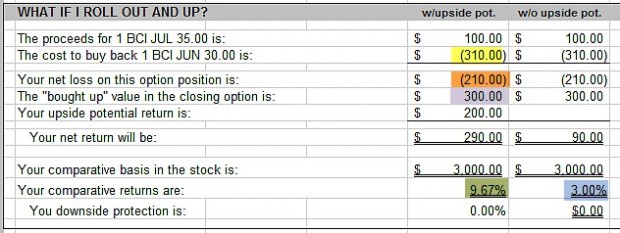
- Cost to close = $3.10 (Yellow)
- Premium from the sale of the next month $35.00 strike = $1.00
- Option debit from rolling-out-and-up = $2.10 (Brown)
- Buy-up value of stock from $30.00 (original strike) to $33.00(current market value) = $3.00 (Purple)
- Net credit from rolling out-and-up = $0.90
- Initial return = 3% (Blue)
- Upside potential to the $35.00 strike = 6.67% (9.67 total potential return- Green)
Setting cost basis and option premium for the second trade after rolling-out-and-up
- Stock value = $33.00
- Option premium for this out-of-the-money strike = $0.90
- 20% guideline = $0.18
- 10% guideline = $0.09
- The are guidelines, so veering slightly from these numbers is okay
***Thanks to Paul S for this outstanding question which allowed me to provide color to our members on an exit strategy that is an integral part of our position management arsenal.
On behalf of retail investors
Isn’t it time for companies like Amazon (NASDAQ:AMZN) and Google (NASDAQ:GOOGL) to split their shares like Apple (NASDAQ:AAPL) did in June, 2014 to make them more affordable for retail investors? After all, Blue Collar Investors do play a major role in the success of these corporations.
Market tone
Global stocks were little changed amid conflicting central bank outlooks from the US Federal Reserve and the Bank of Japan. Oil prices continued their downward slide. The Chicago Board Options Exchange Volatility Index (VIX) dipped slightly this week to 11.87. This week’s reports and international news of importance:
- The U.S. economy expanded at a disappointing 1.2% annual rate, as reported by the US Bureau of Economic Analysis. However, the US consumer activity was strong, but weak corporate investment was a drag on headline growth
- In the eurozone, Q2 growth came in at 1.6%, in line with the consensus forecast
- The US Federal Reserve upgraded its outlook for the US economy, saying near-term risks have diminished while pointing to improved employment figures
- Michel Barnier, a former French finance minister, has been appointed the European Union’s chief Brexit negotiator. The appointment is seen as somewhat provocative by members of the UK financial community, given Barnier’s past tussles with London while he was finance minister and during his time as the EU’s single market commissioner. He will begin work in October.
- A crackdown on perceived enemies of Turkish president Recep Tayyip Erdogan continues in the wake of a failed coup two weeks ago. Jean-Claude Juncker, head of the European Commission, this week said there is no possibility for Turkey to join the EU
- The Bank of Japan surprised markets on Friday by leaving interest rates and its bond-buying program unchanged after its policy-setting meeting on Friday
- According to FactSet Research, since 1900 the Dow Jones Industrial Average has increased in value 69% of the time during the summer Olympic Games. The average gain for the Dow was 1.8% during the games
THE WEEK AHEAD
- Global manufacturing purchasing managers’ indices are released on Monday, August 1st
- Global service sector PMIs are released on Wednesday, August 3rd
- The Bank of England Monetary Policy Committee meets to set rates on Thursday, August 4th
- The US employment report is released on Friday, August 5th
For the week, the S&P 500 slipped slightly by 0.07% for a year-to-date return of +6.34%.
Summary
IBD: Market in confirmed uptrend
GMI: 6/6- Buy signal since market close of July 1, 2016
BCI: Moderately bullish. I’m favoring out-of-the-money strikes 2-to-1 as earnings season has supported the resilient stock market
WHAT THE BROAD MARKET INDICATORS (S&P 500 AND VIX) ARE TELLING US
The charts continue to point to a bullish short-term outlook. In the past six months the S&P 500 rose by 12% while the VIX declined by 40%, a moderately bullish picture.