Micron surges 16% after one of the biggest beats in U.S. semis history

There has been a bunch of new data over the last couple of days, but I am afraid that all of the new stuff will not keep me from sounding like a broken record.
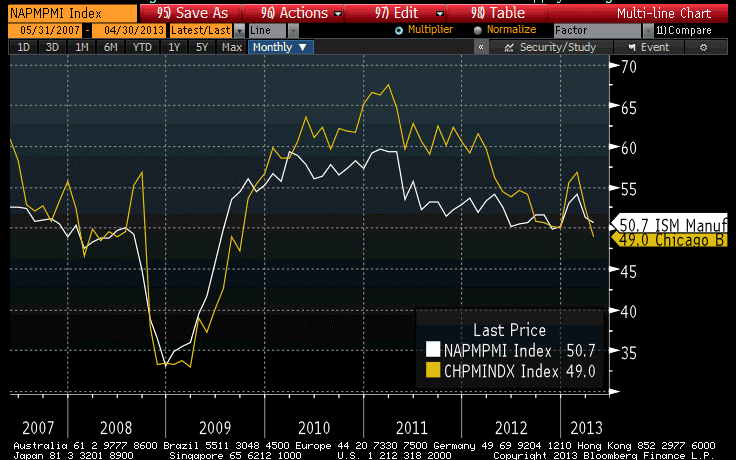
Consumer Confidence jumped yesterday, but more interesting is the fact that the “Jobs Hard to Get” subindex rose to the highest level since late last year, suggesting that weak jobs data isn’t entirely a one-off. Today, the ADP report was weaker-than-expected, at 119k (versus expectations for 150k) and a downward revision to last month. The Chicago Purchasing Managers’ Index on Tuesday was the weakest since 2009, but the ISM Manufacturing report today was on-target. Still, neither manufacturing index is generating much confidence that the economy is about to take off, and the early-year bump has been entirely reversed (see chart, source Bloomberg).
The Shiller Home Price Index, reported on Tuesday, was higher-than-expected at 9.3% year-on-year, rather than the 9.0% expected (and versus an 8.1% last!). What’s really interesting about this is that the recent surge in year-on-year growth has come because the usual seasonal pattern that sees prices sag in the springtime hasn’t been in evidence this year – accordingly, the year-on-year comparisons have gotten easier as prices have gone sideways rather than falling as they tend to do between August and March (see chart, source Bloomberg).
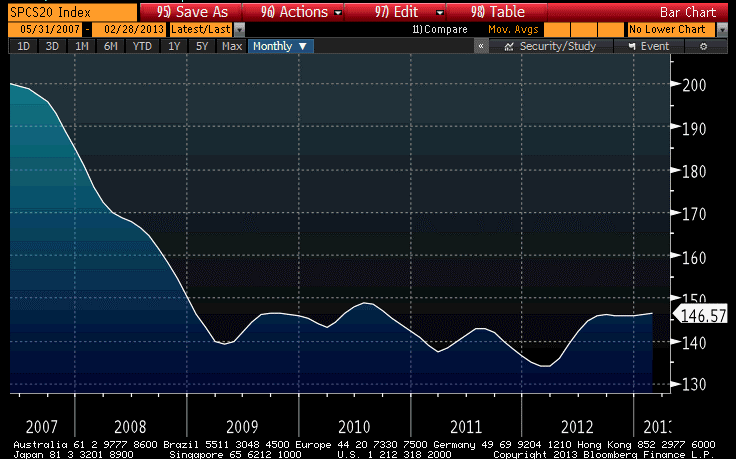
That’s interesting because such a phenomenon was also a condition of the bubble years prior to 2007 – prices generally rose steadily with only a hint of seasonality. Post-bubble, if you wanted to sell your house in February you had to offer a concession on price. Those concessions aren’t happening any more, which is a back-door confirmation of the overall price action.
As I have said before, ad nauseum, we are seeing slow and/or falling growth and firm and/or rising inflation in the pipeline, and that’s not at all inconsistent. Mainstream economists, and journalists of all stripes, seem to accept as a fundamental verity the linkage between growth and inflation, but the only minor problem with this firmly-held belief is that it ain’t so. Growth is bad, and inflation is still going to go up. In Q1, core CPI rose at a 2.1% pace, and I still think that for the full year core CPI will rise at 2.6%-3.0%.
I want to add a quick word here about a thesis that has been advanced recently. The thought is that if the abrupt housing demand is coming from investors rather than consumers, then rising housing prices might be consistent with pressure on rents. I think it’s important to clear up this confusion. Microeconomics tells us that when the price of a good goes up, the price of a substitute tends to rise as well. It is possible, if the overall price level is flat, that a phenomenon such as is described in this hypothetical could happen, with home prices rising and rents falling. But what is much more likely is that rents simply go up more slowly than home prices, so that they decline relative to home prices, rather than declining absolutely. This is, in fact, what we see historically: large increases in home prices tend to lead to increases in rents, but not of the same magnitude, and vice-versa. Whether the mechanism for this is a systematic institutional investor presence or just a large number of one-off instances of individuals renting out their second “investment” homes doesn’t really matter. Accordingly, I don’t expect to see a drastically different course carved out by the rental/home price relationship from what it has been historically. The main difference may be that the lags between home prices, inventories, rents, and so on might get screwed up somewhat, if institutional investors cause this to happen in a more organized way than the organic way in which it usually happens.
Another aside: there has also been a lot made recently, especially in commodity markets, about weak data from China. It is amazing how important it is to global commodity markets that China grows at 9% and not 8%. If I were a member of Chinese leadership, I would be trying to convince my data bureau to release slightly weak figures, since every time it does the hedge funds of the world offer large amounts of commodities as discount prices, which is just what a growing economy needs. It’s not like anyone believes the figures when they are reported to be high; I wonder why we believe it when they are reported to be low?
In addition to the data today, the Federal Reserve finished its meeting and announced no change in monetary policy for now. And there isn’t one coming for a while, either. There was no important change in the statement, although the Fed did take care to remind us that it “is prepared to increase or reduce the pace of its purchases to maintain appropriate policy accommodation as the outlook for the labor market or inflation changes.” [emphasis added] That’s comforting. But the simple fact is that the economy isn’t going to be booming any time soon, and the Committee isn’t going to taper its purchases unless it does because they labor under the delusion that they’re helping. Perhaps next year.
For the rest of the week, investors will be focused on Friday’s Employment Report. I am not really worried about the report being weaker-than-expected, because from everything I read it seems that the market is already anticipating something close to Armageddon (or at least, that’s how they are explaining the continued pressure on breakevens and commodities). So far, this is a routine slowdown that might be slipping into a renewed recession. Meanwhile, expectations on Friday are for Payrolls of 145k, up from 88k but down from the pace of the last year. And the ‘whisper’ number seems to be lower than that. I suspect the more likely surprise is that there is an upward revision to the 88k and the number exceeds estimates. Somehow, that will be also perceived as a negative for breakevens!
TIPS suffered today, even as nominal bonds rallied. Our Fisher yield decomposition model currently suggests that TIPS are as cheap, relative to nominals, as they have been since early September last year (when 10-year breakevens were at the same level they are at now). I am quite bullish on breakevens from here.
Consumer Confidence jumped yesterday, but more interesting is the fact that the “Jobs Hard to Get” subindex rose to the highest level since late last year, suggesting that weak jobs data isn’t entirely a one-off. Today, the ADP report was weaker-than-expected, at 119k (versus expectations for 150k) and a downward revision to last month. The Chicago Purchasing Managers’ Index on Tuesday was the weakest since 2009, but the ISM Manufacturing report today was on-target. Still, neither manufacturing index is generating much confidence that the economy is about to take off, and the early-year bump has been entirely reversed (see chart, source Bloomberg).
The Shiller Home Price Index, reported on Tuesday, was higher-than-expected at 9.3% year-on-year, rather than the 9.0% expected (and versus an 8.1% last!). What’s really interesting about this is that the recent surge in year-on-year growth has come because the usual seasonal pattern that sees prices sag in the springtime hasn’t been in evidence this year – accordingly, the year-on-year comparisons have gotten easier as prices have gone sideways rather than falling as they tend to do between August and March (see chart, source Bloomberg).
That’s interesting because such a phenomenon was also a condition of the bubble years prior to 2007 – prices generally rose steadily with only a hint of seasonality. Post-bubble, if you wanted to sell your house in February you had to offer a concession on price. Those concessions aren’t happening any more, which is a back-door confirmation of the overall price action.
As I have said before, ad nauseum, we are seeing slow and/or falling growth and firm and/or rising inflation in the pipeline, and that’s not at all inconsistent. Mainstream economists, and journalists of all stripes, seem to accept as a fundamental verity the linkage between growth and inflation, but the only minor problem with this firmly-held belief is that it ain’t so. Growth is bad, and inflation is still going to go up. In Q1, core CPI rose at a 2.1% pace, and I still think that for the full year core CPI will rise at 2.6%-3.0%.
I want to add a quick word here about a thesis that has been advanced recently. The thought is that if the abrupt housing demand is coming from investors rather than consumers, then rising housing prices might be consistent with pressure on rents. I think it’s important to clear up this confusion. Microeconomics tells us that when the price of a good goes up, the price of a substitute tends to rise as well. It is possible, if the overall price level is flat, that a phenomenon such as is described in this hypothetical could happen, with home prices rising and rents falling. But what is much more likely is that rents simply go up more slowly than home prices, so that they decline relative to home prices, rather than declining absolutely. This is, in fact, what we see historically: large increases in home prices tend to lead to increases in rents, but not of the same magnitude, and vice-versa. Whether the mechanism for this is a systematic institutional investor presence or just a large number of one-off instances of individuals renting out their second “investment” homes doesn’t really matter. Accordingly, I don’t expect to see a drastically different course carved out by the rental/home price relationship from what it has been historically. The main difference may be that the lags between home prices, inventories, rents, and so on might get screwed up somewhat, if institutional investors cause this to happen in a more organized way than the organic way in which it usually happens.
Another aside: there has also been a lot made recently, especially in commodity markets, about weak data from China. It is amazing how important it is to global commodity markets that China grows at 9% and not 8%. If I were a member of Chinese leadership, I would be trying to convince my data bureau to release slightly weak figures, since every time it does the hedge funds of the world offer large amounts of commodities as discount prices, which is just what a growing economy needs. It’s not like anyone believes the figures when they are reported to be high; I wonder why we believe it when they are reported to be low?
In addition to the data today, the Federal Reserve finished its meeting and announced no change in monetary policy for now. And there isn’t one coming for a while, either. There was no important change in the statement, although the Fed did take care to remind us that it “is prepared to increase or reduce the pace of its purchases to maintain appropriate policy accommodation as the outlook for the labor market or inflation changes.” [emphasis added] That’s comforting. But the simple fact is that the economy isn’t going to be booming any time soon, and the Committee isn’t going to taper its purchases unless it does because they labor under the delusion that they’re helping. Perhaps next year.
For the rest of the week, investors will be focused on Friday’s Employment Report. I am not really worried about the report being weaker-than-expected, because from everything I read it seems that the market is already anticipating something close to Armageddon (or at least, that’s how they are explaining the continued pressure on breakevens and commodities). So far, this is a routine slowdown that might be slipping into a renewed recession. Meanwhile, expectations on Friday are for Payrolls of 145k, up from 88k but down from the pace of the last year. And the ‘whisper’ number seems to be lower than that. I suspect the more likely surprise is that there is an upward revision to the 88k and the number exceeds estimates. Somehow, that will be also perceived as a negative for breakevens!
TIPS suffered today, even as nominal bonds rallied. Our Fisher yield decomposition model currently suggests that TIPS are as cheap, relative to nominals, as they have been since early September last year (when 10-year breakevens were at the same level they are at now). I am quite bullish on breakevens from here.