Why the U.S. dollar still reigns supreme

Following its meeting in January 2012, the FOMC issued a statement regarding its longer-run goals and monetary policy strategy. The FOMC noted that the Committee judges inflation at the rate of 2 percent…..
There has been a strong focus lately on the part of the Federal Reserve’s objectives in conducting monetary policy that relates to employment. This is very important and to be fair, most likely the more important goal for the Congress which set up the dual mandate. We all know at times it can be at odds with the inflation mandate. But do you really understand what is going on between the two of them right now? No patter your politics it is clear that the job market is improving. The debate remains around whether it is happening quickly enough or not, but it is improving. We will get another measure of it the Friday, and the forecast is for 165,000 new jobs to be added and the unemployment rate to remain steady. So with the employment situation improving, how are they doing with that other mandate? Turns out not so good. Take a look at the chart of the CRB Index below. It has been falling fairly steadily since April 2011.
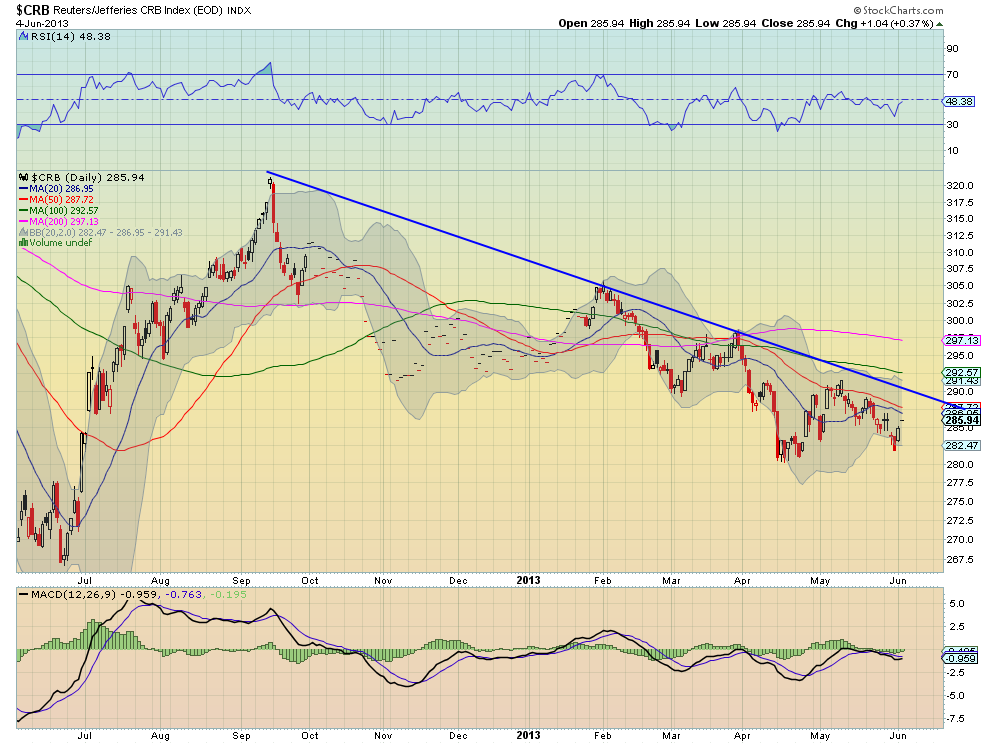
In fact if you measure from April 2011 to April 2013, the annualized rate of decline in the CRB Index is about 12%. That is no where near a 2% rate of inflation. This is a real deflationary problem for the Fed and one that is being exasperated by central banks around the globe, stealing our inflation driving power by doing what we are doing, quantitative easing. I will let the economists, and currency and bond traders take the argument over from here about how best to deal with this. Certainly the timing for its importance is not in the moment. But as an equity trader, it tells me that despite an improving employment picture there are other reasons that the Fed cannot pull the plug on Quantitative Easing very soon. There will continue to be a strong breeze at the back of the Equity markets for some time, lifting them higher as the Fed tries to create inflation.
The information in this blog post represents my own opinions and does not contain a recommendation for any particular security or investment. I or my affiliates may hold positions or other interests in securities mentioned in the Blog, please see my Disclaimer page for my full disclaimer.
Original post
There has been a strong focus lately on the part of the Federal Reserve’s objectives in conducting monetary policy that relates to employment. This is very important and to be fair, most likely the more important goal for the Congress which set up the dual mandate. We all know at times it can be at odds with the inflation mandate. But do you really understand what is going on between the two of them right now? No patter your politics it is clear that the job market is improving. The debate remains around whether it is happening quickly enough or not, but it is improving. We will get another measure of it the Friday, and the forecast is for 165,000 new jobs to be added and the unemployment rate to remain steady. So with the employment situation improving, how are they doing with that other mandate? Turns out not so good. Take a look at the chart of the CRB Index below. It has been falling fairly steadily since April 2011.
In fact if you measure from April 2011 to April 2013, the annualized rate of decline in the CRB Index is about 12%. That is no where near a 2% rate of inflation. This is a real deflationary problem for the Fed and one that is being exasperated by central banks around the globe, stealing our inflation driving power by doing what we are doing, quantitative easing. I will let the economists, and currency and bond traders take the argument over from here about how best to deal with this. Certainly the timing for its importance is not in the moment. But as an equity trader, it tells me that despite an improving employment picture there are other reasons that the Fed cannot pull the plug on Quantitative Easing very soon. There will continue to be a strong breeze at the back of the Equity markets for some time, lifting them higher as the Fed tries to create inflation.
The information in this blog post represents my own opinions and does not contain a recommendation for any particular security or investment. I or my affiliates may hold positions or other interests in securities mentioned in the Blog, please see my Disclaimer page for my full disclaimer.
Original post