


Seth Klarman is a prominent (yet deliberately low-profile) figure in the financial world. As a billionaire investor, hedge fund manager, and author, he is widely recognized for his rigorous value investing approach and his seminal, continuously-bestselling book, Margin of Safety.
This article takes a closer look at the key facts about Seth Klarman – from his early life and business achievements to his personal life, net worth, and social impact.
For those interested in his financial footprint, we’ll also get into the foundation and evolution of his highly successful Baupost Group, the core tenets of his distinctive investment philosophy, his significant philanthropic contributions, and how everyday investors can gain exposure to some of the same holdings he champions.
Understanding Klarman’s disciplined, risk-averse, and contrarian methodology offers invaluable lessons for any thoughtful investor seeking long-term success beyond the noise of daily market fluctuations.

Seth Klarman Quick Facts
Full Name: Seth Andrew Klarman
Born: May 21st, 1957
Place of Birth: New York City, U.S.
Parents: Herbert E. Klarman (health economist and author, 1916-1999) and Jean Siskind Klarman (social worker, 1923-1974).
Siblings: Younger brother Michael Klarman
Education: Attended Cornell University in New York (BA Economics), then went on to Harvard Business School (MBA)
Spouse: Beth Schultz (m. 1982)
Children: Three (two daughters and a son)
Occupation(s): Hedge Fund Manager, Investor, Author
Known For: Founder and CEO of Baupost Group, Author of Margin of Safety (1991)

Seth Klarman’s Family
Parents
Seth Klarman was born in New York and raised in Baltimore, Maryland, in a household that valued intellectual pursuits. His father, Herbert E. Klarman, was a renowned public health economist at Johns Hopkins University. This academic and analytical environment likely influenced Seth’s own data-driven and rigorous approach to investing.
His mother, Jean Siskind Klarman, was a social worker. The family’s Jewish faith was also a significant part of his upbringing, and it has remained a cornerstone of his identity and philanthropic focus throughout his life. (Following Jean’s passing, his father later remarried Muriel Steinberg Klarman).
Spouse & Children
Seth Klarman met Beth Shultz during a summer internship and the couple married in 1982. The Klarmans have three children (two daughters and a son). In stark contrast to many other public figures, and in line with Seth Klarman’s well-known preference for privacy, his children have remained almost entirely out of the public spotlight. Their names, personal lives, and professional pursuits are kept private, although Klarman has noted that despite a busy work schedule, he consistently prioritizes his family, making sure to attend piano recitals and coach soccer teams.
Who Is Seth Klarman? Early Life & Education
Seth Andrew Klarman was born on May 21, 1957, in New York City, into a Jewish family. When he was six years old, his family relocated to the Mt. Washington area of Baltimore, Maryland, near the Pimlico Race Course. His father, Herbert E. Klarman, was a public health economist who taught at Johns Hopkins University and NYU, while his mother began her career as an English teacher before becoming a psychiatric social worker. His parents divorced shortly after the move to Baltimore.
Klarman displayed an innate aptitude for business and a keen understanding of value from a remarkably young age. At the age of ten, his father helped him to make his first stock purchase: one share of Johnson & Johnson. The reason behind this particular pick came from his experience of actually using one of their products (band-aids). This initial investment proved fortunate, as the stock later split three-for-one and eventually tripled his initial capital, reinforcing his early grasp of fundamental value, even if he didn’t yet use that term for his preferred investment strategy.
As a teenager, his entrepreneurial spirit continued to flourish through various small ventures, including a paper route, a snow cone stand, a snow shoveling business, and selling stamp-coin collections on weekends. These experiences collectively cultivated a self-reliant and pragmatic approach to transactions and value creation, laying a crucial foundation for his future investment philosophy.
Klarman’s College Career
Klarman pursued his academic journey at Cornell University in Ithaca, New York. Although initially interested in majoring in mathematics, he ultimately chose to pursue economics, graduating magna cum laude in 1979 with a minor in history.
A pivotal period in his early career was his internship during his junior year summer and subsequent 18-month employment after graduation at the Mutual Shares fund. There, he was introduced to and worked closely with Max Heine and Michael Price, two legendary figures in value investing.
While he found the position at Mutual Shares to be a good fit, he made the difficult decision to leave and attend Harvard Business School (HBS) to study for an MBA. At HBS, he distinguished himself as a Baker Scholar and was classmates with future prominent figures such as Jeffrey Immelt and Jamie Dimon.
He credits his time at HBS with teaching him about leadership and immersing him in a series of real-life business situations, experiences he continues to draw upon for complex managerial challenges.
The Baupost Group
Upon graduating from Harvard Business School in 1982, Seth Klarman helped to establish the Boston-based private investment partnership with Harvard Professor William J. Poorvu and partners Howard H. Stevenson, Jordan Baruch, and Isaac Auerbach. Professor Poorvu specifically recruited Klarman to manage a pool of capital he had raised from the sale of his shares in a local television station. The fund commenced operations with US$27 million in startup capital.
The founders’ decision to back Klarman, despite his limited track record at the time, underscores a profound belief in his intellectual conviction and the fundamental soundness of his value investing philosophy. This early trust, rooted in a shared philosophical alignment, allowed Klarman the crucial platform to implement his distinctive value investing strategies from day one. He has remained the chief executive and portfolio manager of Baupost Group since its inception.
Over the ensuing three decades, Klarman meticulously built Baupost into one of the most successful hedge fund companies globally. The firm’s consistent performance is remarkable, having achieved an enviable 20% annual compound rate of return over its first 26 years. This sustained growth, from $27 million in initial capital to becoming one of the largest hedge funds in the world, ranked 4th in net gains since inception by Bloomberg L.P., is a testament to the long-term efficacy of a disciplined, risk-managed value investing approach. The consistent compounding of capital, largely achieved through a rigorous focus on avoiding significant losses, rather than merely chasing spectacular gains, has been a hallmark of Baupost’s success. The firm has also expanded significantly in terms of personnel, growing from a team of 3 to 100 employees thanks largely to a critical (but often overlooked) culture of collaboration, support and intellectual honesty.
Seth Klarman Net Worth By Year
This famous investor is a notoriously private individual. Unlike public company CEOs like Warren Buffett and Bill Gates, whose net worth is largely tied to publicly traded stock, Klarman’s net worth is not as transparent and is therefore more difficult to track with a high level of precision. The most reliable public estimates come from well-regarded financial publications that compile annual snapshot data for their billionaire lists.
| Year | Estimated Net Worth | Source(s) |
|---|---|---|
| 2024 | $1.3 Billion | Forbes (Real-Time, as of late 2024) |
| 2023 | $1.3 Billion | Forbes |
| 2022 | $1.5 Billion | Forbes |
| 2021 | $1.5 Billion | Forbes |
| 2020 | $1.5 Billion | Forbes |
| 2019 | $1.5 Billion | Forbes |
| 2018 | $1.5 Billion | Forbes |
| 2017 | $1.5 Billion | Forbes |
| 2016 | $1.5 Billion | Forbes |
| 2015 | $1.55 Billion | Forbes 400 (2015) |
| 2014 | $1.5 Billion | Forbes 400 (2014) |
| 2013 | $1.4 Billion | Forbes 400 (2013) |
| 2012 | $1.2 Billion | Forbes 400 (2012) |
| 2011 | $1.1 Billion | Forbes 400 (2011) |
| Pre-2011 | Data not readily available | Klarman’s name appears less frequently on public wealth lists, making reliable estimates difficult to source. |
How Does Seth Klarman Make Money?
Seth Klarman’s immense wealth isn’t generated from a traditional salary. Instead, it’s centered on his hedge fund, The Baupost Group. His income and wealth accumulation are driven by three primary mechanisms: management fees, performance fees, and the growth of his own personal capital invested in the fund.
Let’s break down this engine piece by piece.
1. His “Salary”: The Owner’s Cut of Management Fees
This is Klarman’s most direct and consistent income stream. Baupost, the firm, charges its clients an annual management fee (typically 1-2%) on all the money it manages (its Assets Under Management, or AUM).
- How it benefits Klarman: Baupost is a private company, and Klarman is its founder and majority owner. After paying for the firm’s expenses (analysts’ salaries, rent, research, etc), the remaining profit from these management fees is distributed to the owners. As the principal owner, Klarman receives the lion’s share.
- The Scale: With Baupost’s AUM often around $27 billion, a 1% fee generates $270 million in firm revenue. A significant portion of this becomes Klarman’s personal income year after year, forming a multi-million dollar “salary” that is far more stable than the market’s ups and downs.
2. His “Billionaire Bonus”: The Owner’s Cut of Performance Fees
This is what elevates Klarman’s income from “very wealthy” to the billionaire class. When Baupost has a successful year and generates profits for its clients, the firm takes a cut of those profits, typically 20%. This is called “carried interest.”
- How it benefits Klarman: This is the ultimate performance bonus. If the firm generates, for instance, $4 billion in profit for clients, its 20% cut would be $800 million in revenue. As the primary owner, Klarman is the main (although not only) recipient of this enormous windfall.
- The Impact: A few years of strong performance can generate billions in fee revenue for the firm, a large portion of which flows directly to Klarman. This is the primary mechanism that built the foundation of his multi-billion-dollar net worth.
3. His Personal Fortune’s Growth: “Eating His Own Cooking”
This is arguably the most powerful wealth-compounding mechanism for Klarman, and it’s completely separate from the fees. Klarman has a massive amount of his own money—a substantial portion of his billion-dollar net worth—invested in the exact same Baupost funds as his clients.
- How it benefits Klarman: When he makes money for his clients, he is simultaneously making money for himself. This isn’t about fees; this is about his personal investment account growing. If Baupost’s investments appreciate by 15% in a year, his personal capital invested in the fund also grows by 15%.
- The Scale: If Klarman has, hypothetically, $500 million of his own money in the fund, a 15% return adds $75 million directly to his personal net worth—on top of any income he receives from the fees. This demonstrates his “skin in the game” and ensures his interests are perfectly aligned with his investors.
The Klarman Wealth Machine
You can think of Seth Klarman’s personal financial situation as a three-part engine:
- Consistent Income: He receives a massive “salary” from his ownership stake in the firm’s management fees.
- Explosive Payouts: He receives an enormous “bonus” in good years from his share of the firm’s performance fees.
- Self-Compounding Wealth: His own vast fortune, invested in his own funds, grows and compounds on its own.
In short, Seth Klarman built a machine where he is paid handsomely to manage it, receives the lion’s share of its extraordinary successes, and simultaneously has his own fortune compounding within it.
Can I Buy Baupost Group Stocks?
No. Baupost group is a private company, which means that it is owned by its board members and is not traded on any of the world’s stock exchanges.
InvestingPro: Your Key To Investment Firm Data 📊🔎
Compare the holdings of publicly traded investment firms such as Berkshire Hathaway and Bridgewater Associates, access vital financial stats and make smarter investment moves.
🛠️ Access to 1,200+ additional fundamental metrics
🔎 Competitor comparison tools
📊 Evaluate stocks with 14+ proven financial models
Say goodbye to inefficiency – choose InvestingPro for swift insights and more profitable decisions within minutes of signing up.
Klarman’s “Margin of Safety” Investment Philosophy
In 1991, at the age of 34, Seth Klarman authored the now-famous Margin of Safety: Risk-Averse Value Investing Strategies for the Thoughtful Investor. It draws heavily from the foundational work of Benjamin Graham and David Dodd, particularly the chapter titled “Margin of Safety” in Graham’s classic, The Intelligent Investor.
Despite its initial commercial performance, (selling only 5,000 copies and being considered a ‘flop’) the book has since achieved cult-like status within the value investing community. This dramatic shift underscores the idea that investment principles rooted in fundamental value and rigorous risk management ultimately outweigh FOMO-based market fads or quick-win successes.
Klarman’s investment philosophy, as detailed in Margin of Safety, is built upon four core tenets:
- Risk-Averse Approach: A fundamental aspect of his philosophy is paying as much, if not more, attention to what can go wrong (potential risk) as to what can go right (potential return). The power of compounding even moderate returns over many years is compelling, but a single large loss can irrevocably destroy years of investment success. Therefore, consistently good returns achieved with limited downside risk are always preferable to volatile, occasionally spectacular gains that carry a considerable risk of principal impairment.
Learn More About Risk-Averse Investing 📜
The Investing.com Academy has a whole range of articles which go into more detail about the type of strategies used by risk-averse investors, and how to keep your finger on the pulse to avoid potential drawdowns and other portfolio-dropping events.
- Bottom-Up Strategy: This approach involves identifying specific undervalued investment opportunities through meticulous fundamental analysis, one investment at a time. This stands in stark contrast to top-down investing, which attempts to predict broad market or economic trends, a notoriously unpredictable endeavor. The cornerstone of this approach is the “margin of safety.” This is achieved when securities are purchased at prices sufficiently below their underlying value. It acts as a crucial buffer, protecting investors from large losses in declining markets and accounting for human error, bad luck, or extreme volatility in a complex and unpredictable world.
- Absolute-Performance Oriented: Klarman emphasizes focusing on returns relative to one’s own investment goals, rather than comparing performance against market benchmarks or other investors. This orientation includes a crucial willingness to hold significant cash when truly attractive bargains are unavailable, rather than feeling compelled to remain fully invested.
- Contrarianism & Patience: Value investing, by its very nature, is inherently contrarian. Securities that are out-of-favor are significantly more likely to be undervalued, whereas popular securities are almost never so, as their prices have already been bid up based on optimistic expectations. This approach demands immense discipline to resist the temptation of unattractive opportunities, profound patience to wait for the truly exceptional ones, and acute judgment to discern precisely when to act. Klarman operates on the belief that markets are, at best, “weak form efficient,” meaning they can and often do stray from underlying value for prolonged periods. Opportunities arise when information is not widely available, when analysis is particularly complex, or when investors buy and sell for reasons unrelated to fundamental value.
Additional Tenets of Seth Klarman’s Investment Philosophy
| Tenet | Description | Key Implication |
|---|---|---|
| Avoiding Loss | The primary goal is to avoid appreciable loss of principal over several years. | Preserves capital, enabling long-term compounding and mitigating the devastating impact of large drawdowns. |
| Margin of Safety | Purchasing securities at prices significantly below their underlying value. | Provides a protective buffer against valuation errors, bad luck, and market volatility, reducing downside risk. |
| Valuation as Imprecise Art | Business valuation is not an exact science; true value exists within a range and is dynamic. | Requires conservative projections and a focus on intrinsic value, rather than chasing precise, often inaccurate, forecasts. |
| Contrarianism | Investing in out-of-favor or unloved securities that are more likely to be undervalued. | Demands patience and discipline to act against the crowd, often enduring initial paper losses for long-term gains. |
| Holding Cash Strategically | Maintaining significant cash reserves when attractive investment opportunities are scarce. | Acts as a strategic weapon, providing liquidity and flexibility to capitalize on market dislocations and distressed selling. |
| Discipline & Patience | The ability to resist temptations, wait for optimal opportunities, and act decisively when they appear. | Overcomes behavioral biases (greed, fear, herd mentality) that undermine long-term investment success. |
| Focus on Underlying Business Reality | Distinguishing between short-term stock price fluctuations and the fundamental value of the underlying business. | Guides decisions based on intrinsic worth and cash flow generation, rather than market sentiment or speculation. |
| Distinguishing Investment from Speculation | Investing generates cash flow; speculation relies solely on future resale price. | Ensures capital is allocated to productive assets with definable value, avoiding gambles based on market whims. |
| Bottom-Up Approach | Identifying specific, undervalued opportunities through detailed fundamental analysis. | Avoids the pitfalls of top-down forecasting, focusing on individual business merit rather than broad market predictions. |
| Absolute Performance Orientation | Prioritizing returns relative to one’s own investment goals, not market benchmarks. | Fosters independent thinking and allows for periods of holding cash or underperformance relative to a rising market if no bargains exist. |
Notable Investments and Portfolio Evolution
Baupost’s portfolio composition reflects a flexible application of its fixed value investing philosophy. Key holdings have recently included:
- Liberty Global Ltd Class C (NASDAQ:LBTYK), representing 18.7% of the portfolio, with a reported 14% loss on a $1.03 billion investment.
- Clarivate PLC (NYSE:CLVT), a new holding in Q3 2023, comprising 13.72% of the portfolio, with Baupost owning 11% of all outstanding shares valued at $651 million.
- Alphabet Inc. Class C Stocks (NASDAQ:GOOG), constituting 11.45% of the portfolio, reflecting a four-year trading history and a 64% gain on a $331 million investment.
- Fidelity National Information Services (NYSE:FIS), a newer holding from Q3 2022, making up 9.13% of the portfolio, with a 5.5% loss on a $459 million investment.
- Willis Towers Watson (NASDAQ:WTW), at 7.59% of the portfolio, showing a 5.4% gain on a $342 million investment.
- Viasat Inc. (NASDAQ:VSAT), at 7.58% of the portfolio, with a significant 41% loss on a $613 million investment.
- Warner Bros Discovery Inc. (NASDAQ:WBD), accounting for 5.33% of the portfolio.
During 2023, Klarman’s portfolio underwent a significant reshape. While some observers criticized the exits from Meta and Amazon, suggesting they could be legitimate long-term investments, Klarman’s disciplined approach implies that exits must occur when the perceived margin of safety diminishes or when more compelling opportunities arise, regardless of prevailing market sentiment.
This demonstrates that true value investing is not about holding forever, but about holding until value is realized or superior opportunities become available.
Key Milestones in Seth Klarman’s Career
| Year | milestone | Significance |
|---|---|---|
| 1957 | Born in New York City. | The beginning of his life, raised in a household valuing academic and economic rigor. |
| 1979 | Graduated from Cornell University; Joined Mutual Shares full-time. | Completed his undergraduate education and began his practical apprenticeship in value investing under legends Max Heine and Michael Price. |
| 1982 | Graduated from Harvard Business School; Co-founded Baupost Group. | Completed his formal business education with high honors (Baker Scholar) and launched the investment firm that would define his career. |
| 1990 | Established The Klarman Family Foundation. | Created his primary philanthropic vehicle with his wife, Beth, signaling a long-term commitment to giving back. |
| 1991 | Published Margin of Safety. | Authored his seminal book, which became a “bible” for value investors, with original copies eventually selling for thousands of dollars. |
| 1995 | Became a lead investor and chair of Facing History and Ourselves. | Took on a significant leadership role in a non-profit organization, demonstrating his long-standing commitment to civic education and social justice. |
| 2002 | Joined the ownership group of the Boston Red Sox. | Became a minority partner in John W. Henry’s consortium that purchased the team, reflecting a personal interest beyond the world of finance. |
| 2008 | Selected as lead editor of Security Analysis, 6th Edition. | Recognized as the ‘modern heir to Benjamin Graham’ by being chosen to update the foundational text of value investing. |
| 2008-09 | Deployed capital aggressively during the Global Financial Crisis. | While other funds suffered, Baupost reportedly generated massive returns by investing its large cash holdings into distressed assets at bargain prices. |
| 2010 | Became an initial signatory of The Giving Pledge. | Publicly committed to donating the majority of his wealth to philanthropy, reinforcing his dedication to charitable causes. |
| 2011 | Baupost Group opened its first international office in London. | Expanded operations to capitalize on distressed debt and other opportunities in Europe following the continent’s own sovereign debt crisis. |
| 2012 | Funded the Klarman Cell Observatory at the Broad Institute. | Made a major philanthropic gift to advance biomedical research, a key focus area for his foundation. |
| c. 2015 | Became a major holder of distressed Puerto Rican debt. | Made a significant, and at times controversial, investment in the island’s bonds, showcasing his strategy of entering complex and unpopular situations. |
| 2017 | Investor letter warned about political and social divisions in the U.S. | Used his influential platform to voice deep concerns about the Trump administration and the erosion of democratic norms, a recurring theme in his writing. |
| 2018 | Klarman Hall opened at Harvard Business School. | His foundation’s gift funded a major new convening center at his alma mater, cementing his legacy as one of its most influential alumni. |
| 2021 | Investor letter warned of a “speculative mania” in markets. | Critiqued the market environment fueled by SPACs, crypto, and meme stocks, reinforcing his timeless message about risk and the dangers of herd behavior. |
Leadership and Management Style
As the Chief Executive Officer and Portfolio Manager of The Baupost Group since its inception in 1982, Seth Klarman has cultivated a distinctive leadership and management style that underpins the firm’s enduring success.
Klarman takes immense pride in nurturing a collaborative and supportive culture within Baupost, where mutual respect and teamwork are not merely encouraged but actively rewarded.
Beyond his direct management of Baupost, Klarman’s influence extends through various leadership roles and recognitions. He was selected as the lead editor for the sixth edition of Benjamin Graham and David Dodd’s classic Security Analysis in 2008, a testament to his expertise in foundational investment principles.
In 2011, he received the Harvard Business School Alumni Achievement Award, and in 2020, he was elected to the American Academy of Arts and Sciences. He also serves on the Board of Directors of the Broad Institute, is Vice Chair of Beth Israel Hospital’s Board of Managers, and a member of their Board of Trustees, demonstrating his commitment to broader institutional leadership.
He’s also a member of Harvard Business School’s Board of Dean’s Advisors and regularly teaches investment classes at leading colleges and business schools.
Seth Klarman’s Controversies and Challenges
While Seth Klarman is widely respected for his investment acumen, his career has not been without its share of controversies and challenges, often stemming from Baupost’s pursuit of complex and unconventional opportunities.
One notable instance involved the formation of Highland Companies in 2006, a Nova Scotia-based corporation through which Baupost began acquiring over 7,000 acres of farmland in Melancthon Township, Ontario. By early 2011, Highland Companies submitted an application for a large 2,316-acre Amabel dolomite mega-quarry on this land. This proposal met with intense community opposition due to significant concerns over potential groundwater contamination, the impact on local heritage, food security, and ancillary issues such as increased truck traffic, highway safety, noise, and dust pollution. Facing widespread resistance, Highland Companies ultimately withdrew the application in November 2012.
Beyond Investing: Philanthropy and Legacy
Klarman’s philanthropic philosophy is a direct extension of his disciplined investment approach. He firmly believes that “there comes a responsibility with success, and that is leaving the world better than you found it”. He views ‘giving back’ as a key metric for gauging success, alongside the creation of value for others.
In 1990, he established the Klarman Family Foundation alongside his wife, Beth Schultz, to benefit causes they deeply believe in. The Foundation’s mission is to identify unmet needs and advance solutions, emphasizing creative thinking, strategic leadership, and the strengthening of robust organizations. For Klarman, wealth creation and wealth deployment are not disparate endeavors but integrated expressions of a consistent, principled approach to value creation and societal impact.
Recognizing the rapid compounding of societal problems, the Foundation operates with a sense of urgency, willing to invest based on opportunities to make a tangible difference rather than being constrained by annual grant-making budgets. A core tenet guiding all their work is the belief in the ‘preservation of democratic norms’. They also highly value partnerships with other funders, viewing these collaborations as opportunities to learn and leverage greater collective impact, continuously applying these learnings to enhance their philanthropic practices and outcomes.
The Foundation’s grantmaking spans several evolving areas of interest. These include:
- Advancing understanding of the biological basis of health and illness, supporting initiatives aimed at deepening knowledge in this critical field.
- Ensuring a healthy democracy, dedicated to supporting efforts that contribute to the strength and well-being of democratic systems.
- Expanding access to vital services and enrichment opportunities, working to increase accessibility to essential resources that improve lives.
- Supporting the global Jewish community, involving grantmaking to strengthen and sustain Jewish communities worldwide.
Just as he strategically hedges against financial tail risks, Klarman invests in foundational societal structures—such as democracy, health, and education—as a form of ‘societal margin of safety,’ recognizing that the long-term health and stability of the broader system fundamentally underpin all other forms of value creation.
Seth Klarman Interesting Facts and Statistics
- The Meaning of “Baupost”: The name of his firm, Baupost Group, is a portmanteau created from the names of the four founding limited partners who provided the initial $27 million in capital: Beck, Auerbach, Poor, and Goldberg families.
- The $4,000 Book: His book, Margin of Safety, had a small initial print run of just 5,000 copies in 1991 and sold poorly at first. It is now out of print and has become a collector’s item, with used copies selling for between $1,500 and $4,000 online.
- The Generous Pirate: In 2017, Klarman refused offers to reprint Margin of Safety for profit. Instead, to combat price gouging, he authorized a free PDF version to be distributed to his firm’s shareholders.
- A Champion Horse Owner: Klarman is a highly successful thoroughbred horse owner. He co-owns Klaravich Stables, which has produced numerous champion horses.
- Triple Crown Race Winner: His stable won two of the three jewels of the Triple Crown: the Preakness Stakes in 2017 with Cloud Computing, and the Belmont Stakes in 2022 with Early Voting.
- He Still Uses a Fax Machine: Despite the prevalence of high-frequency trading and instant information, Klarman has famously held onto his fax machine, seeing it as a valuable tool for receiving serious, less-frenzied communication.
- The King of Cash: A defining feature of his strategy is holding large amounts of cash (sometimes up to 50% of his fund’s assets) while waiting for opportunities. He views cash not as a drag on returns, but as a “call option on future opportunity.”
- He Returned Billions to Investors: In the early 2000s, Baupost did something almost unheard of: it returned billions of dollars to its investors, believing the fund had grown too large to effectively deploy capital in its niche strategies.
- An Early “Never-Trumper”: Though a registered independent who has donated to both political parties in the U.S., Klarman became one of the most prominent financial figures to publicly oppose Donald Trump, warning in his 2017 investor letter about the erosion of democratic norms.
- Funding The Times of Israel: His foundation was the primary funder for the launch of The Times of Israel, an online, multi-language newspaper that has become a major source of news on Israel and the Jewish world.
- Owner of the Boston Red Sox (partly): He is a minority partner in the Fenway Sports Group, the consortium led by John W. Henry that owns the Boston Red Sox and Liverpool F.C.
- The Messy Desk Theory: Anecdotes from those who have worked with him tell us that his desk is famously cluttered and disorganized… a stark contrast to his highly disciplined and organized investment approach!
- His First Big Win Was a Bankrupt Piano Company: One of his earliest major investment successes came from buying the bonds of Baldwin-United, a piano maker that had gone bankrupt after a disastrous foray into the insurance business.
- He Bought the Boston Globe’s Old Headquarters: In 2018, Baupost Group purchased the iconic former headquarters of the Boston Globe newspaper for $81 million, a prime example of his firm’s real estate investments.
- A Major Force in Biomedical Research: Through his foundation, he funded the Klarman Cell Observatory at the Broad Institute of MIT and Harvard, a major initiative to systematically map and understand human cells.
- Harvard Business School’s Klarman Hall: His foundation gave a gift of over $100 million to Harvard Business School to build Klarman Hall, a state-of-the-art convening center that opened in 2018.
- He Was a Baker Scholar at Harvard: He graduated from Harvard Business School with high distinction as a Baker Scholar, an honor reserved for the top 5% of the graduating class.
- He Rarely Appears on TV: Klarman is intensely private and has only given a handful of television interviews in his entire 40+ year career, most notably with Charlie Rose in 2011.
- His Average Returns are Legendary: While Baupost is a private fund, its compound annual returns since inception in 1982 are widely reported to be in the high teens (around 19%), a remarkable record of consistent, low-risk performance over four decades.
- He Was Once Benjamin Graham’s Teaching Assistant’s Assistant: As a student at Cornell, Klarman worked for a professor who had been a teaching assistant for Benjamin Graham, the father of value investing, creating a direct intellectual lineage.
Seth Klarman’s Famous Quotes
As we’ve seen throughout this article, Seth Klarman is known for his disciplined, risk-averse investment philosophy. His writings, particularly in his sought-after book Margin of Safety and his annual investor letters, are filled with wisdom on how to navigate complex markets. Here are a few of his more famous quotes.
“A margin of safety is achieved when securities are purchased at prices sufficiently below underlying value to allow for human error, bad luck, or extreme volatility in a complex, unpredictable, and rapidly changing world.”
Source: Margin of Safety (1991)
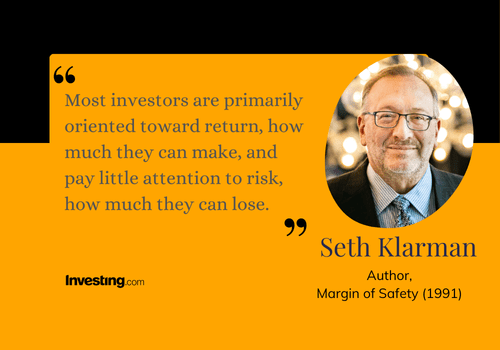
“Most investors are primarily oriented toward return, how much they can make, and pay little attention to risk, how much they can lose.”
Source: Margin of Safety (1991)
“Value investing is simple to understand but difficult to implement.”
Source: Margin of Safety (1991)
“The best opportunities are often found in the securities of companies that are despised. The uglier the situation, the better the investment opportunity is likely to be.”
Source: Attributed to his annual investor letters and a core theme in Margin of Safety.
“The single greatest edge an investor can have is a long-term orientation.”
Source: Interview with Charlie Rose (2011)
“Investing, when it looks the easiest, is at its hardest.”
Source: Baupost Group’s 2007 Year-End Letter to Investors
“We don’t have a particular view on the market. We think it’s a waste of time… We’re bottom-up investors.”
Source: Interview with Charlie Rose (2011)
“Holding cash is a decision. It’s the decision to wait. It is a call option on future opportunity, and you should be willing to pay a small price for that option.”
Source: Baupost Group’s 2010 Year-End Letter to Investors
“The constant availability of information is a great danger to an investor. It’s a great temptation to constantly be fiddling, to be looking at the news.”
Source: Interview at the MIT Sloan Investment Conference (2014)
“Loss avoidance must be the cornerstone of your investment philosophy.”
Source: Margin of Safety (1991)
Wrapping Up
Seth Klarman’s career clearly shows the power of an unwavering commitment to a principled investment philosophy. This impact stems from his steadfast adherence to value investing, the profound concept of the “margin of safety,” and a consistently risk-averse, contrarian approach to markets. This success has solidified his reputation as a truly “thoughtful investor,” who prioritizes capital preservation and long-term compounding over short-term market fads or speculative gains.
Beyond his financial achievements, Klarman’s legacy is significantly shaped by his substantial philanthropic contributions through the Klarman Family Foundation. His belief in leveraging his success to create broader societal value, shown through the Foundation’s rigorous, strategic, and impactful giving across critical areas, underscores a holistic view of responsibility.
Klarman’s quiet, principled approach offers a powerful counter-narrative to the often-frenzied and short-sighted financial world, serving as a compelling testament that sustainable, long-term success is ultimately derived from intellectual honesty, rigorous fundamental analysis, and unwavering discipline.
InvestingPro Stock Picks – Copy Seth Klarman’s Stock Portfolio 📊💡
We’d all love to be able to invest like Seth Klarman. But what if you could invest better?
Our state-of-the-art AI models have analyzed every stock in Klarman’s portfolio to help investors summarize the best stocks in an already stellar group.
InvestingPro offers real-time insights into billionaire portfolios, including quarterly updates and stock performance breakdowns.


 App Store
 Google Play