


What is NOPAT?
Net Operating Profit After Tax (NOPAT) is a financial metric that represents a company’s potential profitability if it had no debt. It is crucial for evaluating business performance as it offers a clear picture of operating efficiency by excluding the effects of leverage. NOPAT is particularly useful for comparing companies with different capital structures.
How to Calculate NOPAT?

To calculate NOPAT, you use the following formula:
NOPAT = Operating Income × (1 − Tax Rate)
In this formula,
- Operating Income is the company’s profit from its core business operations, excluding taxes and interest expenses, while
- Tax rate represents the percentage of income that the company pays in taxes.

Why is NOPAT Important?
NOPAT is a vital metric for assessing a company’s operational efficiency and profitability. It provides valuable insights for investors, analysts, and managers, helping them make informed decisions and comparisons. By focusing on core business activities and excluding the effects of financing decisions, NOPAT ensures a clear understanding of a company’s true performance.
Performance Measurement
NOPAT measures a company’s operational efficiency and profitability by focusing on core business activities. It eliminates the impact of tax and financing decisions, providing a clear view of how well the company is performing.
Valuation
Investors and analysts use NOPAT to value a company. By providing a more accurate representation of operating performance, NOPAT helps in comparing companies across different industries and capital structures.
Internal Management
Managers use NOPAT to assess the effectiveness of business strategies and operational decisions. It helps in making informed decisions to enhance profitability and efficiency. Mergers and acquisitions analysts utilize NOPAT to determine the free cash flow to the firm (FCFF) and the economic free cash flow to the firm.
Example Calculations of NOPAT
Case 1: Uncovering After-Tax Profitability
Consider a scenario where a company reports an EBIT of $15,000 with a tax rate of 25%. Applying the NOPAT formula ($15,000 x (1 – 0.25)), we find the net operating profit after tax amounts to $11,250. This calculation showcases the cash flows available to the firm after accounting for taxes, providing a clear view of operational efficiency.
Case 2: Analyzing Operational Efficiency
Imagine a company with an operating income of $300,000 and a tax rate of 35%. Using the NOPAT formula (Operating income x (1 – tax rate)), the resulting NOPAT would be $195,000. This figure represents the company’s potential earnings if it operated without debt, highlighting its core profitability beyond financial leveraging effects.
How to Interpret NOPAT
When evaluating a company as an investment, analysts examine various performance indicators. Two commonly used metrics are sales and net income growth. While sales offer a top-line view of performance, they do not address operating efficiency. Net income accounts for operating expenses but also includes tax benefits from debt.
NOPAT, on the other hand, is a hybrid metric that allows analysts to assess company performance independently of leverage, providing a clearer picture of true operating efficiency.
By focusing on NOPAT, analysts can better understand a company’s operational effectiveness without the influence of its capital structure. This makes NOPAT a crucial tool for comparing the performance of companies with varying levels of debt, ensuring a more accurate evaluation of their core business operations.
Limitations of NOPAT
Despite being a critical financial metric, NOPAT comes with its own set of limitations, which is important for investors to understand and be aware of.
Overlooking Growth Stages
The NOPAT (Net Operating Profit After Tax) formula is often used to compare companies within the same industry. However, it fails to account for the different growth stages that these businesses may be experiencing. The growth stage of a company can significantly influence its operations and financial health, making comparisons based solely on NOPAT potentially misleading.
Ignoring Capital Structure Influences
Another critical limitation of NOPAT is its disregard for the impact of treasury decisions on a company’s capital structure. Companies may have treasury departments that implement strategies affecting their capital structure, which NOPAT does not consider. This omission can prevent a full understanding of a company’s potential, particularly for those that have made strategic changes to improve cash flow in ways that differ from their competitors.
Incomplete Performance Picture
Due to these limitations, NOPAT does not always provide a perfectly accurate comparison, even within the same industry. Businesses at different stages of growth or those that have undertaken unique treasury actions may appear less favorably when evaluated solely by NOPAT. Thus, while useful, NOPAT should be supplemented with other metrics to gain a comprehensive view of a company’s performance.
How to Find NOPAT?
InvestingPro offers detailed insights into companies’ NOPAT including sector benchmarks and competitor analysis.
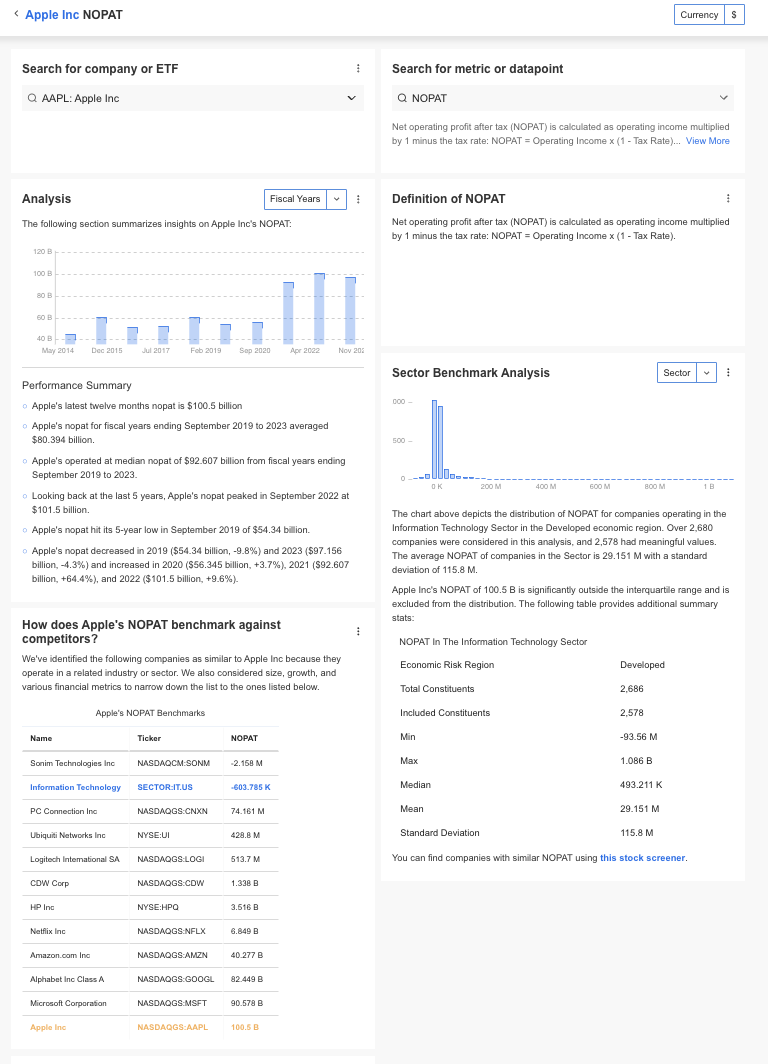
InvestingPro: Access NOPAT Data Instantly
Unlock Premium Data With InvestingPro 📈💸
Gain instant access to NOPAT data within the InvestingPro platform
✓ Access to 1200+ additional fundamental metrics
✓ Competitor comparison tools
✓ Evaluate stocks with 14+ proven financial models
FAQs
What is the difference between NOPAT and net income?
Net income includes all revenues and expenses, including taxes and interest, while NOPAT focuses solely on operating profits after taxes, excluding interest. This makes NOPAT a better indicator of operational efficiency.
Why is NOPAT important for investors?
Investors use NOPAT to evaluate a company’s operating performance without the influence of its capital structure. This makes it easier to compare companies with different levels of debt.
How does NOPAT relate to free cash flow?
NOPAT is a key component in calculating free cash flow (FCF). FCF is derived by subtracting capital expenditures and changes in working capital from NOPAT, which shows the actual cash available for distribution to shareholders and creditors.
Can NOPAT be negative?
Yes, NOPAT can be negative if a company’s operating expenses exceed its operating income, indicating the company is not generating profit from its core operations.
How does NOPAT impact return on invested capital (ROIC)?
NOPAT is used to calculate Return on Invested Capital (ROIC), a measure of how effectively a company uses its capital to generate profit. ROIC is calculated by dividing NOPAT by the total capital invested in the business.




 App Store
 Google Play