


Shareholder Yield is a financial metric used by investors to measure how effectively a company returns value to its shareholders. While most investors are familiar with dividends, Shareholder Yield encompasses not only dividend payments but also stock buybacks and debt reductions. This makes it a broader measure of a company’s commitment to generating value for its investors.
In essence, Shareholder Yield is designed to give investors a more complete picture of the total returns they receive from a company, combining the impacts of dividends, share repurchases, and debt repayment.
The formula to calculate Shareholder Yield is straightforward:

Shareholder Yield = (Dividend Payments + Share Repurchases − Net Debt Issued) / Market Capitalization
In this formula,
- Dividend Payments: Cash paid out to shareholders as dividends.
- Share Repurchases: The company’s buybacks of its own shares.
- Net Debt Issued: The amount of debt the company issues or repays, adjusted for changes in debt levels.
- Market Capitalization: The total value of the company’s outstanding shares (current stock price multiplied by the number of shares).
This formula gives a percentage that reflects the total shareholder returns the company generates through all avenues, beyond just the direct dividend payout.

Let’s assume that a company has the following financial data:
- Dividend Payments: $1 million
- Share Repurchases: $2 million
- Net Debt Issued: $500,000
- Market Capitalization: $50 million
Using the formula:
Shareholder Yield = (Dividend Payments + Share Repurchases − Net Debt Issued) / Market Capitalization
Shareholder Yield = (1,000,000 + 2,000,000 − 500,000) / 50,000,000 = 2,500,000 / 50,000,000
Shareholder Yield = 5%
In this example, the company’s Shareholder Yield is 5%, meaning that shareholders received 5% of the company’s market value back in the form of dividends, share buybacks, and debt reduction.
Shareholder Yield is an essential tool for evaluating a company’s financial management and its approach to rewarding investors. It goes beyond the simple payout of dividends and takes into account the broader picture of how a company is distributing value to shareholders.
Here are some reasons why Shareholder Yield is essential:
Comprehensive View of Returns
Shareholder Yield considers all forms of shareholder returns — dividends, buybacks, and debt reductions — providing a more complete picture of a company’s commitment to creating shareholder value. This is crucial for making informed investment decisions.
Attractiveness to Income-Oriented Investors
For income-seeking investors, Shareholder Yield is an attractive metric because it includes dividends as well as buybacks. Even if a company doesn’t pay a dividend, it may still be returning value to shareholders through buybacks, which boosts stock prices.
Debt Management Insights
Companies that prioritize debt repayment as part of their Shareholder Yield demonstrate fiscal responsibility. Reducing debt improves a company’s financial health, lowering future interest costs and contributing to overall long-term growth.
Stock Buybacks Signal Confidence
When a company buys back its shares (called a stock buyback), it often signals confidence in its future growth. High levels of share repurchases can reflect a company’s belief that its stock is undervalued, which can be an attractive signal for potential investors.
Comparison Tool Across Companies
Shareholder Yield offers a straightforward way to compare companies within the same industry. It levels the playing field by incorporating various methods of shareholder returns, allowing investors to identify companies that are returning the most value.
Interpreting Shareholder Yield requires understanding the context of the company’s financial practices and goals. A higher Shareholder Yield may suggest a company is effectively returning value to shareholders, but it also requires careful analysis to ensure sustainability.
A high Shareholder Yield may indicate that a company is aggressively returning value to its shareholders through dividends, buybacks, and debt reduction. However, investors should assess whether this is sustainable and whether the company is forgoing reinvestment in growth.
A low or negative Shareholder Yield may suggest that a company is not returning significant value to shareholders or is potentially over-leveraged. It could also indicate that the company is reinvesting profits into growth opportunities, which may benefit long-term investors.
Growth vs. Income Strategies
Companies focused on growth may have a lower Shareholder Yield, as they prefer to reinvest profits into business expansion rather than distributing them to shareholders. On the other hand, income-focused companies might have higher Shareholder Yields with significant dividends and buybacks.
Changes Over Time
Monitoring changes in Shareholder Yield over time can offer insights into a company’s shifting priorities. A decreasing ratio might signal a reduction in shareholder rewards or a shift toward more debt issuance, while an increase may indicate growing shareholder returns.
Industry Comparisons
Comparing Shareholder Yield across companies in the same sector helps to identify market leaders in delivering value to shareholders. A higher ratio relative to peers may suggest superior capital allocation or effective financial management.
A good Shareholder Yield depends on various factors, including the company’s industry, financial health, and overall strategy. However, here are general guidelines:
- A Good Shareholder Yield is typically above 5-6%. This suggests that a company is returning a meaningful portion of its market value to shareholders, either through dividends, share buybacks, or debt reduction.
- For Growth Companies: A lower Shareholder Yield may be acceptable if the company is reinvesting profits for future growth. In these cases, the focus is on capital appreciation rather than current shareholder returns.
- For Income Investors: A higher Shareholder Yield is often preferred, particularly if dividends are a significant part of the return. Investors should seek companies with a balanced approach that includes dividends, share repurchases, and sensible debt management.
Although Shareholder Yield offers a more complete view of how a company rewards shareholders, it has limitations that investors must consider.
Does Not Account for Operational Performance
Shareholder Yield focuses on how a company distributes value but does not consider how well the company is performing operationally. A company may have a high Shareholder Yield but low growth or profitability, which should also be considered in investment decisions.
Short-Term Focus
Companies with high Shareholder Yields may be focusing more on short-term payouts, such as dividends or buybacks, rather than investing in long-term growth. This could limit future earnings potential and lead to underperformance over time.
Debt Issuance Impact
Shareholder Yield deducts net debt issued, but it doesn’t consider the total impact of debt. Some companies may issue significant amounts of debt to fund buybacks or dividends, which could increase financial risk over time.
Inconsistent Buyback Reporting
Not all companies report share buybacks in the same way, leading to inconsistencies when calculating Shareholder Yield. Some buybacks may not be disclosed accurately, skewing the yield calculation and making cross-company comparisons difficult.
Potential for Earnings Manipulation
Companies might manipulate earnings through share buybacks to boost per-share metrics, like earnings per share (EPS), without delivering substantial long-term value. Investors need to ensure that buybacks are made for the right reasons and do not mask poor operational performance.
InvestingPro offers detailed insights into companies’ Shareholder Yield including sector benchmarks and competitor analysis.
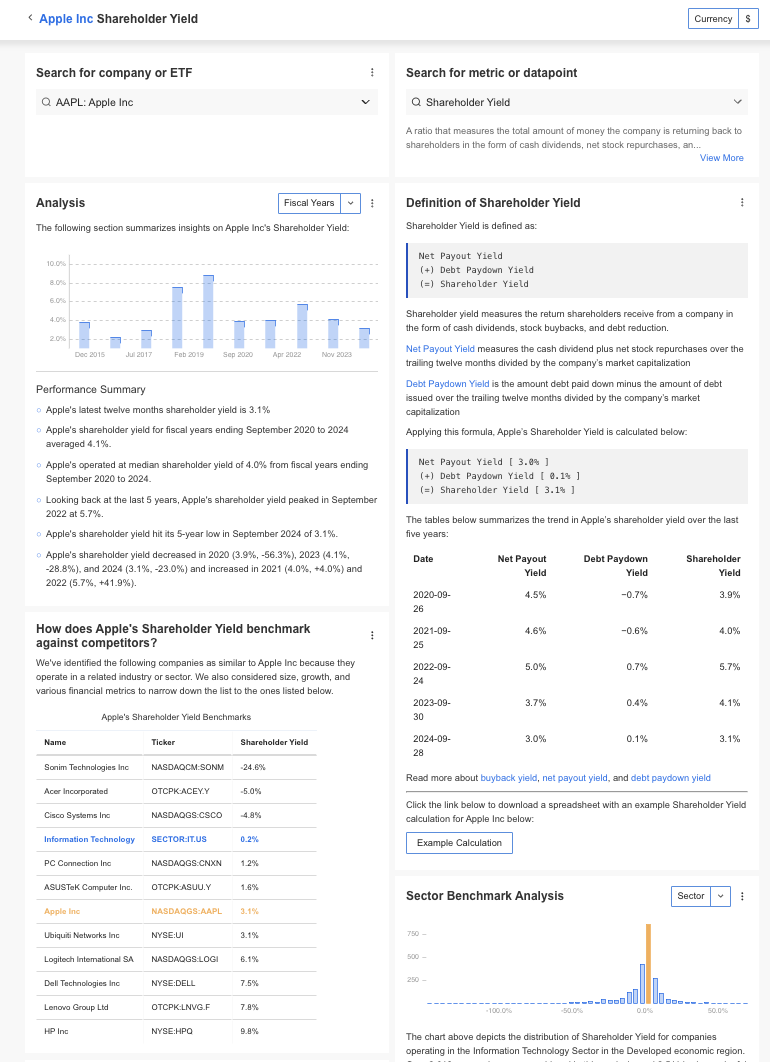
Unlock Premium Data With InvestingPro 📈💸
Gain instant access to Shareholder Yield data within the InvestingPro platform
🛠 Access to 1200+ additional fundamental metrics
🔍 Competitor comparison tools
📊 Evaluate stocks with 14+ proven financial models
Shareholder Yield measures the total value a company returns to its shareholders through dividends, stock buybacks, and debt reduction.
It provides a more comprehensive picture of shareholder returns, helping investors evaluate how well a company rewards its investors beyond dividends.
A Shareholder Yield above 5-6% is considered good, as this level indicates meaningful returns to shareholders. The ideal figure depends on industry norms and company goals.
Investors can compare the Shareholder Yield of companies within the same industry to identify firms that are most effective at returning value to shareholders.


 App Store
 Google Play