


What are Restructuring Charges?
Restructuring charges refer to one-time costs that a company incurs when it makes significant changes to its business operations. These changes often include downsizing, closing facilities, or reorganizing divisions to improve efficiency or profitability. Companies report these charges in their income statements as non-operational expenses, ensuring transparency for investors and stakeholders.
Restructuring charges typically arise during periods of strategic change, such as mergers, acquisitions, or financial distress. While they are necessary for long-term improvement, these charges can signal temporary financial instability to the market.
How to Calculate Restructuring Charges?
Calculating restructuring charges involves identifying all costs associated with the organizational change. While the specific formula can vary depending on the situation, it generally includes the following:

Restructuring Charges = Severance Pay + Asset Write-Downs + Lease Termination Costs + Consultancy Fees
The liabilities in the aforementioned formula include:
- Severance Costs: Payments made to laid-off employees, including benefits and bonuses.
- Lease Termination Costs: Fees for ending lease agreements prematurely.
- Asset Write-Downs: The reduction in book value of assets no longer useful due to restructuring.
- Consultancy Fees: Costs for advisory services related to restructuring.
By summing these costs, companies can report a comprehensive restructuring charge in their financial statements.

Example Calculation of Restructuring Charges
Consider a manufacturing company, XYZ Corp that decides to restructure its operations to improve efficiency and reduce costs. The restructuring plan includes closing an underperforming factory, laying off employees, and upgrading its remaining facilities. Below are the detailed expenses:
- Severance Pay:
XYZ Corp lays off 200 employees, each receiving an average severance package of $10,000.
Severance Pay = 200 × 10,000 = 2,000,000
- Asset Write-Downs:
The factory being closed has machinery and equipment with a book value of $1,500,000, but their market value is only $500,000. The company writes down the difference as a loss.
Asset Write-Downs = Book Value − MarketValue
Asset Write-Downs = 1,500,000 – 500,000 = 1,000,000
- Lease Termination Costs:
The company terminates a lease agreement for the factory, incurring penalties and remaining obligations totaling $300,000.
Lease Termination Costs = 300,000
- Consultancy Fees:
XYZ Corp hires restructuring experts to oversee the process, costing $200,000.
Consultancy Fees = 200,000
Total Restructuring Charges
Total Restructuring Charges = Severance Pay + Asset Write-Downs + Lease Termination Costs + Consultancy Fees
Total Restructuring Charges = 2,000,000 + 1,000,000 + 300,000 + 200,000 = 3,500,000
The restructuring charges for XYZ Corp total $3,500,000. This amount is recorded as a one-time expense on the company’s income statement for the relevant financial period.
Why Are Restructuring Charges Important?
Restructuring charges are significant for both companies and investors as they provide insights into a company’s financial strategy, current challenges, and future outlook.
They are important because they provide insights into a company’s efforts to improve operations, address inefficiencies, and adjust to changing market conditions. While these charges can reduce short-term profitability, they are often a necessary part of a strategy to drive long-term growth and value for shareholders. Understanding the metric is crucial for several reasons:
Signal of Organizational Change
Restructuring charges indicate significant operational changes, such as downsizing or shifting focus. These changes, while costly initially, can lead to improved efficiency and profitability in the long term, signaling a proactive strategy to adapt and stay competitive.
Short-Term Financial Impact with Long-Term Benefits
Though restructuring charges impact short-term profits, they often lead to operational improvements and cost reductions. These changes are typically non-recurring and can result in a more efficient, profitable company in the future, benefiting shareholders long-term.
Investor Decision-Making
Investors use restructuring charges to evaluate a company’s strategy. Charges due to necessary improvements (e.g., workforce optimization) can be a positive sign, but frequent restructuring without long-term performance improvements may raise concerns about poor management or inefficiencies.
Transparency and Accountability
Restructuring charges provide transparency about a company’s operational changes, ensuring investors understand the reasons for restructuring. Detailed disclosures ensure accountability and allow investors to assess whether the costs are justifiable for future growth.
Understanding the Cost of Change
Restructuring charges highlight the financial costs of making significant changes, like closing underperforming units or upgrading technology. These charges help investors understand the financial investment needed to drive long-term improvements and business success.
How to Interpret Restructuring Charges?
The interpretation of Total Current Liabilities depends on its relationship with other financial metrics:
Interpreting restructuring charges involves analyzing their context and implications:
- High Charges in a Strong Market: May indicate inefficiencies being addressed proactively.
- Recurring Restructuring Costs: Could signal poor management or frequent strategic missteps.
- Alignment with Strategy: Charges aligned with a clear growth strategy are less concerning.
For example, a company investing in technological upgrades may incur restructuring charges that suggest future operational improvements.
What is a Good Restructuring Charge?
There’s no universally “good” restructuring charge. However, a good restructuring charge typically refers to one that is both strategically sound and proportionate to the company’s size and future growth plans.
Below are key factors to evaluate when determining whether restructuring charges are beneficial or indicative of potential problems:
- One-Time Nature: Charges should be infrequent and not recurring.
- Alignment with Growth: Charges should support a clear and strategic objective.
- Proportionality: Charges should be reasonable compared to the company’s revenue and size.
For instance, a restructuring charge of $1 million might be negligible for a multinational corporation but significant for a small enterprise.
What are the Limitations of Total Current Liabilities?
While restructuring charges can provide valuable insights into a company’s efforts to improve its operations, there are several limitations to consider:
- Short-Term Focus: Restructuring charges focus on short-term costs for long-term benefits, making it difficult to gauge their immediate impact. Patience is required to see if the expected improvements materialize.
- Potential for Misleading Financial Health: Companies might use restructuring charges to smooth earnings, hiding underlying issues. This can give a misleading impression of financial health.
- Lack of Transparency: Some companies fail to provide clear explanations for restructuring charges, making it hard for investors to assess whether they’re part of a solid strategy or poor management.
- Impact on Stock Price: Restructuring charges often lead to short-term stock price declines, as investors may react negatively before understanding the long-term benefits.
- Inconsistent Reporting Standards: Different companies may report restructuring charges inconsistently, making it difficult to compare charges across firms or industries.
- Difficult to Quantify Long-Term Benefits: While restructuring charges aim to improve operations, the long-term benefits are hard to quantify and may not materialize as expected due to external factors.
How to Find Restructuring Charges?
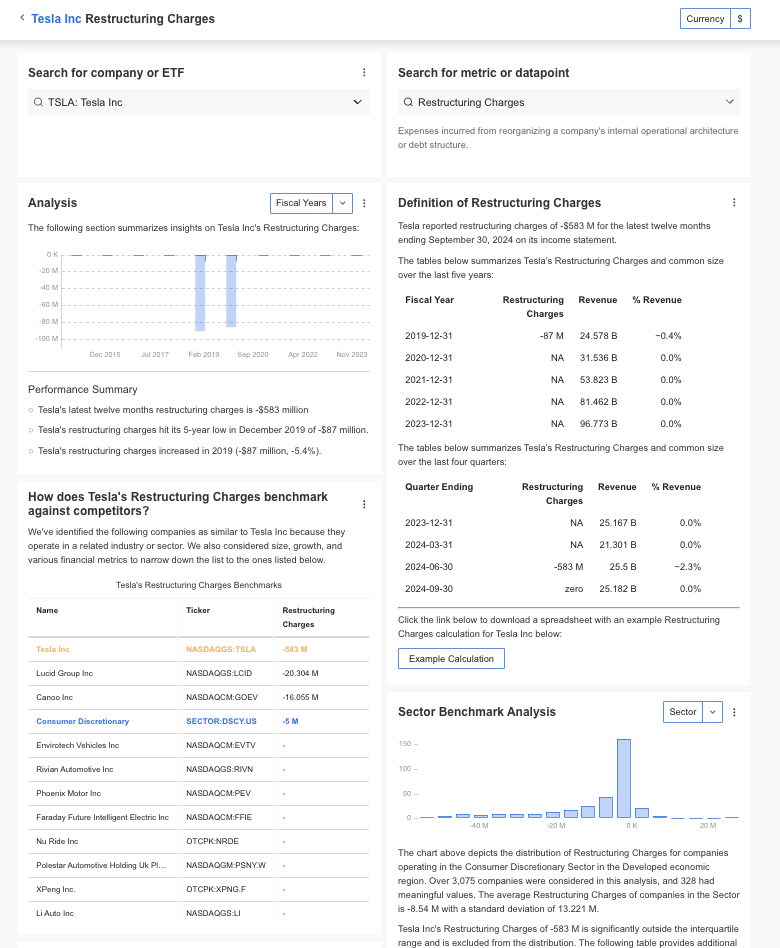
InvestingPro offers detailed insights into companies’ Restructuring Charges including sector benchmarks and competitor analysis.
InvestingPro+: Access Restructuring Charges Data Instantly
Unlock Premium Data With InvestingPro 📈💸
Gain instant access to Restructuring Charges data within the InvestingPro platform
🛠 Access to 1200+ additional fundamental metrics
🔍 Competitor comparison tools
📊 Evaluate stocks with 14+ proven financial models
Restructuring Charges FAQ
Are restructuring charges tax-deductible?
Yes, restructuring charges are typically tax-deductible as business expenses. However, the specific tax treatment may vary depending on local regulations and the type of restructuring. Companies should consult tax professionals for accurate advice on deductions.
Do restructuring charges impact stock prices?
Yes, significant restructuring charges can lead to temporary declines in stock prices. Investors may perceive these charges as a sign of operational difficulties or uncertainty, although stock prices may recover over time if the restructuring proves successful.
Can restructuring charges indicate financial distress?
Not always. While restructuring charges can indicate challenges, they may also reflect a company’s proactive strategy to improve profitability, streamline operations, or reposition itself in the market, which may ultimately strengthen its financial position over the long term.
How do restructuring charges differ from operating expenses?
Restructuring charges are one-time, non-recurring expenses related to changes in company operations, such as layoffs or asset write-offs. In contrast, operating expenses are recurring costs that a company incurs regularly to maintain day-to-day business activities, like salaries and rent.
Should investors be concerned about high restructuring charges?
High restructuring charges should be assessed in context. If they align with a clear, strategic plan for future growth or efficiency, they are less concerning. However, recurring or unexplained charges may indicate ongoing operational issues or poor management.




 App Store
 Google Play