


What are Research and Development (R&D) Expenses?
Research and Development (R&D) expenses are pivotal investments that enable companies to innovate, design, and refine their products or services. These costs directly support a company’s ability to compete in fast-evolving industries like technology, pharmaceuticals, and automotive.
How to Calculate R&D Investment?
A common metric used to assess R&D spending is R&D intensity:

R&D Intensity (%) = (R&D Expenses / Total Revenue) × 100
This formula measures the proportion of revenue reinvested in innovation, providing insight into how a company prioritizes long-term growth.
Comparison Metrics
To evaluate R&D effectiveness, companies often benchmark their spending against industry averages or competitors. Metrics such as return on investment (ROI) in R&D help gauge whether the expenditure leads to revenue growth or improved profitability.

Why are R&D Expenses Important?
For investors and financial analysts, understanding R&D expenses offers insight into a company’s priorities, competitive positioning, and potential for growth.
R&D expenses support the exploration of new opportunities and the improvement of existing offerings. These expenditures are not limited to groundbreaking innovations; they also include incremental improvements to maintain relevance in competitive markets. Some key purposes include:
- Product Development: Creating new products to meet market demands.
- Process Innovation: Enhancing production efficiency or reducing costs.
- Market Differentiation: Staying ahead of competitors by offering superior or unique products.
- Regulatory Compliance: Meeting evolving industry standards or legal requirements.
Key Components of R&D Expenses
Personnel Costs
The largest portion of R&D spending often goes toward salaries and benefits for researchers, engineers, and scientists. These professionals develop prototypes, test ideas, and refine innovations.
Material Costs
Prototyping requires materials, equipment, and consumables, all of which contribute to the expense of testing and iteration.
Equipment and Facilities
State-of-the-art tools, software, and laboratories play a crucial role in modern R&D processes. These assets often represent significant upfront investments.
Outsourcing and Collaboration
Some companies collaborate with universities, research institutions, or third-party consultants to leverage external expertise.
Indirect Costs
These include facility maintenance, utility expenses, and administrative support directly related to R&D activities.
Accounting for R&D Expenses
US GAAP
Under Generally Accepted Accounting Principles (GAAP) in the United States, R&D expenses are treated as operating costs and expensed as incurred. This conservative approach reflects the uncertainty of future returns from R&D investments.
IFRS
The International Financial Reporting Standards (IFRS) allow certain development expenses to be capitalized if specific criteria are met. However, research costs must be expensed immediately. Capitalization under IFRS is contingent on factors such as technical feasibility and the likelihood of economic benefits.
Advantages of R&D Expenses
- Competitive Edge: R&D enables companies to differentiate their offerings and stay ahead of competitors.
- Revenue Growth: Innovative products often command higher margins and capture new markets, driving revenue.
- Adaptability: Continuous research ensures businesses can adapt to regulatory changes, market disruptions, or evolving consumer preferences.
Challenges in R&D Expenses
- Uncertainty of Returns: Not all R&D projects lead to commercial success. Companies must weigh the potential benefits against the risk of failure.
- High Costs: R&D requires significant upfront investments, which can strain cash flow for smaller businesses.
- Balancing Short-Term and Long-Term Goals: Excessive R&D spending might hinder profitability in the short term, while insufficient investment can lead to stagnation.
How to Find R&D Expenses?
InvestingPro offers detailed insights into companies’ R&D Expenses including sector benchmarks and competitor analysis.
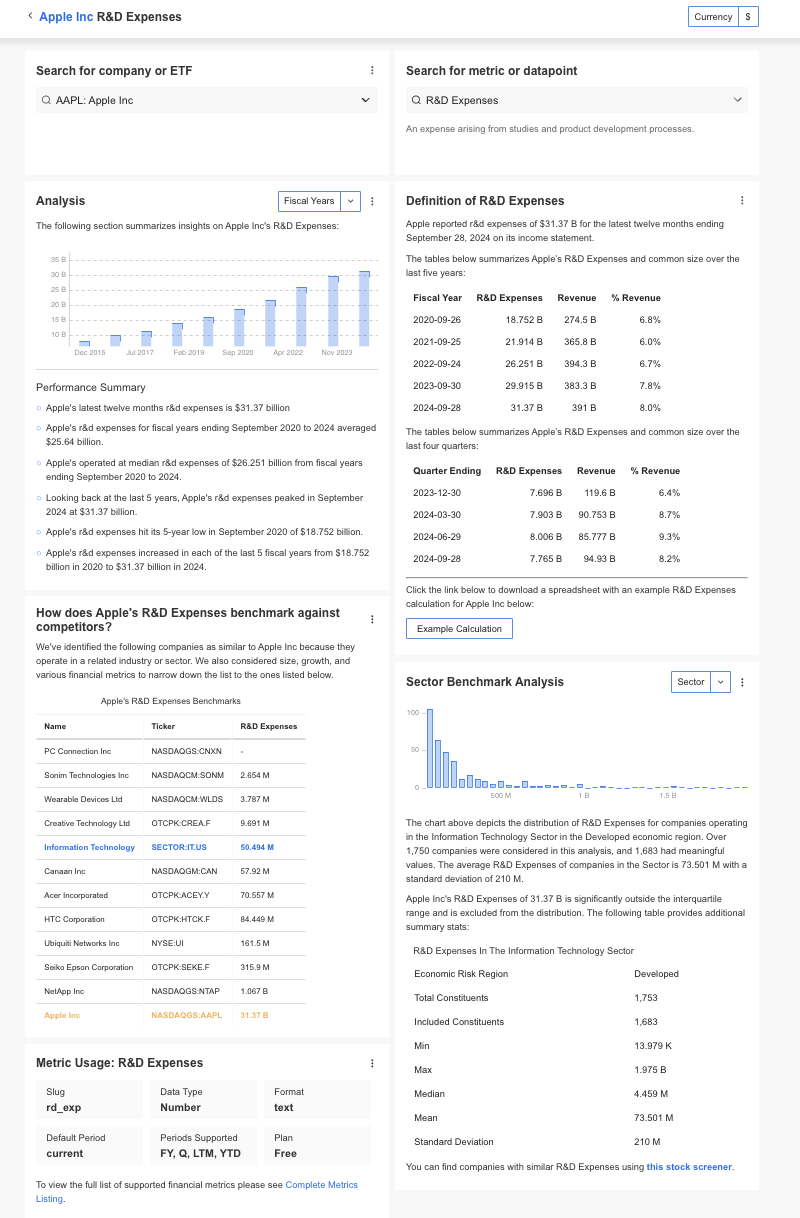
InvestingPro: Access R&D Expenses Data Instantly
Unlock Premium Data With InvestingPro 📈💸
Gain instant access to R&D Expenses data within the InvestingPro platform
🛠 Access to 1200+ additional fundamental metrics
🔍 Competitor comparison tools
📊 Evaluate stocks with 14+ proven financial models
R&D Expenses FAQs
What qualifies as R&D?
R&D includes activities aimed at developing or improving products, processes, or technologies. Routine quality control or marketing activities do not qualify.
Are R&D expenses tax-deductible?
In many jurisdictions, R&D expenses qualify for tax credits or deductions, incentivizing innovation.
How do investors evaluate R&D spending?
Investors assess R&D intensity, effectiveness, and the alignment of expenditures with a company’s strategic goals.
Can small businesses afford R&D?
Yes, governments often provide grants, tax credits, or subsidies to support R&D efforts in small and medium-sized enterprises.
How does R&D impact stock valuation?
Consistent R&D investment signals growth potential but must translate into tangible outcomes to positively affect stock performance.




 App Store
 Google Play