


What is Preferred Stock Redeemable?
Preferred Stock Redeemable refers to a class of preferred shares issued by a company that includes a redemption feature. This feature allows the issuer to repurchase these shares at a predetermined price after a specific date. Unlike common stocks, redeemable preferred stocks often provide fixed dividends and carry less risk since they prioritize payouts over common shares.
Redeemable preferred stock is commonly used by companies to raise capital without diluting control. This type of stock is advantageous for investors seeking regular income and stability, as well as for issuers who may want flexibility to retire the stock under favorable financial conditions.
How to Calculate Preferred Stock Redeemable?
To calculate the value of redeemable preferred stock, you need to focus on the redemption price and any accrued dividends if applicable. The formula is:

Redeemable Value = Redemption Price + Accrued Dividends (if any)
The components in the formula mean:
- Redemption Price: The agreed-upon price at which the issuer can repurchase the stock.
- Accrued Dividends: Dividends that have been declared but not yet paid.

Example Calculation of Preferred Stock Redeemable
Consider a company, ABC Corp, issues 10,000 shares of redeemable preferred stock with the following features:
- Par Value: $100 per share
- Dividend Rate: 6% annually
- Redemption Period: The shares are eligible for redemption at the end of 5 years.
- Redemption Price: $110 per share (including a premium above the par value).
- Accrued Dividends: At the end of the redemption period, 1 year of dividends remains unpaid.
We will calculate the redeemable value per share and the total amount the company must pay to redeem all the shares.
Calculate Annual Dividends
The annual dividend is determined using the dividend rate applied to the par value of the preferred stock.
Annual Dividend = Par Value × Dividend Rate
Annual Dividend = 100 × 6% = $6 per share
Determine Accrued Dividends
Since 1 year of dividends remains unpaid, the total accrued dividends per share are equal to one year’s worth of dividends.
Accrued Dividends = $6 per share
The redeemable value of a share includes the redemption price and any accrued dividends.
Redeemable Value Per Share = Redemption Price + Accrued Dividends
Redeemable Value Per Share = 110 + 6 = 116
Calculate Total Redemption Amount
To find the total cost for the company to redeem all shares, multiply the redeemable value per share by the total number of shares.
Total Redemption Amount = Redeemable Value Per Share × Number of Shares
Total Redemption Amount = 116 × 10,000 = 1,160,000
The redeemable value per share is $116, and the total redemption amount required to repurchase all 10,000 shares is $1,160,000.
Key Takeaways
- The redemption price may include a premium over the par value, which compensates investors for early redemption.
- Accrued dividends must be added to the redemption price, reflecting unpaid earnings owed to shareholders.
- Total redemption costs scale with the number of shares issued, highlighting the financial impact on the issuing company.
Why is Preferred Stock Redeemable Important?
Preferred Stock Redeemable plays a vital role in the financial ecosystem, benefiting both issuers and investors. Its importance can be understood by analyzing its advantages and the value it adds to corporate finance and investment portfolios.
For issuers, it’s a powerful tool for managing capital costs while maintaining strategic control. For investors, it offers the benefits of fixed income and reduced exposure to equity market volatility. This dual-purpose role underscores its enduring relevance in financial markets.
For Investors
- Predictable Income: Preferred stock provides fixed dividends, making it a reliable source of income.
- Lower Risk: As redeemable preferred stockholders are prioritized over common shareholders, they face reduced investment risk.
- Liquidity Assurance: The redemption feature assures investors that they can exit their investment under agreed-upon conditions.
- Attractive Alternative to Bonds: For those looking for a middle ground between the safety of bonds and the growth potential of equity, redeemable preferred stock is an appealing option.
For Issuers
- Flexibility in Financing: Issuers can reclaim shares under favorable market conditions, potentially lowering the cost of capital.
- Non-Dilutive: Unlike common stock issuance, redeemable preferred shares avoid diluting ownership.
- Cost Management: Issuers can redeem the stock when market conditions are favorable, such as when interest rates decline. This flexibility helps manage financing costs efficiently, as redeemable preferred stock is often cheaper than issuing common equity or debt.
- Appealing to Investors: Offering redeemable shares makes a company more attractive to conservative investors.
How to Interpret Preferred Stock Redeemable?
The key to interpreting preferred stock redeemable lies in evaluating its terms. Investors and analysts should consider:
- Redemption Price: Indicates the baseline value investors can expect.
- Dividend Rate: Reflects the level of income generated annually.
- Redemption Period: Determines the timeline for potential returns or exit.
What is a Good Preferred Stock Redeemable?
A good redeemable preferred stock offers a balance of high dividend yield, favorable redemption terms, and strong issuer financials. It should align with the investor’s goals for income, safety, and risk tolerance. Factors to evaluate include:
- Issuer Credit Rating: Higher ratings imply reduced credit risk.
- Dividend Coverage Ratio: Indicates the issuer’s ability to sustain dividend payments.
- Redemption Conditions: Fair terms and flexibility for investors.
- Market Comparisons: Competitive yields compared to bonds or other fixed-income instruments.
What are the Limitations of Preferred Stock Redeemable?
While Preferred Stock Redeemable has significant advantages for both issuers and investors, it also comes with certain limitations. Understanding these drawbacks is essential for making informed decisions about issuing or investing in this type of security.
- Limited Capital Appreciation: Unlike common stocks, preferred stocks seldom experience significant value growth.
- Call Risk: Investors face the risk of shares being redeemed when market conditions are favorable for the issuer.
- Fixed Returns: Dividend rates are fixed, potentially underperforming in inflationary periods.
- Market Sensitivity: Changes in interest rates can affect the attractiveness and pricing of redeemable preferred stock.
How to Find Preferred Stock Redeemable?
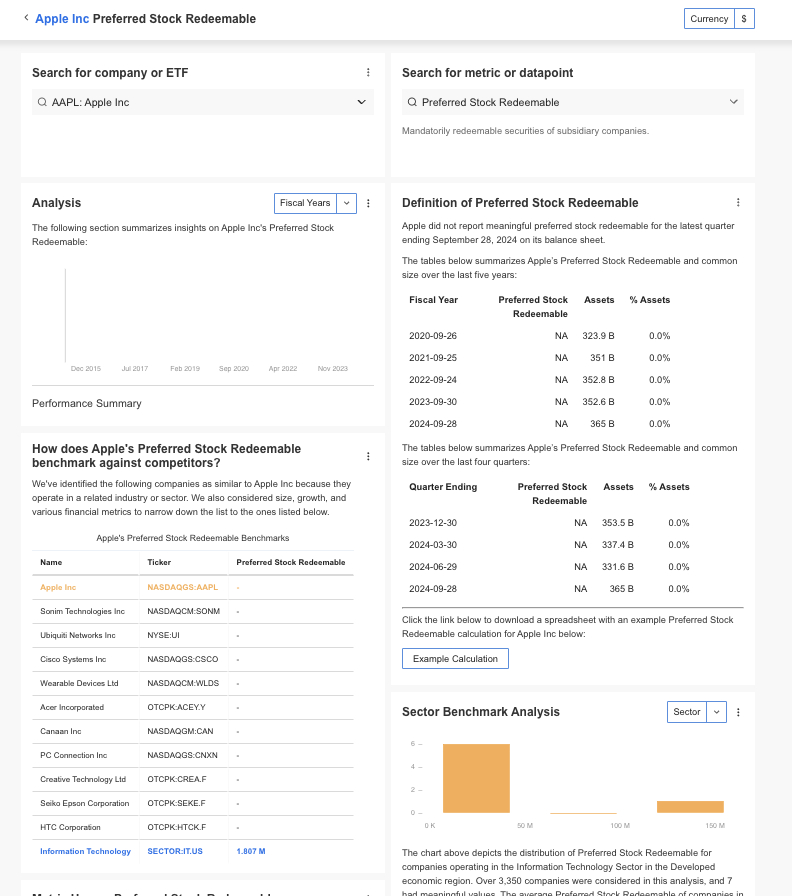
InvestingPro offers detailed insights into companies’ Preferred Stock Redeemable including sector benchmarks and competitor analysis.
InvestingPro+: Access Preferred Stock Redeemable Data Instantly
Unlock Premium Data With InvestingPro 📈💸
Gain instant access to Preferred Stock Redeemable data within the InvestingPro platform
🛠 Access to 1200+ additional fundamental metrics
🔍 Competitor comparison tools
📊 Evaluate stocks with 14+ proven financial models
Preferred Stock Redeemable FAQ
What is the difference between preferred stock and redeemable preferred stock?
Redeemable preferred stock includes a clause allowing the issuer to repurchase shares at a predetermined price, while regular preferred stock may not have such a feature.
How does the redemption process work?
The issuer notifies shareholders about redemption terms, repurchasing shares at the agreed price, along with any accrued dividends.
Can investors refuse redemption?
No, the issuer holds the right to enforce redemption as per the stock’s terms.
Are dividends on redeemable preferred stock guaranteed?
While fixed, dividends are not guaranteed and depend on the issuer’s financial health.
Is redeemable preferred stock better than common stock?
It depends on the investor’s goals. Redeemable preferred stock suits those seeking income and stability, while common stock is better for growth-focused investors.




 App Store
 Google Play