


What is FCF/OCF?
FCF/OCF, or Free Cash Flow to Operating Cash Flow ratio, is a financial metric used to evaluate a company’s ability to generate cash from its core operations and convert that cash into free cash flow.
It measures how well a company manages its cash flow, particularly in terms of turning the cash generated by its regular business activities into cash that can be used for growth, debt repayment, dividends, or other investments.
How to Calculate FCF/OCF?
The FCF/OCF ratio is calculated by dividing Free Cash Flow (FCF) by Operating Cash Flow (OCF):
FCF/OCF = FCF / OCF
In this formula:
- Free Cash Flow (FCF) is the cash generated by the company’s operations after deducting capital expenditures required to maintain or expand the business. The formula for FCF is:
FCF = Operating Cash Flow − Capital Expenditures
- Operating Cash Flow (OCF) is the cash generated by the company’s core business operations, typically reported in the company’s cash flow statement.
By dividing FCF by OCF, you get a ratio that shows how efficiently the company is turning its operating cash into free cash.

Example Calculation of FCF/OCF
Let’s consider a hypothetical company to demonstrate the calculation of FCF/OCF.
Suppose the company reports the following data in its financial statements:
- Operating Cash Flow (OCF): $500,000
- Capital Expenditures: $200,000
To calculate Free Cash Flow (FCF):
FCF = OCF − Capital Expenditures = 500,000 − 200,000 = 300,000
Now, to calculate the FCF/OCF ratio:
FCF/OCF = 300,000 / 500,000 = 0.6
This means the company is converting 60% of its operating cash flow into free cash flow. A ratio of 0.6 could be seen as reasonable, though investors might expect this number to be higher, depending on the industry.
Why is FCF/OCF Important?
The FCF/OCF ratio is an essential tool for investors, analysts, and financial professionals, as it provides valuable insights into a company’s financial health and operational efficiency. Here’s why it’s important:
Cash Flow Conversion
This ratio helps determine how well a company is converting operating cash flow into free cash flow, which is available for reinvestment, debt repayment, dividends, or other strategic uses. A higher ratio suggests better efficiency in using cash generated from core operations.
Assessing Operational Efficiency
The FCF/OCF ratio can highlight inefficiencies in a company’s operations. If the ratio is low, it could indicate that the company is not generating enough free cash flow from its operations to cover its capital expenditures or other financial obligations, which could lead to problems down the line.
Financial Health
A high FCF/OCF ratio is often seen as a positive indicator of a company’s financial health. It suggests that the company has a strong operational cash flow base, is investing wisely in capital expenditures, and has more flexibility in managing its finances.
Investment Decision Tool
Investors use this ratio to gauge the sustainability of a company’s cash flow. A high ratio often signals that the company is capable of generating consistent and reliable cash flow, making it a more attractive investment.
Long-Term Viability
The FCF/OCF ratio can indicate how well a company is positioned for long-term growth. By effectively converting operational cash flow into free cash flow, a company may be better positioned to fund future growth initiatives without relying too heavily on external financing.
How to Interpret FCF/OCF?
The ideal FCF/OCF ratio can vary depending on the industry, company size, and stage of growth. However, here are some general guidelines:
- Higher Ratio (Above 1): A ratio above 1 is generally considered good, as it indicates that the company is generating more free cash flow than operating cash flow. This is a sign of strong financial health and operational efficiency.
- Moderate Ratio (Around 0.5 to 1): A ratio in this range may indicate that the company is still converting a decent portion of its operating cash flow into free cash flow, though it may face challenges or have substantial capital expenditures that limit its free cash flow generation.
- Low Ratio (Below 0.5): A ratio below 0.5 may be a red flag. It suggests that the company is not efficiently converting its operating cash flow into free cash flow, which could indicate potential liquidity issues, inefficiencies in capital spending, or an unsustainable business model.
Limitations of FCF/OCF
While FCF/OCF is a useful metric, it’s important to be aware of its limitations:
Capital Expenditures Variation
Capital expenditures can vary widely from one company to another and can be impacted by industry norms. For example, a company in the tech industry may have lower capital expenditures compared to one in the manufacturing sector, which could skew comparisons between companies in different industries.
Industry Specificity
The significance of a “good” FCF/OCF ratio can vary greatly across industries. For instance, companies in capital-intensive industries, like energy or real estate, may have lower ratios due to high capital expenditure requirements. On the other hand, businesses with low capital expenditure needs (like tech companies) may exhibit a higher ratio.
Volatility in Cash Flow
The ratio can fluctuate depending on a company’s cash flow patterns. A sudden increase in capital expenditures or a temporary drop in operating cash flow could result in a lower FCF/OCF ratio, which may not necessarily indicate long-term financial issues.
Non-Recurring Items
Operating cash flow can be affected by non-recurring items like asset sales, which may artificially inflate the ratio. It’s important to focus on the core, sustainable elements of operating cash flow when using this metric.
External Factors
Macroeconomic factors such as changes in interest rates, commodity prices, or consumer demand can impact operating cash flow and capital expenditures, affecting the FCF/OCF ratio and making it difficult to interpret in isolation.
How to Find FCF/OCF?
InvestingPro offers detailed insights into companies’ FCF/OCF including sector benchmarks and competitor analysis.
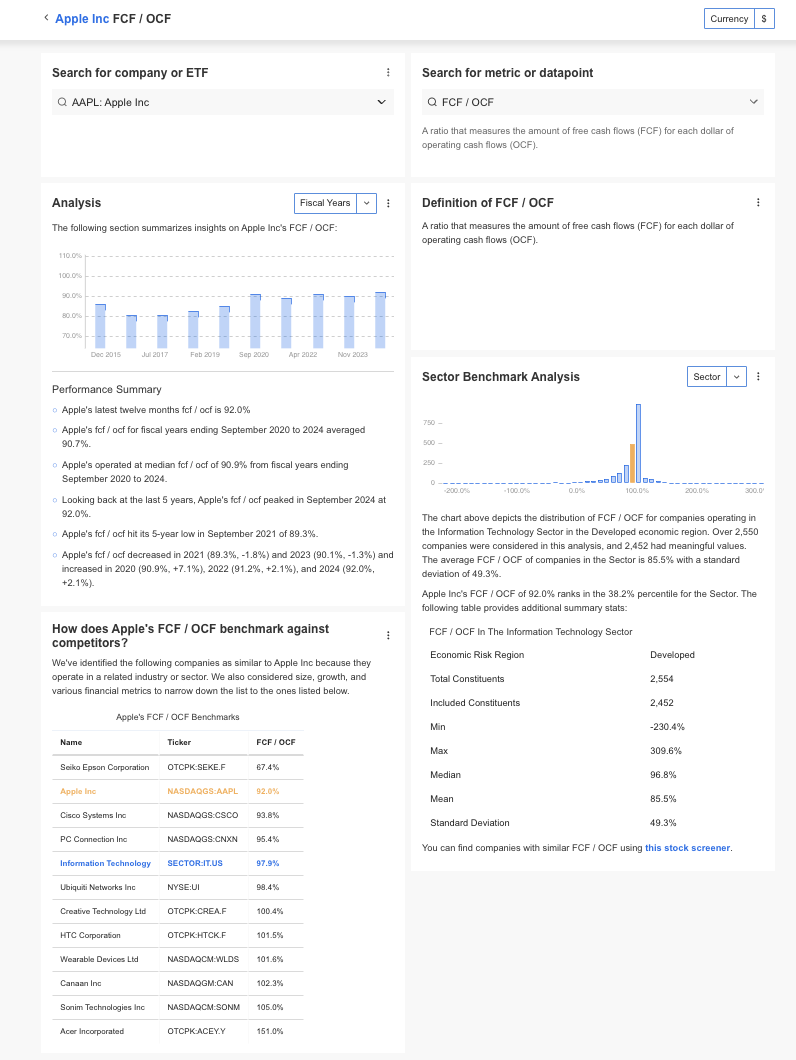
InvestingPro: Access FCF/OCF Data Instantly
Unlock Premium Data With InvestingPro 📈💸
Gain instant access to FCF/OCF data within the InvestingPro platform
🛠 Access to 1200+ additional fundamental metrics
🔍 Competitor comparison tools
📊 Evaluate stocks with 14+ proven financial models
FCF/OCF Frequently Asked Questions
What does a low FCF/OCF ratio mean?
A low FCF/OCF ratio suggests that a company is not efficiently turning its operating cash flow into free cash flow. This could be due to high capital expenditures or poor management of operational costs.
How can I use the FCF/OCF ratio to assess a company?
The FCF/OCF ratio helps assess how efficiently a company is generating cash and converting it into free cash flow. A high ratio indicates strong financial health, while a low ratio may indicate inefficiencies or financial strain.
How does FCF/OCF differ from other financial ratios?
Unlike profitability ratios or liquidity ratios, the FCF/OCF ratio specifically measures the conversion of operational cash flow into free cash flow, focusing on a company’s ability to fund investments and pay down debt.
Should the FCF/OCF ratio be used alone?
No, the FCF/OCF ratio should be used in conjunction with other financial metrics like profit margins, return on assets, and debt ratios to get a fuller picture of a company’s financial health.
Can FCF/OCF be used to compare companies?
Yes, but only within the same industry. Different industries have different capital expenditure needs, which can make comparisons between companies in different sectors less meaningful.




 App Store
 Google Play