


What Is EBITDAR?
EBITDAR or Earnings Before Interest, Taxes, Depreciation, Amortization, and Restructuring or Rent Costs, is a financial metric used to evaluate a company’s operating performance. It is particularly useful in sectors like hospitality, retail, and airlines, where rent or lease expenses significantly impact profitability.
How to Calculate EBITDAR?
The formula for EBITDAR is:

EBITDAR = EBITDA + Rent + Restructuring Costs
This equation starts with EBITDA, which includes earnings before interest, taxes, depreciation, and amortization. It then adds back rent and restructuring costs, offering a more accurate representation of a company’s core operational performance.

Example Calculation of EBITDAR
Step 1: Revenue and Operating Expenses
Imagine that Company ABC earns $2.5 million in annual revenue. It has total operating expenses of $1 million, including $30,000 for depreciation, $25,000 for amortization, and $120,000 in rental costs. Additionally, the company incurs $50,000 in interest expenses and $30,000 in taxes.
Step 2: Calculate Net Income
To calculate the company’s net income, we subtract total operating expenses, interest, and tax expenses from revenue:
Net Income = $2,500,000 (Revenue) − $1,000,000 (Operating Expenses) − $50,000 (Interest) − $30,000 (Taxes) = $1,420,000
Step 3: Back Into EBIT
Now, to calculate EBIT (Earnings Before Interest and Taxes), we add back the interest and tax expenses to the net income:
EBIT = $1,420,000 (Net Income) + $50,000 (Interest) + $30,000 (Taxes) = $1,500,000
Step 4: Calculate EBITDA
Next, to find EBITDA (Earnings Before Interest, Taxes, Depreciation, and Amortization), we add back the depreciation and amortization expenses:
EBITDA = $1,500,000 (EBIT) + $30,000 (Depreciation) + $25,000 (Amortization) = $1,555,000
Step 5: Arrive at EBITDAR
Finally, we calculate EBITDAR (Earnings Before Interest, Taxes, Depreciation, Amortization, and Rent) by adding rental costs to EBITDA:
EBITDAR = $1,555,000 (EBITDA) + $120,000 (Rental Costs) = $1,675,000
Why is EBITDAR Important?
EBITDAR offers investors a clearer understanding of a company’s true earnings by excluding certain non-operational costs. It allows investors to compare companies with varying capital structures and operating leases, providing a clearer picture of a firm’s core profitability.
This calculation is an important tool for comparing companies with different levels of debt and capital expenditures. It is especially useful when evaluating businesses in sectors with high lease costs, such as retail chains and airlines.
By stripping out rent and restructuring costs, EBITDAR allows investors to focus on the company’s operational performance, providing a more apples-to-apples comparison across firms.
Advantages of EBITDAR
EBITDAR helps analysts and investors zero in on a company’s true operational performance, offering a standardized method to compare businesses across different sectors and regions. It reveals a clearer picture of operating cash flow, making it a powerful tool for financial analysis and decision-making.
Excludes Non-Recurring Costs
By removing one-time restructuring expenses, EBITDAR offers a clearer, more relevant view of ongoing profitability, avoiding distortions from short-term or non-recurring charges.
Facilitates Comparability Across Companies
EBITDAR levels the playing field by excluding rental costs, enabling a fair comparison between companies, regardless of whether they own or lease their assets.
Adjusts for Geographic Cost Variations
Businesses in high-rent locations often face inflated expenses. EBITDAR adjusts for these regional disparities, providing a more standardized financial metric that reflects the company’s core performance.
Focuses on Controllable Earnings
By removing less predictable costs such as rent or interest, EBITDAR allows management to focus on earnings that are directly tied to their operational decisions, offering a more strategic view of profitability.
Enhanced Financial Analysis for Hotels
In the hospitality sector, EBITDAR excludes rental and lease expenses, giving a more accurate picture of a hotel’s operational efficiency and true financial health.
Improves Comparisons Across Properties
Hoteliers can use EBITDAR to benchmark performance across different properties or chains, ensuring fair comparisons that account for rental cost variations.
Highlights Operational Efficiency
EBITDAR shines a spotlight on a company’s core operations, helping management identify areas for improvement and streamline processes for increased profitability.
Crucial for Asset Valuation
When evaluating hotels or similar businesses, EBITDAR becomes a key factor in determining asset value, especially when preparing for sales or acquisitions.
Effective Tool for Management Evaluation
By excluding external financial obligations, EBITDAR offers a clearer picture of how well management is handling the company’s core operations, making it easier to assess leadership effectiveness.
Aids in Risk Assessment
EBITDAR provides a transparent view of a company’s earnings before factoring in major expenses, which helps investors and management identify potential financial risks and make informed investment or operational decisions.
Limitations of EBITDAR
While EBITDAR is a valuable tool for financial analysis, it comes with several limitations that can impact its usefulness in assessing a company’s true financial health.
Ignores Recurring Restructuring Costs
Larger firms may frequently undergo restructuring as part of their regular operations. Since EBITDAR eliminates these costs, it may misrepresent the financial performance of businesses where such expenses are inherent to their structure.
Masks Controllable Costs
By excluding restructuring expenses, EBITDAR may hide inefficiencies in management. Organizations repeatedly restructuring may avoid accountability for operational inefficiencies, as this calculation removes those controllable aspects from the financial picture.
Overlooks Regional Income Variations
EBITDAR adjusts for high rental costs in certain areas but does not account for potentially higher revenue opportunities in those same locations. While rent might be higher, businesses in premium locations can also charge more for their products or services, which EBITDAR does not reflect.
May Present a Misleading View of Cash Activity
Although EBITDAR aims to provide a clearer picture of operational earnings by excluding interest, taxes, and rental costs, it does not account for the fact that these are still actual cash outflows. Ignoring these expenses can lead to an inaccurate assessment of a company’s cash position.
Excludes Significant Cash Flow Expenses
Taxes, interest, depreciation, amortization, and rental costs are real expenses that impact a company’s cash flow. By removing them from the equation, EBITDAR may give a skewed view of a company’s true financial standing.
Not Governed by GAAP
EBITDAR is not a metric regulated by Generally Accepted Accounting Principles (GAAP), which means companies have more flexibility in how they calculate it. This lack of standardization can result in inconsistent or misleading financial reporting.
How to Find EBITDAR?
InvestingPro offers detailed insights into companies’ EBITDAR including sector benchmarks and competitor analysis.
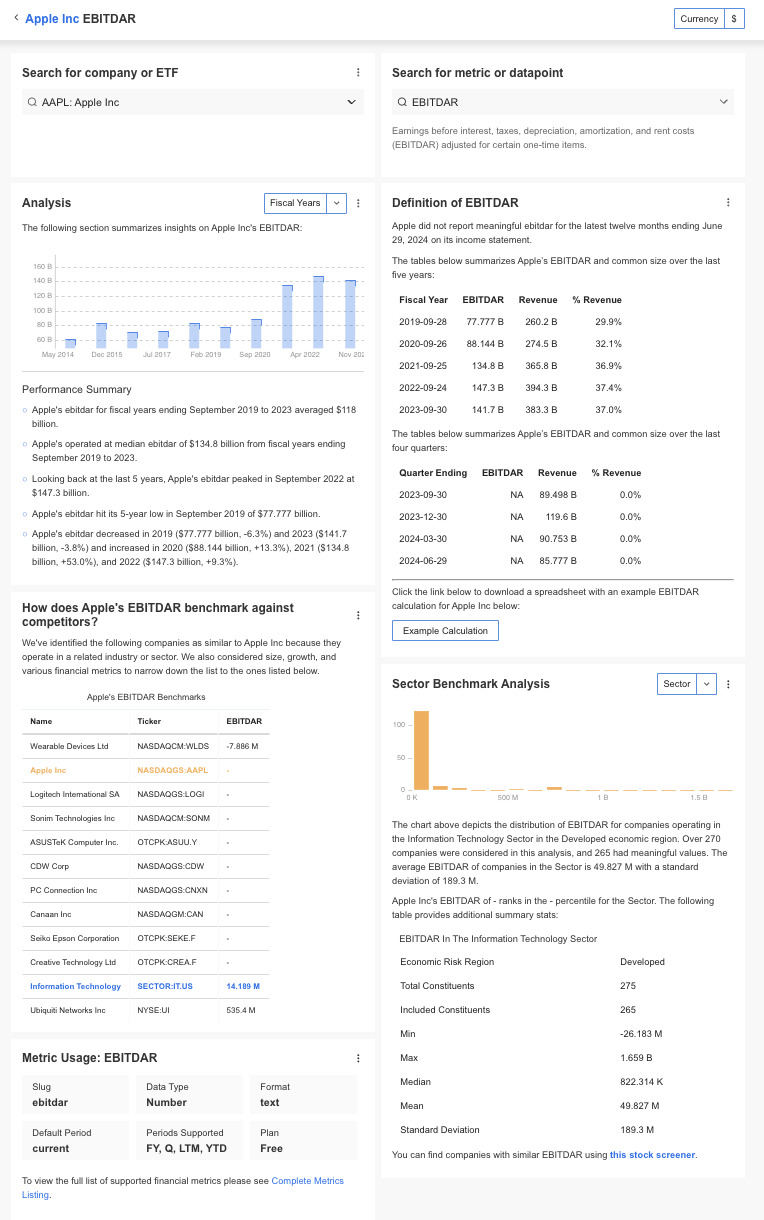
InvestingPro: Access EBITDAR Data Instantly
Unlock Premium Data With InvestingPro 📈💸
Gain instant access to EBITDAR data within the InvestingPro platform
✓ Access to 1200+ additional fundamental metrics
✓ Competitor comparison tools
✓ Evaluate stocks with 14+ proven financial models
FAQs of EBITDAR
What is the difference between EBITDA and EBITDAR?
EBITDA stands for Earnings Before Interest, Taxes, Depreciation, and Amortization, while EBITDAR adds back rent or restructuring costs to EBITDA. EBITDAR is particularly useful for industries where these costs are significant.
Which industries commonly use EBITDAR?
Industries such as hospitality, retail, and airlines frequently use EBITDAR. These sectors typically have high rent or lease costs, making EBITDAR a more relevant measure of operating performance.
How is EBITDAR used by investors?
Investors use EBITDAR to assess a company’s operational efficiency without the impact of its capital structure. This makes it easier to compare companies with varying levels of debt and lease obligations.
What are the limitations of using EBITDAR?
EBITDAR can overstate a company’s financial health by excluding significant costs like rent and restructuring. It should be used alongside other financial metrics for a balanced analysis.




 App Store
 Google Play