


What is EBITDA Margin?
EBITDA Margin, or Earnings Before Interest, Taxes, Depreciation, and Amortization Margin, is a financial metric used to assess a company’s operating performance. It provides insight into a company’s profitability by excluding the effects of financing and accounting decisions.
How to Calculate EBITDA Margin?

The formula to calculate EBITDA Margin is:
EBITDA Margin = (EBITDA / Total Revenue) × 100
This percentage reflects how much of a company’s revenue is converted into EBITDA, providing a clearer picture of operational efficiency.
EBITDA = Operating Income (EBIT) + Depreciation + Amortization

Why is EBITDA Margin Important?
EBITDA Margin is crucial for investors because it focuses on the operational aspects of a business, ignoring variables like interest, taxes, and non-cash depreciation and amortization. This focus allows for a more direct comparison between companies, regardless of their capital structure or tax environments.
It indicates the amount of operating cash generated per dollar of revenue. This metric is useful for comparing businesses within the same industry, as it focuses on operating profitability and cash flow. By excluding non-cash expenses such as depreciation and amortization, EBITDA margin provides a clearer view of a company’s cost-cutting effectiveness and relative profitability.
The measure is valuable for investors and analysts as it shows the cash operating profit margin before considering capital expenditures, taxes, and capital structure, and is commonly used in mergers and acquisitions across various market segments to compare business performance.
How to Interpret EBITDA Margin?
A higher EBITDA Margin indicates a more efficiently managed company with better control over operating expenses, as it suggests lower operating expenses in relation to the company’s total revenue, meaning a more profitable operation and stable earnings.
On the other hand, a low EBITDA margin suggests that a business is facing challenges with profitability and cash flow.
Limitations of EBITDA Margin
The EBITDA margin, while popular for evaluating company performance, has several limitations that investors should be aware of.
Debt Exclusion Skews Financial Performance
One major drawback is its exclusion of debt, which can lead companies to highlight their EBITDA margins to divert attention from their debt levels, thus enhancing their perceived financial performance. This can be misleading, particularly for firms with substantial debt, as large interest payments are not factored into the analysis.
Inappropriate for High Debt Companies
For companies with high debt levels, the EBITDA margin is not a suitable measure. The exclusion of interest payments, which can be significant for these companies, results in an incomplete picture of their financial health. These interest payments should be included in any thorough financial analysis to provide an accurate assessment.
Higher Than Profit Margin
Another limitation is that the EBITDA margin is generally higher than the profit margin. This can lead companies with low profitability to emphasize EBITDA as a measure of success, potentially giving a distorted view of their true financial condition.
Lack of Standardization Under GAAP
Since EBITDA is not regulated by Generally Accepted Accounting Principles (GAAP), companies have considerable discretion in how they calculate it. This lack of standardization can lead to manipulated figures that favorably represent the company’s performance, thereby misleading investors.
Does Not Reflect True Cash Flow
EBITDA excludes non-cash expenses, capital expenditures, and taxes, which means it does not provide a clear estimate of a company’s actual cash flow generation. It also ignores changes in working capital, which are crucial for business growth, and necessary capital expenditures to maintain or replace assets.
As such, a positive EBITDA does not necessarily indicate that a business is generating cash. Investors should instead consider cash flow from operations or free cash flow for a more accurate picture.
How to Find EBITDA Margin?
InvestingPro offers detailed insights into companies’ EBITDA Margin including sector benchmarks and competitor analysis.
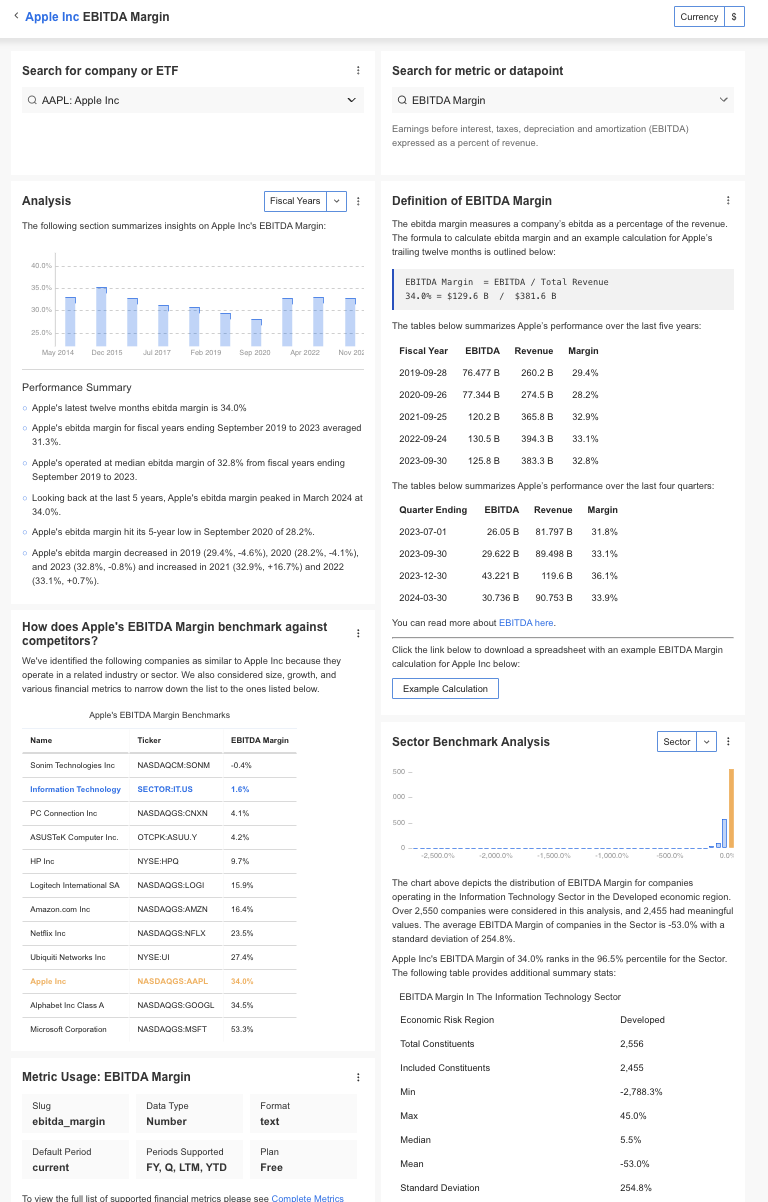
InvestingPro: Access EBITDA Margin Data Instantly
Unlock Premium Data With InvestingPro 📈💸
Gain instant access to EBITDA Margin data within the InvestingPro platform
✓ Access to 1200+ additional fundamental metrics
✓ Competitor comparison tools
✓ Evaluate stocks with 14+ proven financial models
FAQ
What does a high EBITDA Margin indicate?
A high EBITDA Margin suggests that a company is generating a significant profit from its operations before accounting for interest, taxes, depreciation, and amortization. It indicates strong operational efficiency and cost management.
How is EBITDA Margin used in comparing companies?
EBITDA Margin allows for the comparison of operational performance across companies by removing the effects of financing and accounting differences. This makes it easier to evaluate which companies are more efficient in their core operations.
Can EBITDA Margin be negative?
Yes, if a company’s operating expenses exceed its revenues, it can result in a negative EBITDA Margin. This signals potential operational inefficiencies or issues with the business model.
Is EBITDA Margin the same as profit margin?
No, EBITDA Margin is different from profit margin. Profit margin includes all expenses, including interest, taxes, depreciation, and amortization, whereas EBITDA Margin focuses solely on operational performance.


 App Store
 Google Play