


Dividend Per Share (DPS) is a financial metric that shows the amount of cash paid to shareholders for each share they own over a specific period, usually annually. It is an essential figure for income-focused investors, as it highlights the portion of a company’s earnings returned to its shareholders in the form of dividends.
DPS is a key indicator of a company’s profitability and shareholder return policy.
DPS is calculated by dividing the total dividends paid by a company over a certain period by the number of outstanding shares.
The formula is as follows:

DPS = Total Dividends Paid / Shares Outstanding
This formula helps investors assess the actual cash return they are receiving per share, making it easier to compare dividend payouts across different companies.

Example Calculation of DPS Calculation
Let’s break down DPS with a practical example to show how it is calculated.
Financial Year Example: Company XYZ
For the financial year 2022-2023, Company XYZ declared the following dividends:
- Interim dividend: $5 per share
- Final dividend: $6.50 per share
To calculate the total dividend per share, you simply add the interim and final dividends.
Total dividend per share = 5 + 6.50 = 11.50
Thus, the total DPS for the year is $11.50.
Calculating DPS from Total Dividends
Let’s consider another scenario where Company ABC announced a total dividend of $800,000 to be paid out in the next quarter. The company has 2 million shares outstanding. To calculate DPS:
DPS = Total Dividend / Shares Outstanding = 800,000 / 2,000,000 = 0.40
In this example, the DPS is $0.40.
Estimating DPS Using the Income Statement
DPS can also be estimated from the income statement by following a consistent dividend payout ratio. Let’s walk through the process:
- Determine Net Income: Suppose Company B reported a net income of $15 million.
- Find Shares Outstanding: The company has 12 million shares issued but holds 4 million shares in the treasury, leaving 8 million shares outstanding.
- Calculate Earnings Per Share (EPS): Dividing net income by shares outstanding gives the earnings per share:
EPS = 15,000,000 / 8,000,000 = 1.875
- Apply the Payout Ratio: If Company B has historically paid out 50% of its earnings as dividends, then:
DPS = 0.50 × 1.875 = 0.9375
So, the estimated dividend per share for Company B is $0.94.
Dividend Per Share (DPS) is a valuable metric for investors looking to understand a company’s financial health and commitment to returning profits to its shareholders. It is the simplest metric investors can use to determine the dividend payments they will receive from holding shares of a stock over time.
By analyzing DPS, investors can gauge how much they stand to earn from dividends per share, helping them make informed decisions about where to allocate their capital.
Investors often look at DPS in combination with other metrics, such as the dividend yield, to determine whether a stock aligns with their income objectives. For companies, a stable or growing DPS can enhance their attractiveness to income-seeking investors and help support share price stability.
How to Interpret DPS?
A rising DPS can indicate that a company is performing well, generating sufficient profits, and rewarding its shareholders. Conversely, a declining DPS might suggest potential financial challenges or a shift in corporate strategy.
Factors Influencing DPS
Several factors can affect a company’s DPS, including:
Profitability: Companies with strong earnings are more likely to pay and increase dividends.
Payout Ratio: The percentage of earnings paid out as dividends can affect DPS. A lower payout ratio might indicate a conservative dividend policy, while a higher ratio could suggest that a company is committed to distributing a significant portion of its profits.
Business Strategy: Firms focusing on growth may prefer to reinvest profits rather than pay higher dividends, leading to a lower DPS.
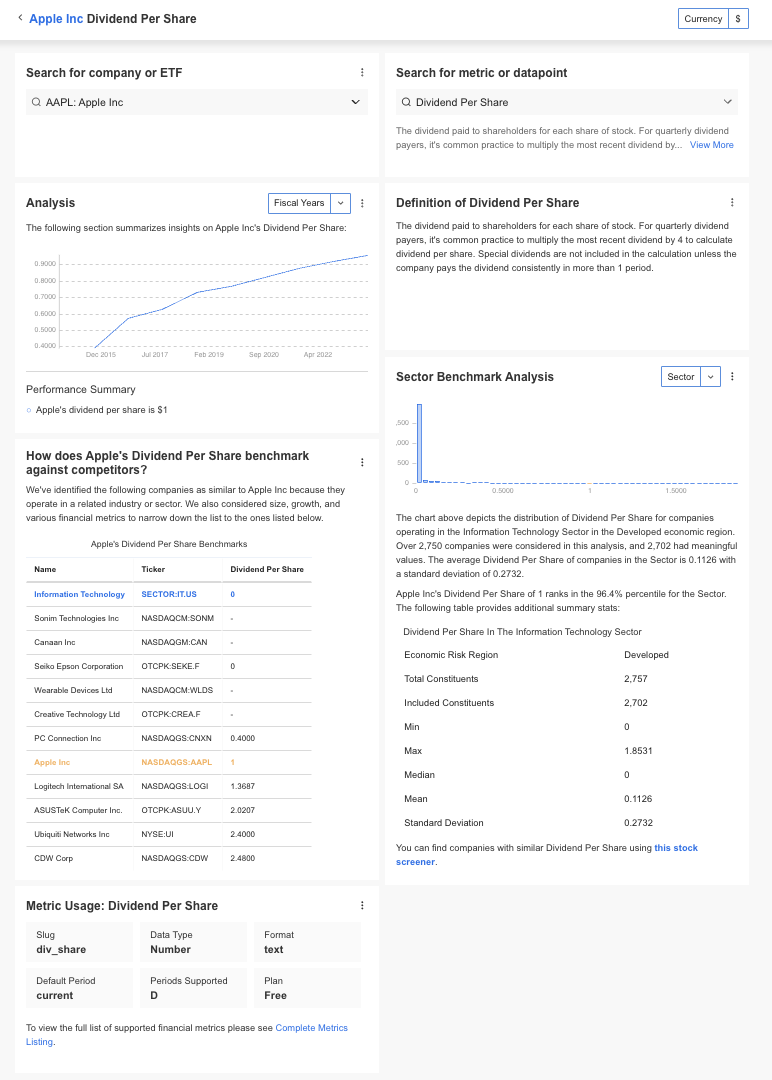
InvestingPro offers detailed insights into companies’ Dividend Per Share (DPS) including sector benchmarks and competitor analysis.
Unlock Premium Data With InvestingPro 📈💸
Gain instant access to DPS data within the InvestingPro platform
🛠 Access to 1200+ additional fundamental metrics
🔍 Competitor comparison tools
📊 Evaluate stocks with 14+ proven financial models
How is DPS different from dividend yield?
DPS measures the total cash dividend paid per share, while dividend yield shows the percentage return on investment from dividends relative to the stock price.
Why is DPS important for income investors?
Income-focused investors rely on steady or growing DPS for a reliable income stream. DPS helps them evaluate whether a company provides consistent returns.
What happens if DPS decreases?
A decrease in DPS could signal financial difficulties or a shift in the company’s strategy toward reinvesting earnings instead of returning them to shareholders.
How often are dividends paid?
Dividends can be paid quarterly, annually, or on a special one-time basis. DPS is typically calculated annually, but some companies also report interim DPS figures.
Can a company have a high DPS and still be risky?
Yes, while a high DPS might attract investors, it can also be a red flag if the company is paying out more than it earns, which may not be sustainable in the long run.




 App Store
 Google Play