


What is the Dividend Coverage Ratio?
The dividend coverage ratio (DCR) is a critical metric for investors seeking to evaluate a company’s ability to sustain its dividend payouts. It measures how well a company’s earnings can cover its dividend payments, while reflecting the company’s capacity to distribute dividends to shareholders without jeopardizing its financial health.
How to Calculate Dividend Coverage Ratio?
The formula for the dividend coverage ratio is as follows:

DCR = Net Income / Dividends Paid
In this formula,
- Net Income represents the company’s earnings after taxes and expenses.
- Dividends Paid is the total cash distributed to shareholders in a given period.

How to Interpret Dividend Coverage Ratio?
The dividend coverage ratio is an indispensable tool for evaluating a company’s dividend sustainability and overall financial health. For those seeking consistent returns, the DCR provides a reliable benchmark to assess risk and reward in dividend-paying stocks.
Here is how Dividend Coverage Ratio is interpreted:
Ratio Above 1
A DCR greater than 1 indicates that the company earns more than enough to cover its dividend obligations, signaling a healthy financial position. For example, a ratio of 2 implies the company earns twice the amount required to pay dividends.
Ratio Equal to 1
A DCR of 1 means the company’s earnings exactly match its dividend payments. While not immediately alarming, this level leaves no room for error or growth.
Ratio Below 1
A ratio below 1 suggests that the company is paying out more in dividends than it earns, potentially leading to financial strain. Companies with a DCR below 1 may need to borrow or use reserves to maintain dividends, raising concerns about sustainability.
Technology companies often maintain DCRs above 3, as they prioritize reinvestment over dividend payouts. In contrast, established sectors like utilities typically operate with DCRs closer to 1.5, reflecting steady but modest growth.
Example Calculation of Dividend Coverage Ratio
Consider XYZ Corporation reports the following for its most recent financial year. Its net income stands at $18 million, and the annual dividend distributed to common shareholders totaled $5 million, while preferred shareholders received $2 million in dividends.
First, subtract the dividends paid to preferred shareholders from the net income:
Net Income Available for Common Shareholders = Total Net Income – Dividends to Preferred Shareholders
Net Income = 18,000,000 − 2,000,000 = 16,000,000
Step 2: Compute the Dividend Coverage Ratio
Next, divide the net income available to common shareholders by the annual dividend paid to them:
Dividend Coverage Ratio = Net Income Available to Common Shareholders / Dividends to Common Shareholders
DCR = 16,000,000 / 5,000,000 = 3.2
Interpretation
The resulting DCR of 3.2 indicates the company’s net income is 3.2 times higher than the dividend payments to common shareholders. This suggests the company is in a robust position to sustain its dividend payouts, providing confidence to investors about the company’s financial health.
A higher DCR, as in this case, generally reflects strong earnings stability, while a lower DCR might signal a tighter margin for dividend payments.
Factors Affecting the Dividend Coverage Ratio
Industry Norms
DCR benchmarks vary by industry. Utility companies, for instance, often have lower ratios due to their stable cash flows, while technology firms might maintain higher ratios to fund growth.
Earnings Volatility
Companies with cyclical earnings may experience fluctuations in their DCR, necessitating careful dividend planning.
Dividend Payout Policies
A higher dividend payout ratio typically results in a lower DCR, as more earnings are allocated to dividends.
Economic Conditions
During economic downturns, earnings may decline, pressuring companies to reassess dividend payments.
Key Applications of Dividend Coverage Ratio
This ratio offers insights into the relationship between a company’s earnings and its dividend obligations, acting as a safeguard for income-focused investors. A deeper understanding of this metric is essential for assessing a company’s financial stability and its commitment to shareholder returns.
Investor Insights
The DCR helps investors gauge the sustainability of a company’s dividends. A high ratio provides confidence in a steady income, while a low ratio may signal potential risks.
Dividend Policy Assessment
Companies use the DCR to evaluate whether their dividend policy aligns with financial goals and market expectations.
Risk Management
The ratio serves as a warning signal for financial instability, helping companies adjust dividend payouts before financial challenges arise.
Practical Implications of the Dividend Coverage Ratio
Case Study: ABC Enterprises
In its latest annual report, ABC Enterprises revealed the following:
- Net Income: $1.2 million
- Dividends Paid: $800,000
Calculation:
DCR = 1,200,000 / 800,000 = 1.5
While the DCR of 1.5 indicates that the company is earning more than its dividend payments, it also suggests limited flexibility for unforeseen challenges. Investors should monitor such companies for signs of earnings volatility.
How to Find Dividend Coverage Ratio?
InvestingPro offers detailed insights into companies’ Dividend Coverage Ratio (DCR) including sector benchmarks and competitor analysis.
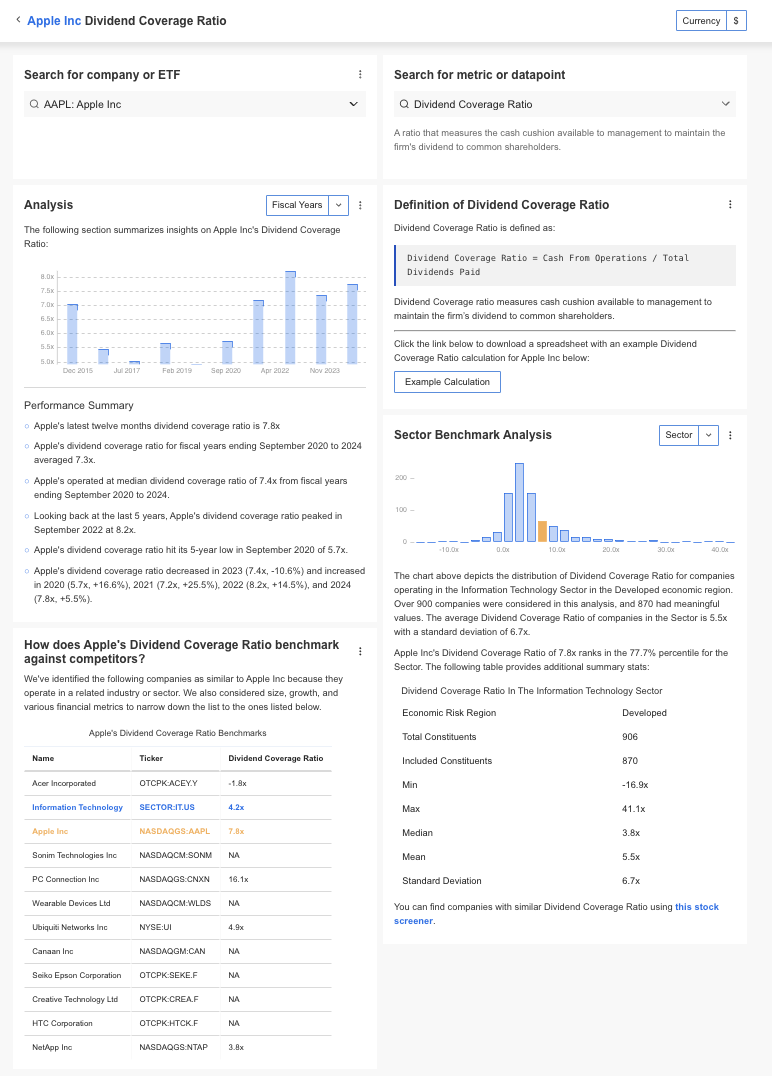
InvestingPro: Access Dividend Coverage Ratio Data Instantly
Unlock Premium Data With InvestingPro 📈💸
Gain instant access to DCR data within the InvestingPro platform
🛠 Access to 1200+ additional fundamental metrics
🔍 Competitor comparison tools
📊 Evaluate stocks with 14+ proven financial models
Dividend Coverage Ratio FAQ
What is a Good Dividend Coverage Ratio?
A DCR above 2 is generally considered strong, indicating ample earnings to cover dividends. Ratios below 1 warrant caution, as they suggest unsustainable dividend practices.
How is DCR Different from the Payout Ratio?
While the DCR measures how many times earnings can cover dividends, the payout ratio calculates the percentage of earnings paid out as dividends. They complement each other in dividend analysis.
Can a High DCR Be Problematic?
A very high DCR might indicate that the company is retaining excess earnings rather than rewarding shareholders, potentially frustrating income-focused investors.
What Are the Risks of a Low DCR?
A low DCR raises concerns about the company’s ability to maintain its dividends, particularly during periods of declining earnings or economic instability.


 App Store
 Google Play