


What is Debt Paydown Yield?
Debt Paydown Yield (DPY) is a financial metric that evaluates how effectively a company uses its free cash flow to reduce outstanding debt. It provides insight into a company’s financial health and its ability to reduce leverage, offering valuable information to investors and stakeholders. Companies often focus on their DPY as part of strategies to enhance their creditworthiness and overall market valuation.
How to Calculate Debt Paydown Yield?
The Debt Paydown Yield is typically expressed as a percentage. The formula for calculating it is as follows:

Debt Paydown Yield = (Debt Reduction Amount / Free Cash Flow) × 100
In this formula,
- Debt Reduction Amount refers to the total debt repaid during a specific period.
- Free Cash Flow (FCF) represents the cash generated by the company after accounting for operating expenses and capital expenditures.
This formula allows investors to measure how much of a company’s free cash flow is being used to reduce its debt obligations.

Example Calculation of Debt Paydown Yield
Let’s assume that a company generates $50 million in free cash flow during the fiscal year. Out of this, it uses $10 million to pay down its debt.
- Free Cash Flow (FCF): $50 million
- Invested Capital: $250 million
Using the formula:
Debt Paydown Yield = (Debt Reduction Amount / Free Cash Flow) × 100
Debt Paydown Yield = (10,000,000 / 50,000,000) × 100 = 20%
In this case, the company’s Debt Paydown Yield is 20%, indicating that it allocated 20% of its free cash flow to reduce its debt. This suggests a strong commitment to improving its financial position.
Why is Debt Paydown Yield Important?
Debt Paydown Yield (DPY) is a crucial metric for evaluating a company’s financial strategy and overall health. Here are the top reasons why it holds significant importance:
Enhances Financial Stability
A consistent DPY signals that a company is actively managing its debt, reducing financial liabilities, and strengthening its balance sheet. This stability builds trust among stakeholders and ensures long-term sustainability.
Boosts Creditworthiness
Companies with a healthy DPY demonstrate responsible financial behavior, which can lead to improved credit ratings. Higher creditworthiness results in lower borrowing costs and easier access to capital markets.
Increases Investor Confidence
Investors favor companies that prioritize debt reduction, as it reflects prudent management. A good DPY often attracts more investment, potentially driving up stock prices and market valuation.
Mitigates Financial Risk
Reducing debt obligations lowers the company’s exposure to financial risks, particularly during economic downturns. This makes the company less vulnerable to cash flow challenges.
Improves Strategic Flexibility
A lower debt burden gives companies more freedom to reinvest in growth opportunities, such as expanding operations, acquiring assets, or innovating. It ensures the company can capitalize on market trends effectively.
How to Interpret Debt Paydown Yield?
Understanding the implications of DPY requires a holistic approach:
- Higher DPY Values: These often indicate robust financial discipline and a focus on deleveraging. However, it’s important to assess whether the company’s investment in growth opportunities is being compromised.
- Lower DPY Values: While a low DPY may raise concerns about excessive leverage, it could also indicate that the company is channeling its free cash flow into expansion or other strategic investments.
- Industry Comparisons: Comparing DPY across similar companies provides context. For instance, capital-intensive industries may naturally have lower DPYs due to significant reinvestment needs.
What is a Good Debt Paydown Yield?
A “good” Debt Paydown Yield (DPY) depends on the industry, company strategy, and financial goals. However, general benchmarks and considerations provide guidance for interpreting this metric effectively:
Benchmark Range: A DPY above 15%-20% is typically considered favorable. It suggests that the company is using a significant portion of its free cash flow to reduce debt, reflecting strong financial discipline.
Industry-Specific Standards: Different industries have varying norms for DPY. Capital-intensive sectors like manufacturing may have lower DPYs due to reinvestment needs, whereas service-oriented companies might display higher DPYs.
Context Matters: A high DPY is often seen as positive but can indicate underinvestment in growth initiatives if excessive. Conversely, a low DPY might be acceptable if the company is using its free cash flow to fund strategic expansions.
Trend Analysis: A consistent or improving DPY over time indicates a company’s commitment to deleveraging. Sudden fluctuations could signal financial instability or changing priorities.
Comparative Analysis: Comparing DPY to peers within the same industry provides meaningful insights. A company outperforming its competitors in DPY may have stronger financial management practices.
In essence, a “good” DPY aligns with a company’s broader financial objectives, balancing debt reduction with reinvestment for growth and sustainability.
What are the Limitations of Debt Paydown Yield?
While Debt Paydown Yield (DPY) is a valuable metric for assessing how effectively a company uses its free cash flow to reduce debt, it is not without its limitations. Understanding these drawbacks is essential for a balanced interpretation of the metric.
- Incomplete Financial Picture: DPY focuses exclusively on debt reduction and ignores other critical aspects like profitability, liquidity, or growth potential, offering only a partial view of a company’s financial health.
- Lack of Industry Standardization: DPY benchmarks vary across industries, making it challenging to draw meaningful comparisons between companies in different sectors without additional context.
- Potential Trade-offs: A high DPY might indicate underinvestment in growth opportunities, research, or innovation, which could compromise long-term competitiveness despite strong debt reduction.
- Susceptibility to Cash Flow Volatility: Companies with fluctuating free cash flow may display inconsistent DPYs, making it difficult to identify clear trends or gauge financial stability accurately.
- Limited Use as a Standalone Metric: DPY does not account for a company’s total debt burden, interest costs, or repayment terms, necessitating the use of complementary metrics for a thorough financial analysis.
How to Find Debt Paydown Yield?
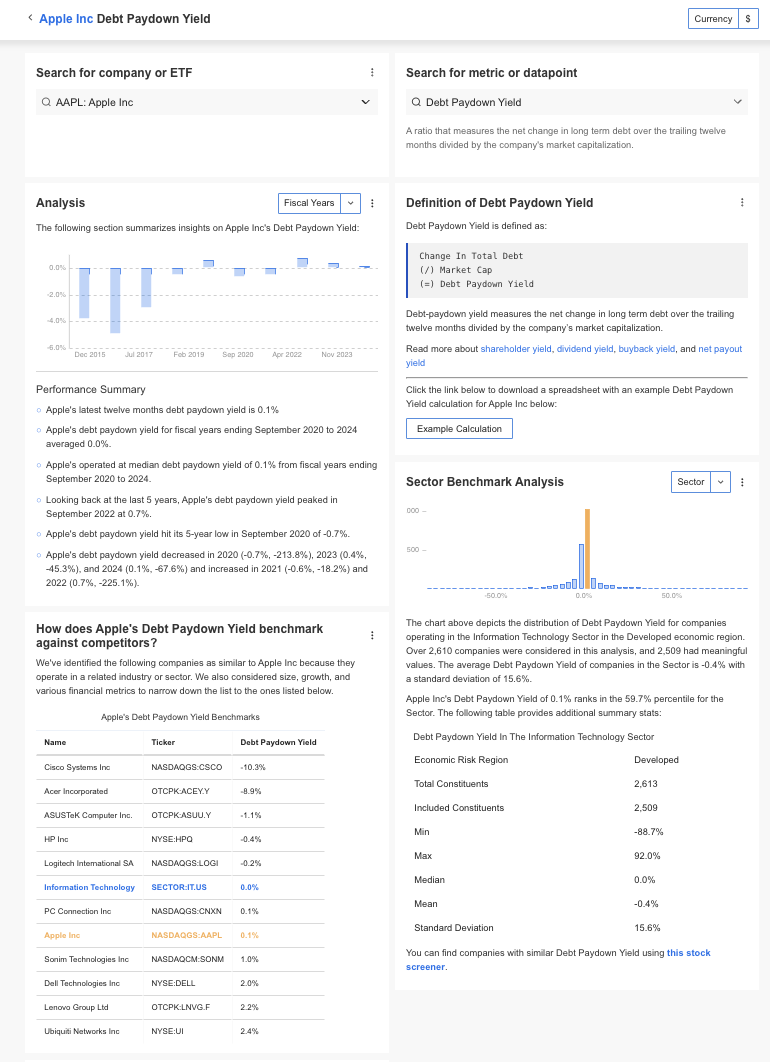
InvestingPro offers detailed insights into companies’ Debt Paydown Yield including sector benchmarks and competitor analysis.
InvestingPro+: Access Debt Paydown Yield Data Instantly
Unlock Premium Data With InvestingPro 📈💸
Gain instant access to Debt Paydown Yield data within the InvestingPro platform
🛠 Access to 1200+ additional fundamental metrics
🔍 Competitor comparison tools
📊 Evaluate stocks with 14+ proven financial models
Debt Paydown Yield FAQs
Is a higher Debt Paydown Yield always better?
Not necessarily. While a high DPY demonstrates strong debt repayment, it might indicate that the company is not adequately investing in growth or other strategic areas.
Can a company have a negative Debt Paydown Yield?
Yes, if a company incurs additional debt instead of repaying existing obligations, its DPY can be negative.
How does DPY affect a company’s stock price?
A healthy DPY often improves investor confidence, potentially boosting the stock price. Conversely, a poor DPY could raise concerns about financial mismanagement.
Is DPY relevant for all industries?
While DPY is important across sectors, its relevance and benchmarks vary. Capital-intensive industries, for instance, may prioritize reinvestment over debt repayment.
How often should DPY be evaluated?
DPY is typically analyzed on a quarterly or annual basis, aligning with financial reporting cycles.
Can small businesses use DPY?
Yes, small businesses can use DPY to monitor their debt repayment efficiency, helping them maintain financial stability.


 App Store
 Google Play