


What is the Benjamin Graham Formula?
The Benjamin Graham formula is a fundamental tool in value investing, designed to estimate a company’s intrinsic value based on its earnings performance and market conditions. It was developed to guide investors in identifying undervalued stocks with potential for long-term growth.
Calculation of Benjamin Graham Formula
The Benjamin Graham formula is used to calculate a stock’s intrinsic value by incorporating its earnings per share (EPS) and growth rate. This calculation enables investors to determine whether a stock is undervalued, overvalued, or fairly priced compared to its market price.
The basic formula is:

V = EPS × (8.5 + 2g)
Where:
- V: Intrinsic value
- EPS: Earnings per share for the past year
- 8.5: A constant multiplier for no-growth companies
- g: Expected growth rate of earnings
The revised version incorporates bond yields for improved accuracy:
V = [EPS × (8.5 + 2g) × 4.4] / Y
In this formula,
- 4.4: The average yield of high-grade corporate bonds in the 1960s
- Y: The current yield of AAA-rated corporate bonds
This adjustment accounts for the time value of money, aligning valuations with changing economic conditions.

Example Calculation Using Benjamin Graham Formula
Consider a company with the following date:
- EPS: $3.5
- Expected Growth Rate (g): 7% annually
- Current Yield on AAA-Rated Corporate Bonds (Y): 4.5%
The goal is to calculate the intrinsic value of the stock and determine whether it is undervalued based on its current market price of $75.
The basic formula is:
V = EPS × (8.5 + 2g)
V = 3.50 × (8.5 + 2g) = 3.5 × (8.5 + 14) = 78.75
The intrinsic value of the stock using the basic formula is $78.75.
The revised formula
V = [EPS × (8.5 + 2g) × 4.4] / Y
V = [3.5 × (8.5 + 14) × 4.4] / 4.5% = 77
The intrinsic value of the stock using the revised formula is $77.
Both calculations suggest that the intrinsic value is higher than the current market price of $75.00. This indicates that the stock might be undervalued and could represent a good investment opportunity for value-focused investors.
Why is the Benjamin Graham Formula Important?
The Benjamin Graham formula offers a disciplined approach to investing. By focusing on intrinsic value, it shields investors from speculative decisions based on short-term market movements.
Key benefits include:
- Risk Mitigation: Identifying undervalued stocks reduces the likelihood of overpaying.
- Long-Term Focus: Emphasizes growth potential and fundamental strength over market hype.
- Versatility: Adapts to different industries and economic cycles, especially with the revised formula.
How to Interpret the Benjamin Graham Formula?
The Benjamin Graham formula provides a framework for determining whether a stock is overvalued, fairly valued, or undervalued. The interpretation of the formula’s outputs depends on the intrinsic value calculation relative to the stock’s market price. Here’s how to interpret the results:
High Intrinsic Value Compared to Market Price
If the intrinsic value calculated using the formula is significantly higher than the current market price of the stock, it suggests that the stock may be undervalued.
Implications:
- Investment Opportunity: The stock could be a good buying opportunity because the market may not fully recognize its earnings potential or growth prospects.
- Risk Assessment: A high intrinsic value relative to the market price often reflects a margin of safety, reducing the likelihood of financial loss.
Low Intrinsic Value Compared to Market Price
If the intrinsic value is significantly lower than the market price, the stock may be overvalued.
Implications:
- Potential Overpricing: The stock might be trading at a premium due to market speculation, excessive optimism, or temporary trends.
- Caution Needed: Investors should evaluate whether the high market price is justified by qualitative factors, such as unique competitive advantages or exceptional growth prospects.
Intrinsic Value Close to Market Price
If the intrinsic value is roughly equal to the market price, it indicates that the stock is fairly valued.
Implications:
- Balanced Opportunity: Investors can expect returns aligned with the stock’s fundamental growth prospects without significant upside or downside risks.
- Neutral Zone: It may not present a strong buy or sell signal but could be suitable for long-term holding.
Applications of the Benjamin Graham Formula
The Benjamin Graham formula can be applied to various scenarios, including:
- Comparing Stock Prices: Determine whether a stock is undervalued compared to its peers.
- Portfolio Management: Assess the intrinsic value of multiple stocks to build a balanced portfolio.
- Risk Assessment: Avoid overpaying for stocks by focusing on intrinsic value over market hype.
Advantages of the Benjamin Graham Formula
The Benjamin Graham formula remains a cornerstone of value investing, offering a systematic method for evaluating stocks based on earnings, growth, and economic factors. Its benefits include:
- Objective Analysis: Relies on quantifiable metrics, eliminating emotional bias.
- Simplicity: Easy to use, making it accessible to novice and experienced investors alike.
- Adaptability: The revised formula adjusts for changing bond yields and market conditions.
- Focus on Fundamentals: Prioritizes earnings and growth potential, aligning with sound investment principles.
Limitations of Benjamin Graham Formula
Even though the Benjamin Graham formula is a crucial financial metric, it is important to understand its limitations in order to make a wise investment decision.
- Simplistic Assumptions: Ignores qualitative factors such as management quality and market trends.
- Dependency on Estimates: Relies heavily on projected growth rates, which may vary.
- Limited Scope: Less effective for startups or companies in volatile industries.
How to Find Benjamin Graham Formula?
InvestingPro offers detailed insights into companies’ Benjamin Graham Formula including sector benchmarks and competitor analysis.
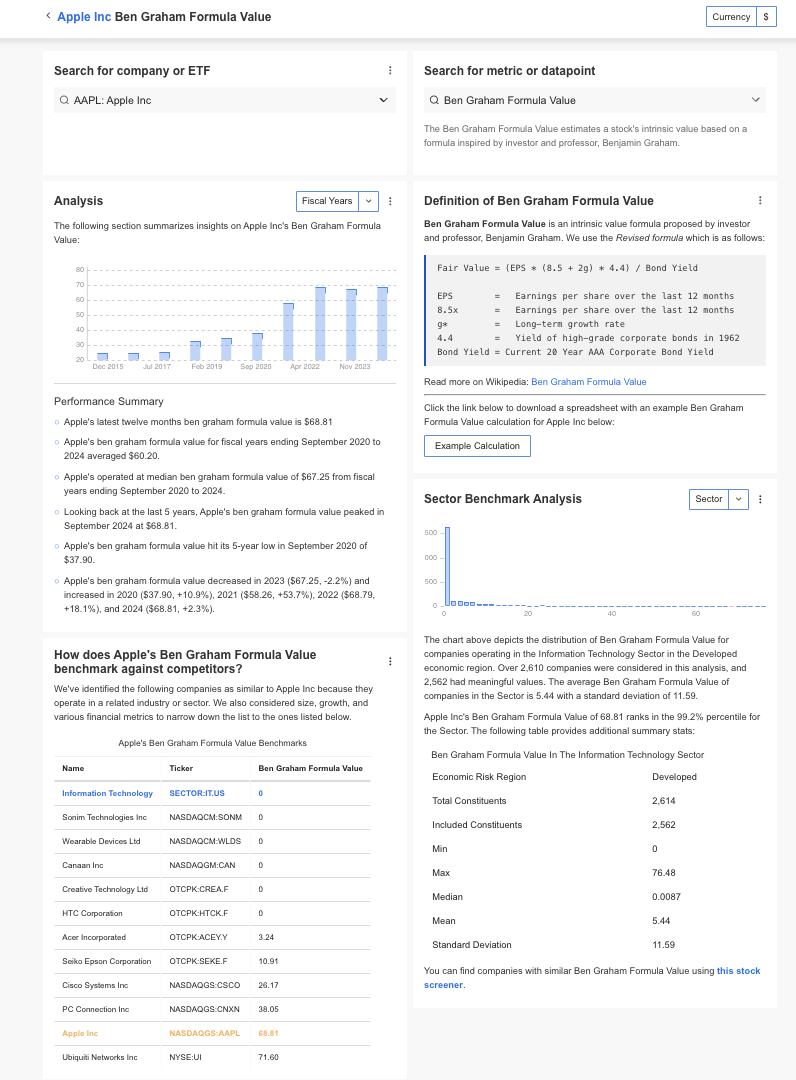
InvestingPro: Access Benjamin Graham Formula Data Instantly
Unlock Premium Data With InvestingPro 📈💸
Gain instant access to Benjamin Graham Formula data within the InvestingPro platform
🛠 Access to 1200+ additional fundamental metrics
🔍 Competitor comparison tools
📊 Evaluate stocks with 14+ proven financial models
Benjamin Graham Formula FAQs
Who Should Use the Benjamin Graham Formula?
The formula is ideal for value investors aiming to identify stocks with long-term growth potential.
How Accurate is it?
Its accuracy depends on the reliability of inputs like EPS and growth rate. It’s best used alongside other valuation methods.
Can it Be Applied to All Stocks?
It works best for stable, established companies. It may not be suitable for speculative or high-growth stocks.
What Makes the Revised Formula Better?
By factoring in bond yields, the revised formula reflects the time value of money and economic conditions.


 App Store
 Google Play