Investing.com

  • Academy Center
  • Markets
  • News
  • Analysis
  • Charts
  • Technical
  • Tools
  • Watchlist
  • Webinars
  • InvestingPro
      Academy
      • Stocks
      • Crypto
      • Trading
      • ETFs
      • Currencies
      • Analysis
      • Statistics
      • Stock Picks
      • Financial Terms
      • Global Stock Picks
      • InvestingPro 101
      • Tools

      Table of contents

      • What is Asset Efficiency?
      • How to Calculate Asset Efficiency?
      • Why is Asset Efficiency Important?
      • How to Interpret Asset Efficiency?
      • Key Factors Impacting Asset Efficiency
      • How to Find Asset Efficiency?
      • InvestingPro: Access Asset Efficiency Data Instantly
      • Asset Efficiency FAQs

      Academy Center > Analysis

      Analysis Beginner

      Asset Efficiency: Definition, Importance, Interpretation & More

      written by
      Malvika Gurung
      arrow-top

      Financial Journalism

      Financial Journalist and Content Contributor at Investing.com

      B.Tech | Jaypee University of Engineering and Technology

      • linkedin logo
      See Full Bio
      | Edited by
      Rachael Rajan
      arrow-top

      Financial Markets Copyeditor - Investing.com

      Rachael has a Bachelor’s degree in mass media from Wilson College, Mumbai and a Master’s degree in English from Pune University.

      • linkedin logo
      See Full Bio
      | updated November 21, 2024

      What is Asset Efficiency?

      Asset efficiency refers to how effectively a company uses its assets to generate revenue. This financial metric is a key indicator of a business’s operational performance, revealing how well a company is managing its resources to maximize output. Higher asset efficiency suggests that a firm is utilizing its assets more productively, which can lead to increased profitability.

      How to Calculate Asset Efficiency?

      Asset efficiency is often calculated using the following formula:

      Asset Efficiency = Revenue / Total Assets​

      This formula highlights the relationship between a company’s revenue and the total assets it has at its disposal. The higher the result, the more efficiently the company is using its assets to produce income.

      Why is Asset Efficiency Important?

      For businesses, improving asset efficiency is essential for maintaining competitiveness and profitability. A company that effectively utilizes its assets can generate more revenue without necessarily increasing its asset base. 

      This is particularly important in capital-intensive industries, where maximizing the use of available resources can lead to significant cost savings.

      Understanding asset efficiency is crucial for both companies and investors. It provides insight into how well a business is managing its resources and can be a predictor of long-term financial health. By continually improving asset efficiency, companies can increase profitability and better position themselves in a competitive market.

      How to Interpret Asset Efficiency?

      Investors closely monitor asset efficiency to assess the overall health of a company. Firms with higher asset efficiency are typically seen as more financially stable, as they can generate more income with fewer resources. This often translates into better long-term returns for shareholders.

      However, the ideal asset turnover ratio varies by industry, so it’s not meaningful to compare ratios across different sectors.

      Asset efficiency has three dimensions:

      • Asset availability: How consistently an asset is available for use
      • Asset performance: How well an asset is used when it’s available
      • Asset yield: How well an asset is used to produce results

      Key Factors Impacting Asset Efficiency

      Several factors can influence a company’s asset efficiency:

      Industry Type: Companies in sectors that require significant capital investment, such as manufacturing, often have lower asset efficiency compared to service-oriented firms.

      Technology: The use of advanced technologies can enhance asset efficiency by improving production processes, reducing downtime, and optimizing resource use.

      Management Practices: Efficient management of assets, including inventory and equipment, can lead to better asset turnover and improved financial performance.

      How to Find Asset Efficiency?

      InvestingPro offers detailed insights into companies’ Asset Efficiency including sector benchmarks and competitor analysis.
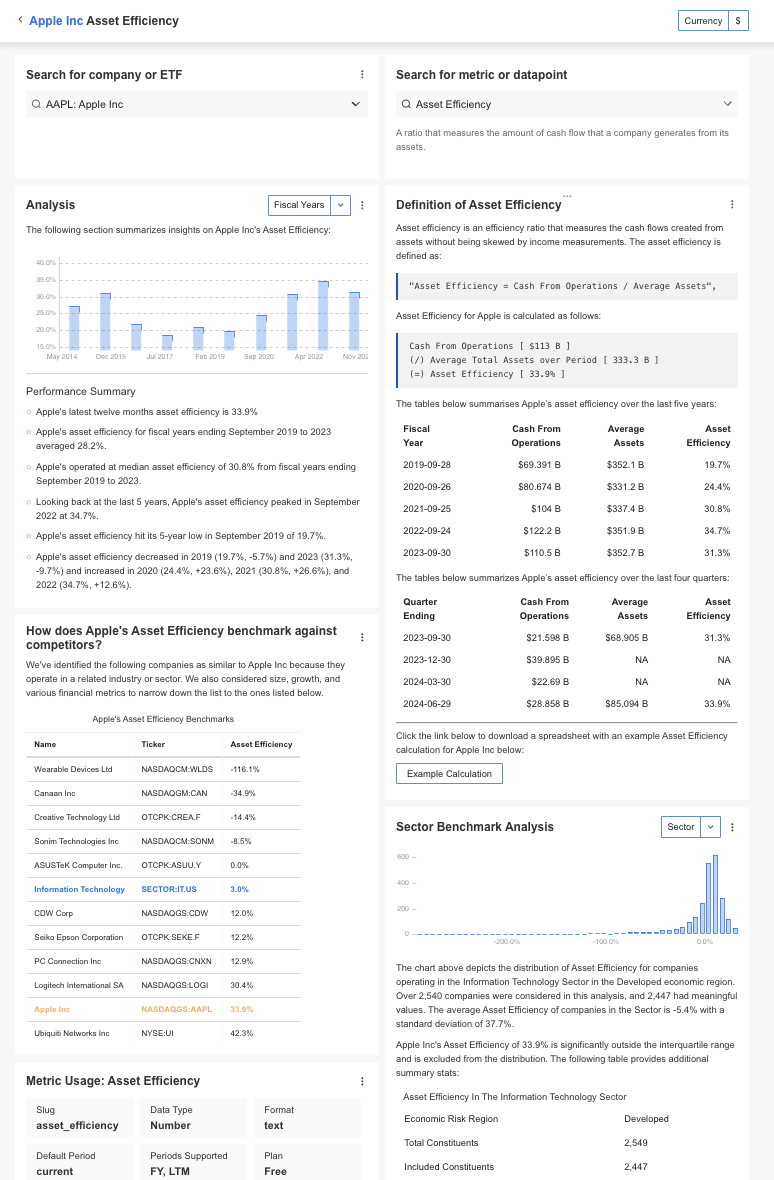
      InvestingPro: Access Asset Efficiency Data Instantly

      Unlock Premium Data With InvestingPro 📈💸

      Gain instant access to Asset Efficiency data within the InvestingPro platform

      🛠 Access to 1200+ additional fundamental metrics

      🔍 Competitor comparison tools

      📊 Evaluate stocks with 14+ proven financial models

      Outsmart the market with InvestingPro today!

      Asset Efficiency FAQs

      How is asset efficiency different from asset turnover?

      Asset efficiency and asset turnover are closely related, but asset turnover specifically measures how many times a company’s assets are turned into sales within a given period. Asset efficiency is a broader term that encompasses how effectively all assets are utilized to generate revenue.

      Why should investors care about asset efficiency?

      Investors view asset efficiency as an indicator of a company’s operational strength. A business that maximizes the use of its assets is more likely to sustain profitability and offer better returns on investment.

      How can a company improve its asset efficiency?

      A company can enhance its asset efficiency by adopting technology that optimizes production, improving inventory management, and regularly maintaining equipment to avoid downtime.

      Does higher asset efficiency always lead to better financial performance?

      While higher asset efficiency generally indicates better use of resources, it doesn’t guarantee overall financial success. Other factors, such as market conditions, competition, and cost control, also play significant roles in determining profitability.

      Is asset efficiency more important in certain industries?

      Yes, industries that rely heavily on capital investments, such as manufacturing or energy, place a higher emphasis on asset efficiency due to the significant costs associated with maintaining and operating their assets.


      Related Terms

      • What Is the Market Risk Premium? A Simple Guide for Investors
      • How to Find Value Stocks: A 4-Step Guide for the Intelligent Investor
      • What is the Capital Asset Pricing Model (CAPM)? A Complete Guide
      • How to Evaluate Quantum Computing Stocks: A Comprehensive Guide
      • What Is the Equity Multiplier? A Guide to Understanding Financial Leverage
      • How to Find Growth Stocks with Strong Fundamentals: A Practical Guide
      • How to Evaluate Cannabis Stocks: A Beginner's Guide to Technical and Fundamental Analysis
      • Cash Flow Quality: The Ultimate Guide to Finding Financially Healthy Companies
      • What Is a Dividend Reinvestment Plan (DRIP)? A Complete Guide
      • What is Technical Analysis? A Beginner's Guide to Reading the Market's Story

      Recent Articles

      How to Use Moving Averages in Stock Trading: Strategies for Entry and Exit Signals

      The stock market is a turbulent sea of constantly shifting prices, driven by news, sentiment, and volume. For new traders, the daily fluctuations can feel

      Step-by-Step Guide to Fibonacci Extensions in Stock Analysis

      For active investors, the challenge is not typically finding a good stock or an entry point; it’s knowing where to get out. When a stock

      Beginner’s Guide to Using Price Action in Stock Charts

      For many investors and traders, looking at a stock chart means navigating a confusing array of lines, squiggles, and colorful technical indicators like the RSI,

      How to Use Oscillators to Confirm Stock Trends

      As an investor, you’ve likely grappled with one of the most fundamental questions in the stock market: Is this trend real, or is it just


      Install Our Apps

      Scan the QR code or install from the link

      www.facebook.comApp Store www.twitter.comGoogle Play

      www.investing.com
      • Blog
      • Mobile
      • Portfolio
      • Widgets
      • About Us
      • Advertise
      • Help & Support
      • Authors
      Investing.com
      www.facebook.com www.twitter.com

      Risk Disclosure: Please be fully informed regarding the risks and costs associated with trading the financial markets, it is one of the riskiest investment forms possible. Currency trading on margin involves high risk, and is not suitable for all investors. Before deciding to trade foreign exchange or any other financial instrument you should carefully consider your investment objectives, level of experience, and risk appetite. Fusion Media may be compensated by the advertisers that appear on the website, based on your interaction with the advertisements or advertisers.

      Fusion Media does not endorse any product or service and does not assume any liability regarding your interaction with any third party displayed on this site, including the nature, quality, supply or fitness for a particular purpose of the product or service, or any damage caused as a result of the use of such product or service.


      © 2007-2025 Fusion Media Limited. All Rights Reserved
      • Terms And Conditions
      • Privacy Policy
      • Risk Warning
      • Do Not Sell My Information