


What is Allowance for Loan Losses?
The Allowance for Loan Losses (ALLL) is a reserve set aside by financial institutions to cover potential loan defaults or credit losses that may occur in the future. This reserve helps ensure that banks are financially prepared to absorb losses from loans that may become uncollectible.
In accounting terms, the ALLL is considered a contra-asset account, meaning it offsets the bank’s loan portfolio on its balance sheet. The purpose of this provision is to ensure that the bank’s earnings are not overstated by setting aside funds in advance to cover possible losses. The ALLL serves as a protective measure for investors, regulators, and the financial institution itself, providing a cushion for unexpected defaults.
How to Calculate Allowance for Loan Losses?
The Allowance for Loan Losses is calculated by estimating the amount of loan defaults that a bank expects to experience. This estimation is based on various factors, including historical loss data, economic conditions, and the overall health of the loan portfolio.
Here’s the basic formula for calculating the ALLL:

ALLL = Loan Losses Expected – Actual Losses Covered
In practice, the calculation involves several steps:
- Historical Loss Data: Banks typically look at historical loan defaults and losses. This helps them understand trends and anticipate future losses based on past performance.
- Risk Classification: Loans are classified based on their level of risk. Riskier loans, such as subprime or higher-interest loans, are more likely to be written off as bad debts, so they require a higher allowance.
- Economic Conditions: The bank must consider economic factors such as unemployment rates, interest rates, and regional economic performance. In a weaker economy, more loans may default, requiring a larger ALLL.
- Loan Portfolio Quality: The health and composition of the loan portfolio are crucial in determining the amount of reserve needed. Banks with a large number of risky loans will need to set aside more funds to cover potential losses.
- Provisions for Loan Losses: Banks adjust the ALLL periodically by making provisions based on updated loss estimates. This reserve is built up over time through quarterly or annual provisions.
The formula is continually updated as new data becomes available, and the reserve is adjusted accordingly. These reserves are reported in the bank’s financial statements, usually under loan loss provisions or bad debt expense.

Example Calculation of Allowance for Loan Losses
Let’s consider a practical example to understand the calculation of the Allowance for Loan Losses.
Bank XYZ has the following data:
- Total Loans: $100,000,000
- Loan Loss Provision: $2,000,000 (annual provision based on estimated loan losses)
- Historical Loss Rate: 1.5% (average historical loss rate for similar loans)
- Economic Factors: Expected downturn in the economy increases the risk of loan defaults.
Calculating Expected Loan Losses
Using the historical loss rate, we calculate the expected loan losses:
Expected Loan Losses = Total Loans × Historical Loss Rate
Expected Loan Losses = $100,000,000 × 1.5% = $1,500,000
Adjusting for Economic Conditions
Given that the economy is expected to decline, the bank increases its loss estimation by 0.5% to account for the additional risk.
Adjusted Loan Losses = $1,500,000 + $500,000 = $2,000,000
Provisions for Loan Losses
The bank sets aside the full amount of $2,000,000 as an allowance for loan losses, which will be shown as a liability on its balance sheet and as an expense on its income statement.
Why is Allowance for Loan Losses Important?
The Allowance for Loan Losses (ALLL) is a crucial financial measure for banks and other financial institutions, as it plays an essential role in risk management, financial stability, and investor confidence. Here’s why the ALLL is so important:
Risk Management
The ALLL serves as a cushion against loan defaults, which are inevitable in any lending business. By setting aside funds to cover potential losses, banks ensure that they can absorb shocks from credit risk without jeopardizing their operations or solvency.
Financial Health Indicator
The level of the ALLL provides insight into a bank’s credit risk exposure. A higher ALLL often indicates that the bank expects a higher volume of loan defaults, while a lower allowance may suggest better portfolio quality or more optimistic outlooks on loan repayments.
Regulatory Compliance
Financial regulators, such as the Federal Reserve in the U.S., require banks to maintain an appropriate level of ALLL based on the size and quality of their loan portfolio. A well-calculated ALLL ensures that a bank complies with regulatory requirements, protecting both the institution and the financial system as a whole.
Protecting Investors and Stakeholders
The ALLL directly impacts a bank’s earnings and profitability. If a bank has insufficient reserves to cover loan losses, it could face unexpected financial troubles, potentially leading to a loss of investor confidence. A well-managed ALLL shows investors that the bank is taking proactive steps to mitigate potential losses, thus safeguarding the interests of shareholders and other stakeholders.
Future Profitability
The ALLL is an essential tool for forecasting potential financial outcomes. By setting aside funds for future loan losses, banks can ensure that they don’t have to use current profits to cover defaults. This helps maintain steady profitability even when the loan portfolio experiences problems.
How to Interpret Allowance for Loan Losses?
Interpreting the Allowance for Loan Losses is essential for understanding a bank’s financial position. There are several key points to consider when analyzing the ALLL:
- High ALLL: A high ALLL might indicate that the bank has a higher number of risky or non-performing loans. It can also suggest that the bank is being cautious in its estimation of future losses, which may be a good sign of prudent risk management.
- Low ALLL: A low ALLL could indicate that the bank is underestimating the risk of loan defaults or has a healthier loan portfolio with fewer non-performing loans. However, it could also suggest that the bank is not adequately preparing for potential losses, which could be a red flag.
- Changes Over Time: Changes in the ALLL over time can provide insights into the quality of the bank’s loan portfolio and the overall economic conditions. If the reserve increases sharply, it may signal an increase in loan defaults or a tougher economic environment.
- Loan Loss Provisions: Monitoring the loan loss provisions made by the bank is crucial. An increase in provisions often signals higher expectations of loan defaults, which could reflect broader economic issues.
What is a Good Allowance for Loan Losses?
A “good” Allowance for Loan Losses is one that accurately reflects the bank’s exposure to credit risk while maintaining adequate reserves for potential loan defaults. Here are some characteristics of a healthy ALLL:
- Adequate Coverage: The ALLL should be sufficient to cover potential loan losses based on the bank’s historical loss experience and current economic conditions.
- Consistency: A bank should maintain a consistent methodology for calculating the ALLL, with appropriate adjustments based on changes in economic conditions or the loan portfolio.
- Proactive Management: A bank that actively adjusts its ALLL as part of a robust risk management strategy demonstrates good financial stewardship and preparedness for future uncertainties.
What are the Limitations of Allowance for Loan Losses?
While the Allowance for Loan Losses (ALLL) is an essential tool for managing credit risk and maintaining financial stability, it does have some limitations that investors, analysts, and financial institutions must consider:
Estimation and Subjectivity
The ALLL is based on management’s estimates, which can vary depending on assumptions and judgment calls. These estimates might not always reflect actual loan loss experiences, leading to over- or underestimation of the reserve.
Economic Uncertainty
Economic fluctuations, like recessions or changes in interest rates, are difficult to predict. The ALLL might not fully account for sudden economic shifts that can significantly impact loan defaults, making it less effective in rapidly changing conditions.
Regulatory Variances
Different accounting standards (GAAP vs. IFRS) and regulatory requirements across regions can affect how the ALLL is calculated. This creates challenges in comparing financial institutions across borders and understanding their true credit risk exposure.
Impairment Recognition Delays
Banks may delay recognizing impairment for loans showing signs of default, which can lead to the ALLL being insufficient in covering actual loan losses. Delays in impairment recognition reduce the reserve’s timeliness and effectiveness.
Impact on Profitability
Changes in the ALLL directly impact a bank’s earnings. A higher reserve can decrease profits, potentially affecting stock prices and investor sentiment. Conversely, an artificially low reserve can inflate profitability, raising concerns about financial health.
How to Find Allowance for Loan Losses?
InvestingPro offers detailed insights into companies’ Allowance for Loan Losses including sector benchmarks and competitor analysis.
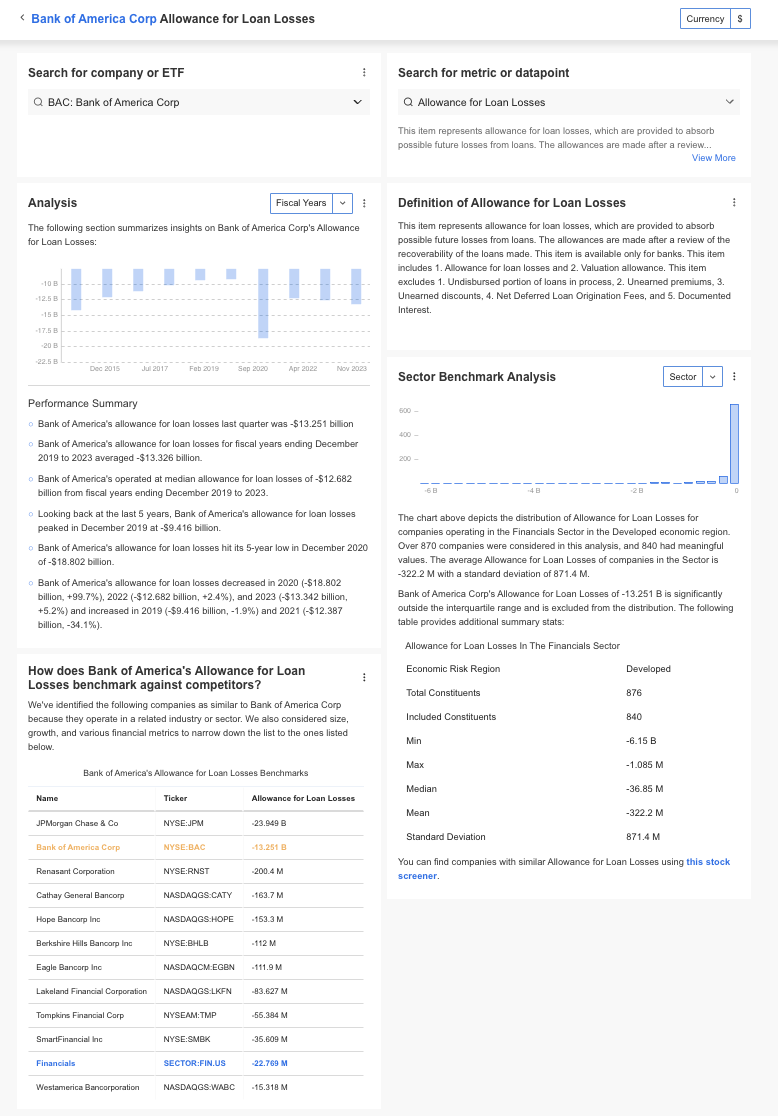
InvestingPro+: Access Allowance for Loan Losses Data Instantly
Unlock Premium Data With InvestingPro 📈💸
Gain instant access to ALLL data within the InvestingPro platform
🛠 Access to 1200+ additional fundamental metrics
🔍 Competitor comparison tools
📊 Evaluate stocks with 14+ proven financial models
Allowance for Loan Losses FAQ
What happens if the Allowance for Loan Losses is too low?
If the ALLL is too low, the bank may not have enough reserves to cover defaults, which can result in financial instability, loss of investor confidence, and potential regulatory penalties.
Can a bank release its Allowance for Loan Losses?
Yes, if loan defaults are lower than expected or the economy improves, a bank may reduce its ALLL, releasing funds back into its income statement.
How often is the Allowance for Loan Losses updated?
The ALLL is typically updated quarterly or annually, based on changes in the loan portfolio, economic conditions, and other relevant factors.
Is the Allowance for Loan Losses tax-deductible?
The allowance itself is not directly tax-deductible, but provisions for loan losses may impact a bank’s tax liabilities by reducing taxable income.
How does the Allowance for Loan Losses affect a bank’s earnings?
An increase in the ALLL can reduce a bank’s earnings, as provisions for loan losses are recorded as an expense. Conversely, a decrease in the ALLL can boost earnings.




 App Store
 Google Play