Next 6-12 months crucial for prediction platforms like Kalshi and Polymarkets

Mosaic Company (NYSE:MOS) reported strong third-quarter 2025 results on November 4, with significant year-over-year improvements across all business segments. The fertilizer producer’s stock rose 4.71% in premarket trading following the earnings release, reflecting positive investor sentiment despite a slight revenue miss.
Quarterly Performance Highlights
Mosaic delivered consolidated revenues of $3.45 billion in Q3 2025, with operating earnings of $340 million and net income of $411 million—more than tripling from $122 million in the same period last year. Adjusted EBITDA reached $806 million, up 80% from $448 million in Q3 2024.
As shown in the following consolidated results breakdown:
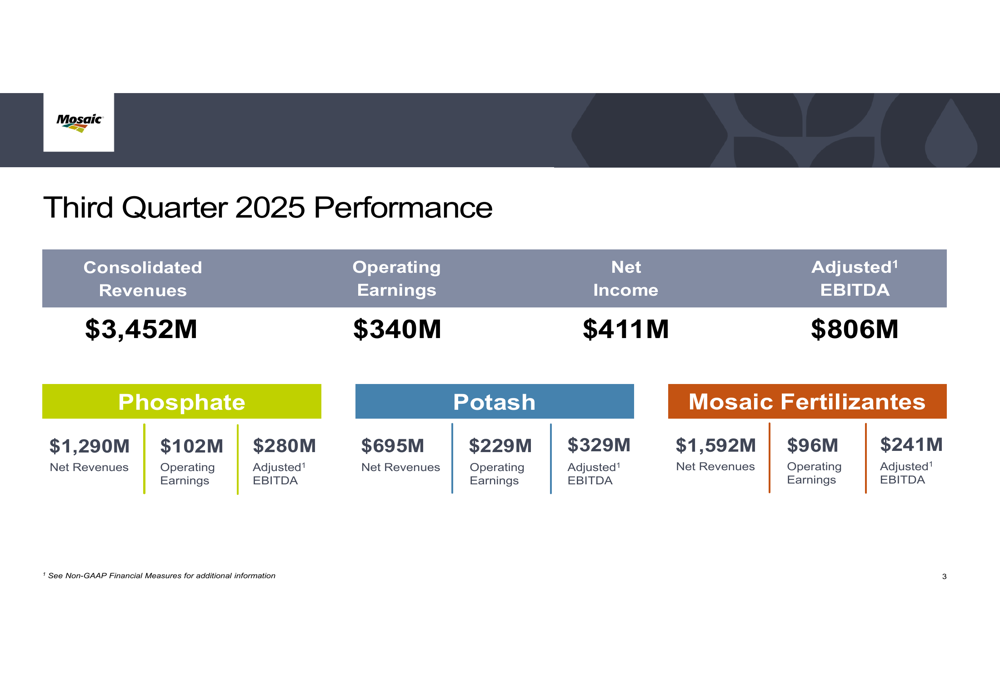
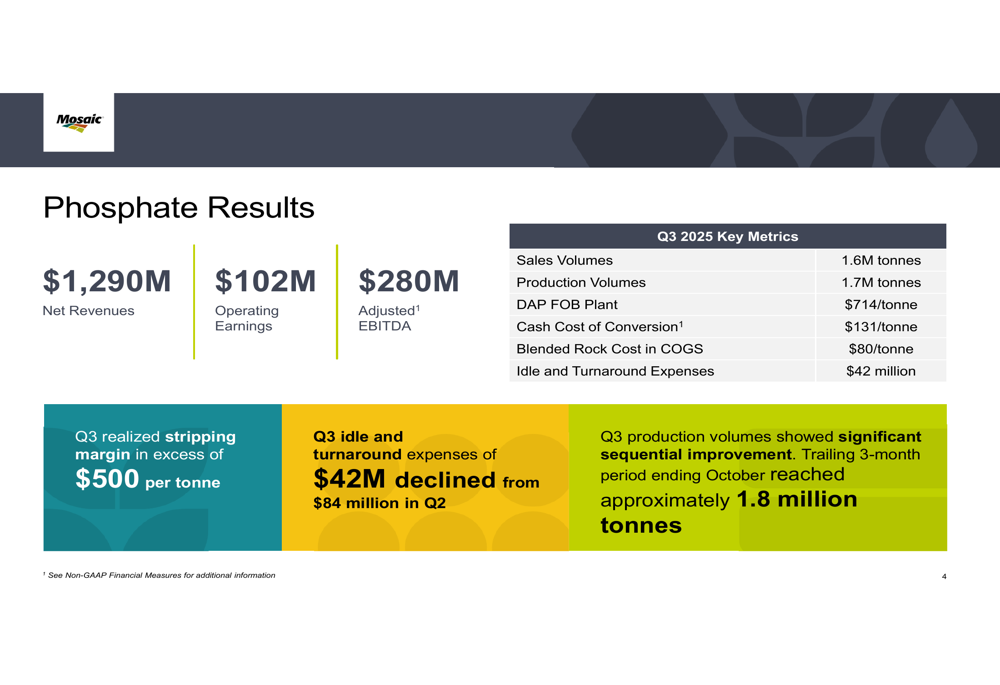
The company’s performance was driven by strong results across all three business segments. The Phosphate segment generated net revenues of $1.29 billion and adjusted EBITDA of $280 million. Key metrics included sales volumes of 1.6 million tonnes and production volumes of 1.7 million tonnes, with a DAP FOB plant price of $714 per tonne.
The detailed phosphate segment results demonstrate significant sequential improvement in production volumes:
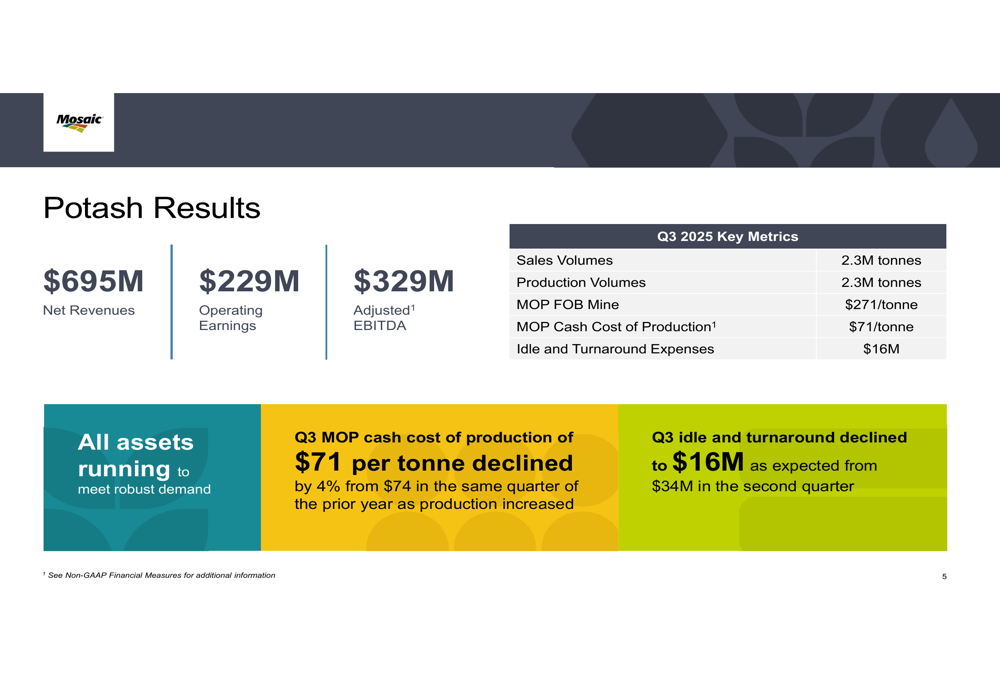
Mosaic’s Potash segment delivered net revenues of $695 million and adjusted EBITDA of $329 million. The segment reported sales and production volumes of 2.3 million tonnes each, with an MOP FOB mine price of $271 per tonne.
The following chart illustrates the potash segment’s strong performance:
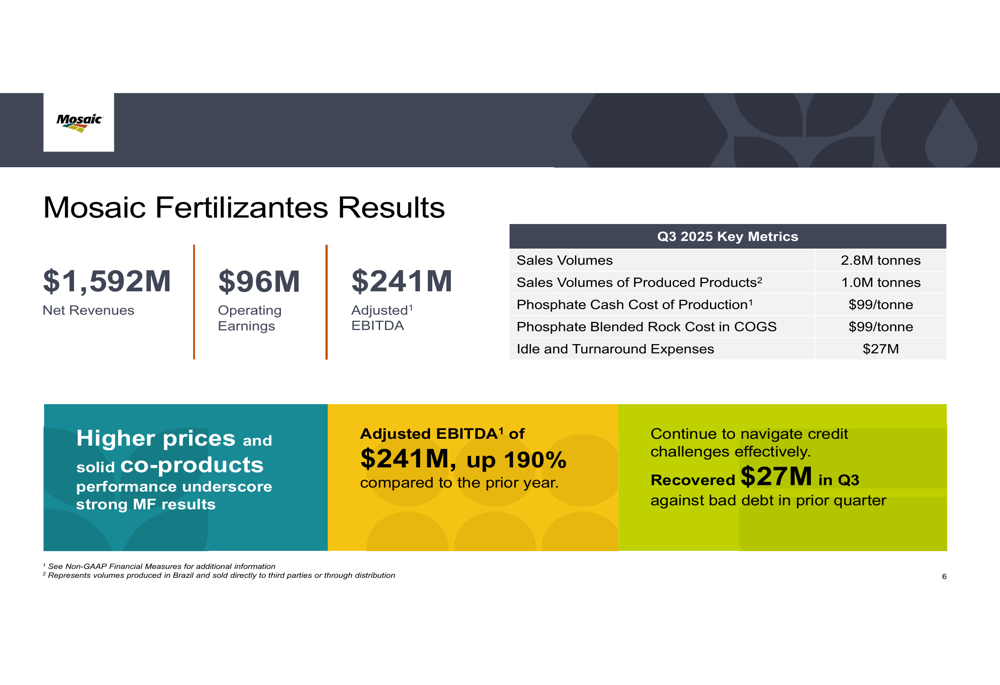
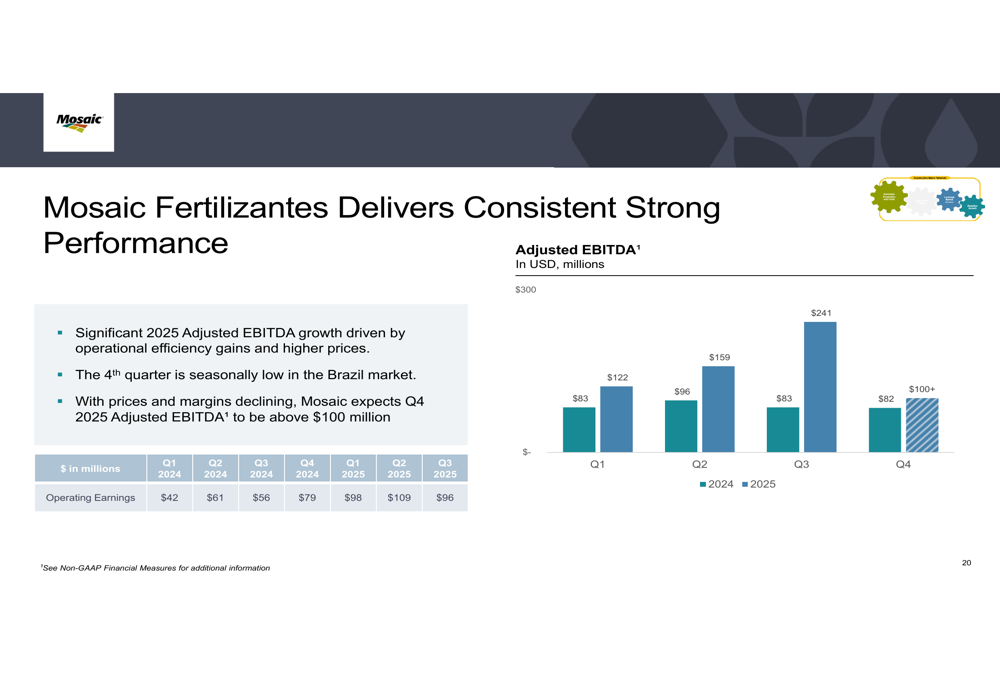
The Mosaic Fertilizantes segment showed particularly impressive growth, with net revenues of $1.59 billion and adjusted EBITDA of $241 million—up 190% compared to the prior year. Sales volumes reached 2.8 million tonnes, including 1.0 million tonnes of produced products.
The segment’s detailed results highlight its strong contribution to overall company performance:
Operational Improvements
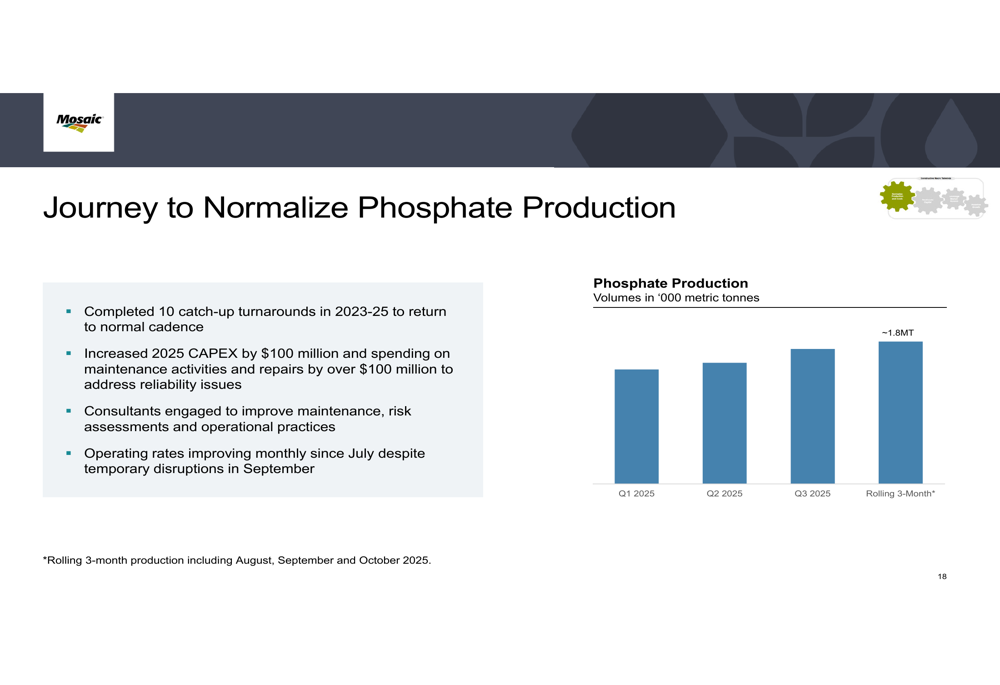
A key driver of Mosaic’s improved performance has been the company’s focus on normalizing production and reducing costs. After completing ten catch-up turnarounds between 2023-2025, phosphate production has been steadily improving, with the trailing three-month period ending October reaching approximately 1.8 million tonnes.
The following chart shows the company’s progress in normalizing phosphate production:
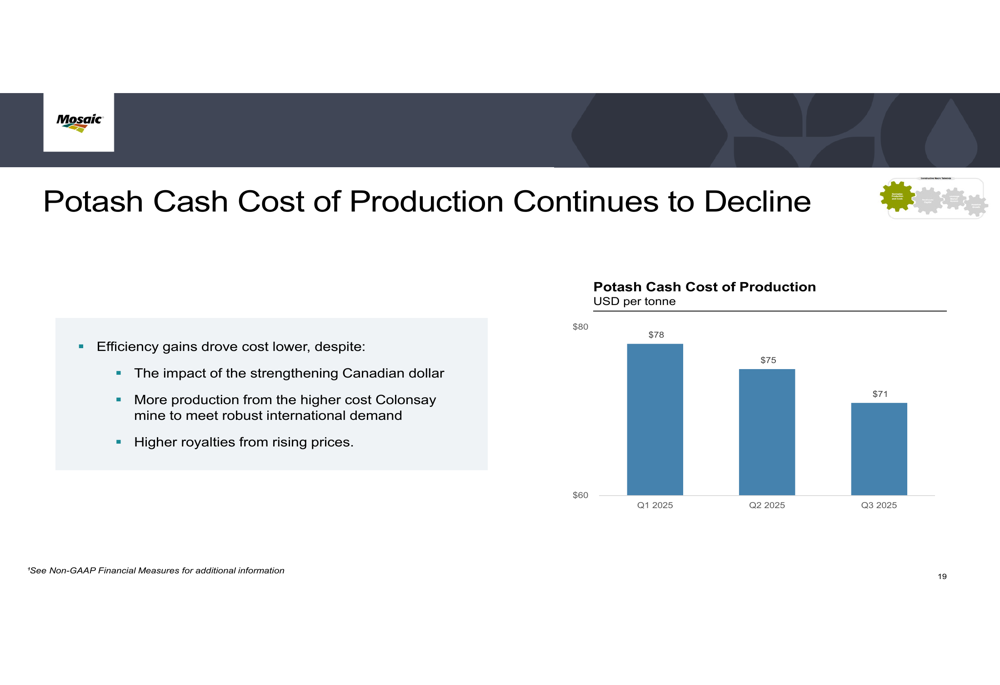
In the Potash segment, efficiency gains have driven production costs lower despite the impact of a strengthening Canadian dollar and higher royalties from rising prices. Cash cost of production decreased from $78 per tonne in Q1 2025 to $71 per tonne in Q3 2025.
As illustrated in this cost reduction trend:
Mosaic Fertilizantes has delivered consistent strong performance throughout 2025, with significant adjusted EBITDA growth driven by operational efficiency gains and higher prices. The segment recovered $27 million in Q3 against bad debt from the prior quarter.
The following chart demonstrates the segment’s consistent growth in adjusted EBITDA:
Market Dynamics
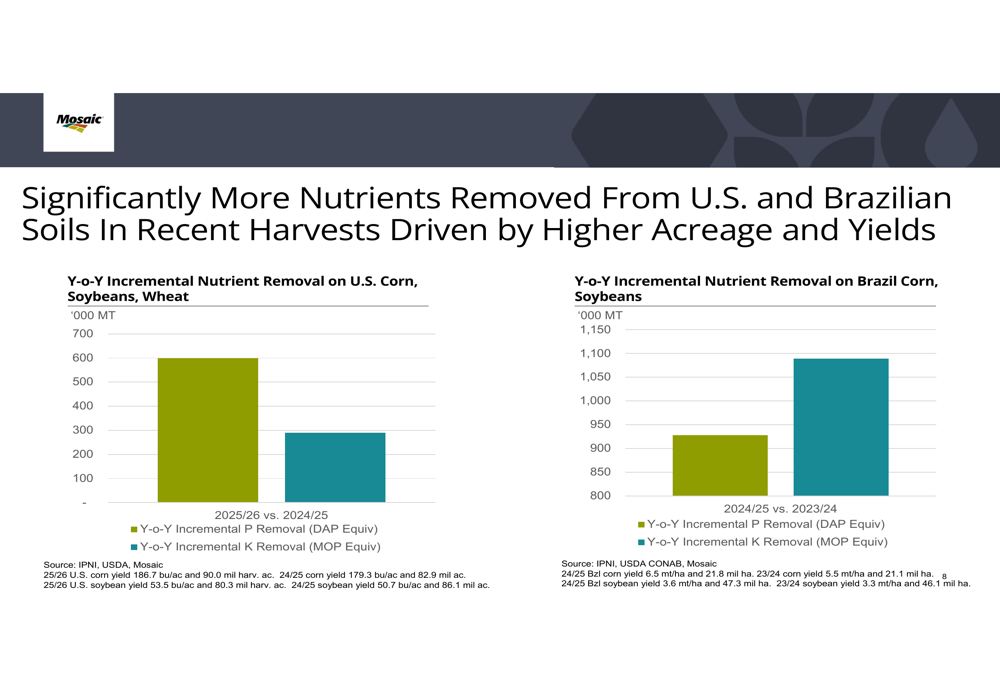
Strong global demand fundamentals are supporting Mosaic’s positive outlook. In both the U.S. and Brazil, significantly more nutrients are being removed from soils due to higher acreage and yields, driving fertilizer demand.
As shown in the following nutrient removal comparison:
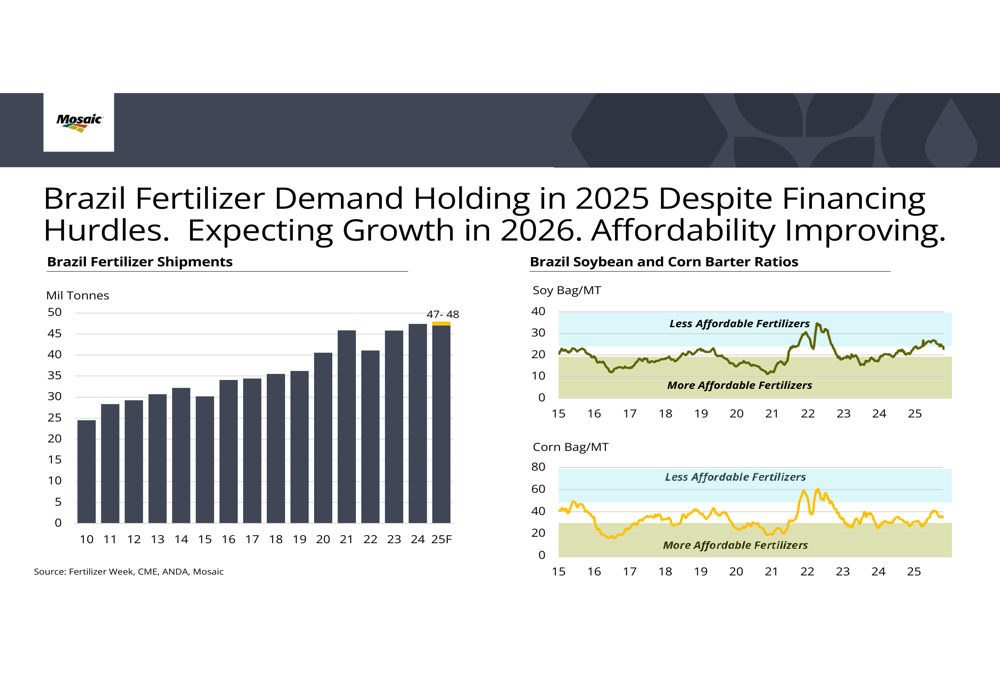
Brazil’s fertilizer demand remains robust, with shipments estimated at 47-48 million tonnes in 2025. The affordability of fertilizers for Brazilian farmers has improved, as illustrated by favorable barter ratios for both soybeans and corn.
The following chart shows Brazil’s fertilizer demand and affordability metrics:
Global phosphate demand continues to be constrained by supply, with shipments estimated at 75-77 million tonnes for 2024-2025. Meanwhile, lithium iron phosphate (LFP) production in China has already surpassed prior annual records in just the first nine months of 2025.
Asia is driving potash demand growth, with Southeast Asian markets on track for record or near-record MOP imports this year. Indonesia, Malaysia, and Thailand are all showing imports significantly above their historical averages.
Strategic Initiatives and Outlook
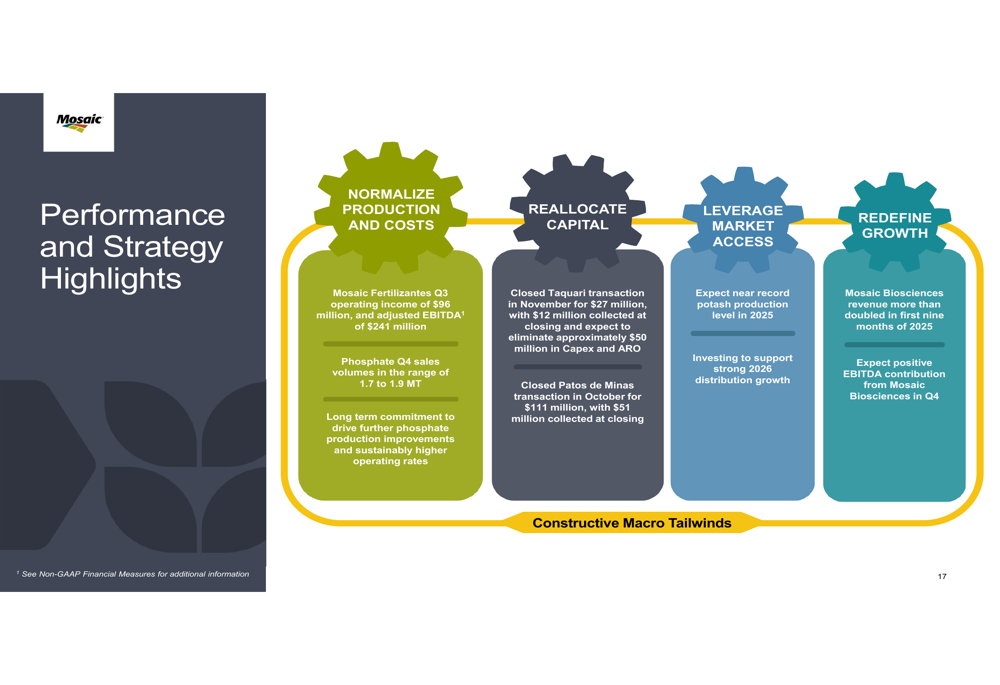
Mosaic has made progress on its capital reallocation strategy, including:
- Closing the Taquari transaction in November for $27 million
- Closing the Patos de Minas transaction in October for $111 million
- Holding approximately 111 million Ma’aden shares valued at approximately $1.9 billion as of September 30, 2025
The company’s performance and strategy highlights are summarized in the following overview:
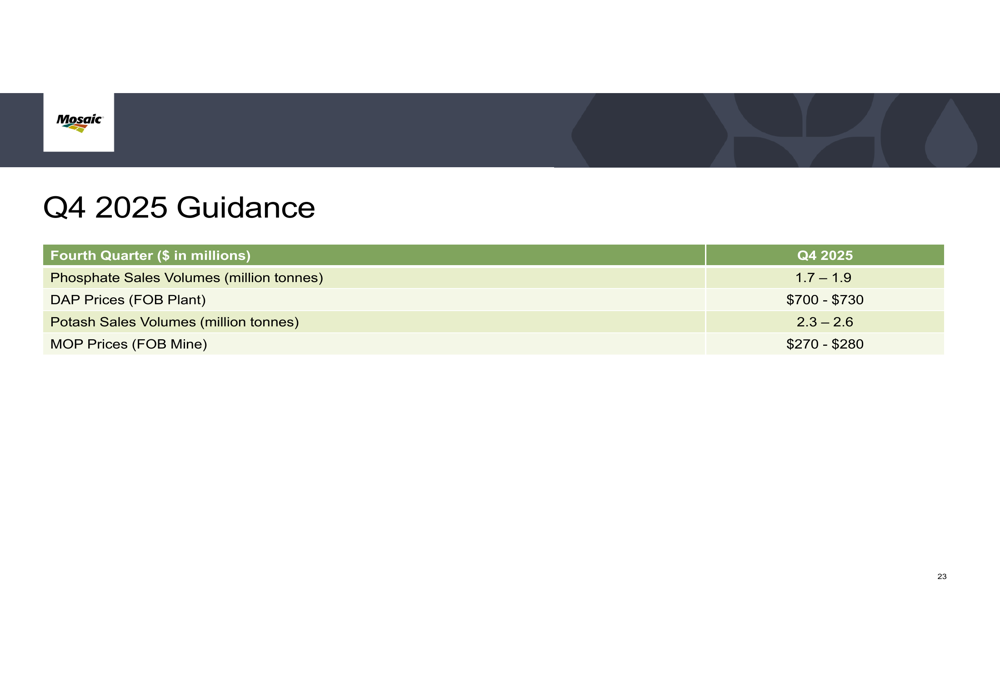
For Q4 2025, Mosaic expects phosphate sales volumes of 1.7-1.9 million tonnes and potash sales volumes of 2.3-2.6 million tonnes. DAP prices are projected at $700-$730 per tonne FOB plant, while MOP prices are expected to be $270-$280 per tonne FOB mine.
The detailed Q4 guidance is presented here:
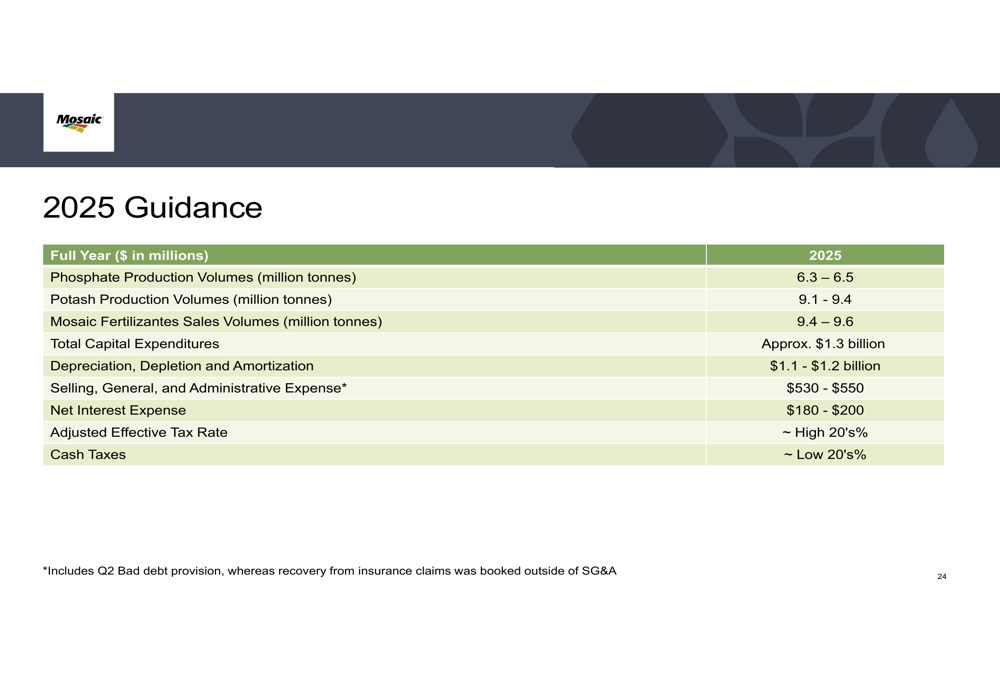
For the full year 2025, Mosaic projects phosphate production volumes of 6.3-6.5 million tonnes and potash production volumes of 9.1-9.4 million tonnes. Total capital expenditures are expected to be approximately $1.3 billion.
As shown in the company’s full-year 2025 guidance:
Forward-Looking Statements
CEO Bruce Bodine expressed confidence in the company’s outlook, stating, "We are well positioned for a strong finish to 2025 and a promising 2026 and beyond." CFO Luciano Siani-Perez emphasized the profitability of incremental production, noting, "The marginal ton earns way more than the average ton."
While the working capital increased in the first nine months of 2025, management expects this trend to reverse in future quarters as phosphate production continues to improve and inventory stabilizes.
Mosaic Biosciences represents a growing opportunity, with revenue more than doubling in the first nine months of 2025 and expectations for a positive EBITDA contribution in Q4.
With strong market fundamentals, operational improvements, and strategic capital allocation, Mosaic appears well-positioned to maintain its positive momentum through the end of 2025 and into 2026.
Full presentation:
This article was generated with the support of AI and reviewed by an editor. For more information see our T&C.