


Meme Coins Key Info 🔑 (TL;DR) ⌚
Meme coins are a cryptocurrency sub-niche that are created as a way to show community-led narratives and social commentary, rather than utility such as a store of value or technological problem-solving. They’re an incredibly volatile but still legitimate form of investment.
Meme Coins may have started out as a tongue-in-cheek addition to cryptocurrency ecosystems, but they quickly became legitimate investing vehicles. They’re volatile, highly speculative, and (sometimes) massively profitable.
If you’re crypto-curious and keep hearing about Dogecoin, Shiba Inu, or the latest political-themed token, this guide breaks down what meme coins actually are, how they differ from more traditional cryptocurrencies, and how to approach them with cautious optimism.
What Is A Meme Coin?
Let’s start with the important basics to get a real handle on how Meme Coins fit into the wider context of investment opportunities.
Definition and Origins of Meme Coins
Meme coins are a subcategory of cryptocurrencies that draw their identity from internet jokes, viral content, or community-led narratives. Rather than being built to solve a technological problem, they typically emerge from humour, irony, or social commentary. Their appeal lies less in utility (e.g. stores of value like traditional cryptocurrency) and more in culture and online communities.
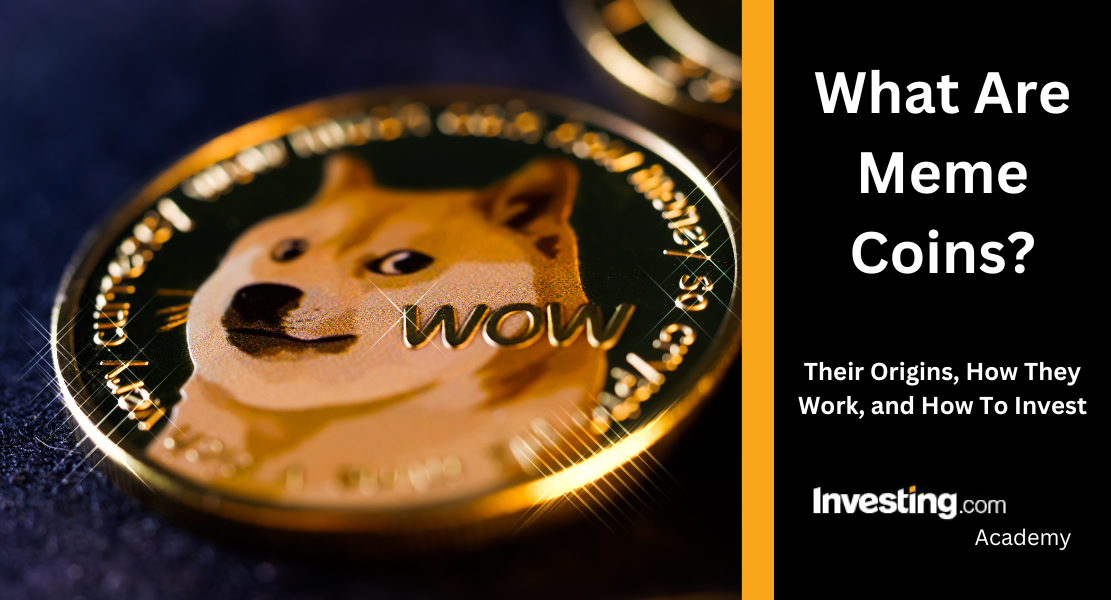
The pioneer in this space is Dogecoin. Launched in 2013 as a parody of both Bitcoin and the Doge meme, it was never meant to be taken seriously. But the internet (as always) had other plans. Over time, Dogecoin gained traction thanks to a devoted online community and a series of celebrity shoutouts. What started as satire became a multibillion-dollar asset. That unexpected success gave rise to hundreds of copycats—Shiba Inu, Pepe, Floki, and others—all chasing viral momentum.
Meme Tokens often overlap with communities like Reddit, Twitter/X and Discord, which brought us meme stocks like GameStop and AMC. In this sense, meme coins aren’t just a crypto phenomenon; they’re a cultural one.
Why Meme Coins Matter to Investors
It doesn’t matter if you’re a believer in decentralized finance or are drawn to community/social investing. Meme coins matter because they clearly show how sentiment and narrative (even on what most would consider a ‘niche’ scale) can become rapid price drivers. They’ve blurred the lines between investing, community identity, and entertainment.
Here’s why they should at least be on an investor’s radar:
- Social Virality: Their price movements are heavily influenced by online trends, meme cycles (Gen Z and older, rather than Gen Alpha), and influential endorsements. If Elon Musk has something to say about Dogecoin, investors can expect an almost immediate price reaction.
- Speculative Potential: Their incredibly low barrier to entry (most trading for pennies or less) and explosive potential attract plenty of speculative traders looking for outsized short-term gains, despite their volatility.
- Retail Appeal: As most meme coins trade at fractions of a cent, a small investment can result in the ownership of hundreds of thousands of tokens. This psychological effect feeds into the lottery-ticket mindset.
More broadly, meme coins have become a barometer for a subsection of retail investor sentiment. They can indicate where attention is flowing, which narratives are resonating online, and how the decentralized internet is shaping its own investment playground.
Find Stocks That Align With Your Personal Risk Tolerance 🔍😰
Find Stocks That Align With Your Personal Risk Tolerance: Compare high-risk Meme Coins with InvestingPro stocks showing fundamentally sound, fair-value prices with strong upside potential.
How Meme Coins Work
Underlying Technology and Tokenomics
Most meme coins don’t reinvent the wheel. Rather than building their own blockchains, they use already established ones like Ethereum (ERC-20), Binance Smart Chain (BEP-20), or Solana (SPL). This keeps the costs minimal and speed to market high.
These tokens rely on the ‘host’ chain for security, infrastructure, and functionality. That’s why it’s common for meme coin enthusiasts to use phrases like ‘wrapped’ or ‘layered’ when discussing these coins.
Meme Token Supply Numbers
Unlike Bitcoin’s ‘hard cap’ of 21 million coins, meme coins often lie in the other direction, with many of them having trillians (not a typo!) of tokens in circulation. For example:
- Pepe Coin: ~420.69 trillian total supply (and a nod to two influential meme-numbers)
- Dogecoin: No cap. Roughly 10,000 DOGE coins are minted every minute.
These numbers are significant because token price alone is meaningless without understanding how many tokens exist and how they’re likely to change over time. A coin worth just $0.0001 might still have a multi-million dollar market cap.
Some meme coins are inflationary (like DOGE, where new coins are continuously added), while others are deflationary, where they burn tokens over time to reduce their supply. Most, though, don’t follow any sort of traditional fiat monetary logic. Their existence and value is about perception (and popularity), not economics.
Meme Coin Smart Contracts & Governance
For many meme coins, smart contracts and governance practices are either barebones or completely missing. There’s no treasury, no staking and no voting rights.
Meme coins are less like tech products and more like internet-native collectibles. Some may evolve over time and build their own ecosystems and become more like their fully-fledged cryptocoin counterparts, but most won’t. And that’s a feature, not a bug.
| Coin | Blockchain Host | Total Supply | Inflationary? | Smart Contract Utility | Governance? |
|---|---|---|---|---|---|
| Dogecoin | Native (Dogecoin) | Unlimited | Yes – ~10K/min added | Minimal (no smart contract) | None |
| Shiba Inu | Ethereum (ERC-20) | 589 trillion | No – fixed post-burn | Ecosystem plans (e.g., Shibarium) | Minimal – centralised decisions |
| Pepe | Ethereum (ERC-20) | ~420.69 trillion | No – fixed supply | No utility (pure meme) | None |
| Floki | Ethereum + BNB Chain | ~10 trillion (varies by version) | Mixed – burn mechanics used | Some DeFi and NFT elements | Central team controls roadmap |
| Bonk | Solana (SPL) | ~100 trillion | No – fixed supply | Community incentives, airdrops | Loosely community-led |
The Role of Community and Hype
The real engine behind any meme coin isn’t tech—it’s attention. Social platforms like Twitter/X, Reddit, etc are where many of the biggest price movements originate. Communities form around in-jokes, shared identity, and a desire to “get involved early.” The louder the hype, the more eyes (and wallets) pile in.
Influencers (crypto-native and not) have the power to push meme coin projects into the spotlight. Viral images, NFT giveaways, airdrops, meme contests, even merch drops—these aren’t just gimmicks. They’re strategies towards market-moving events and can cause double-digit swings.
Some examples of community/hype:
- Shiba Inu launching “Shiboshis” NFTs to draw in collectors.
- Floki sponsoring sports teams and plastering its logo on the London Underground.
- Bonk dropping tokens into Solana wallets as a community-building stunt.
The point here is that traditional assets such as stocks fight for attention through earnings and fundamentals. Meme coins fight with engagement and attention.
Common Launch and Distribution Models
Behind the memes, the mechanics matter. Here’s how meme coins typically get launched and then distributed:
1. Fair Launch
No presales. No early-access wallets. Just a token made public all at once. Everyone buys in at the same time, usually via a decentralised exchange (DEX).
2. Presale or Private Sale
Some meme coins run early access rounds to raise liquidity or reward insiders. This means that early buyers often get massive discounts, meaning they can dump as soon as public trading begins. In such cases, investors should watch out for lack of vesting schedules or disproportionate token allocations.
3. Airdrops
Tokens are distributed for free — often to users holding another crypto, or just as a way to build a user base fast. It’s viral marketing in token form. An example is BONK’s infamous Solana wallet airdrop that sent prices surging in 24 hours.
4. Burns and Locked Liquidity
Some coins launch with a chunk of supply “burned” (sent to an unrecoverable wallet) to artificially reduce circulating supply. Others lock liquidity in smart contracts to try and build trust — although they often still lack fundamental security and governance.
How Meme Coin Launches Compare to ICOs
Meme coin launches often feel like (Initial Coin Offerings ICOs) — but with the formal pitch deck replaced by Pepe memes. Here are the major differences at a glance.
| Feature | ICOs | Meme Coin Launches |
|---|---|---|
| Purpose | Raise capital to fund a project/startup | Build buzz and community; less focus on funding |
| Investor Pitch | Whitepaper, roadmap, team bios | Memes, hype, sometimes anonymous devs |
| Token Sale Format | Structured pre-sale, often with price tiers | Fair launch, stealth drops, or airdrops |
| Regulatory Oversight | Increasingly subject to scrutiny (esp. in the US) | Typically none; often avoids formalities |
| Community Role | Secondary to the project goals | Primary – community is the product |
| Tech Ambition | Often involves building new platforms/protocols | Usually rides on existing chains (ERC-20, etc.) |
Pros and Cons of Investing in Meme Coins
Meme coins offer high stakes. Some investors do win big, but most don’t. While even the most informed decisions can often go awry, at least understanding the upsides and risks will better place you to know whether Meme Coins might have a place in your portfolio.
Potential Upsides
1. Outsized short-term returns
If the community suddenly expands thanks to an influencer on social media or a viral post on Reddit, prices can jump 10x, 100x, or more. It’s rare, but it happens. Just don’t confuse possible with probable.
2. Low financial barrier to entry
You can buy millions of tokens for less than $50. That creates a psychological thrill and makes the space accessible to retail investors who might feel priced out of blue-chip crypto.
3. Built-in crash course in crypto
Holding a meme coin isn’t just for fun. It teaches you how DEXs work, how wallets interact, how social sentiment drives price, and how thin the line is between fun and finance. It’s chaos, but at least it has the potential to be educational at a low cost to entry.
Significant Risks
1. Wild volatility
Prices can swing 50–100% within hours. What pumps today might crash tomorrow. And there’s often no warning. No earnings report. No red flags. Just a sudden drop followed by silence.
2. Zero intrinsic value
There’s no product. No utility. No revenue. Meme coins are priced on vibes. That makes them sensitive to sentiment and immune to fundamentals. Once the joke fades, often so does the price.
3. Rug pulls and pump-and-dumps
Some meme coins are outright scams. Devs vanish after launch. Liquidity gets drained. Early investors dump on newcomers. Transparency is low. Oversight is near-zero.
4. Liquidity traps
It’s possible to buy into these meme coins super fast, especially just after launch. But as an investor it’s important to know how viable it is to cash out when you’re ready. If volume dries up or buyers vanish, you may be stuck holding a bag with no exit.
5. Regulatory risks
As regulators tighten their grip on crypto, exchanges may delist tokens seen as non-compliant or risky. Meme coins — often anonymous and hype-fuelled — are prime targets.
Behavioural and Psychological Factors
Despite myriad differences, the psychology of meme coin ‘investment’ isn’t that different from more traditional investment in stocks — albeit with a much sharper edge.
1. FOMO is real.
When prices surge and Reddit’s buzzing, it’s easy to think you’re missing out. That’s when bad decisions get made. The flip side to this is panic selling when things dip — even though volatility is baked in.
2. Echo chambers amplify the hype.
Many meme coin communities discourage scepticism. Everyone’s “going to the moon”… until they aren’t. Herd thinking leads to overexposure and blind spots.
3. Discipline is your only edge.
Speculative assets test your psychology. Smart investors set boundaries: how much to invest, when to exit, and what they’re willing to lose. Treat it like a trade, not a belief system.
Use The InvestingPro Stock Screener To Outsmart The Market! 🛠️📈
Discover how our AI can help balance speculative positions with stable, fair-value stock picks.
Gain instant access to over 1,200 fundamental metrics for thousands of listed companies. Plus:
🔎 Competitor comparison tools
🛠️ Evaluate stocks with 14+ proven financial models
🔮 Copy stock picks and weightings from top investors (including Warren Buffett)
📊 Use filters to find stocks that perfectly match your strategy
Strengthen Your Returns By Using InvestingPro’s AI Outperformance Stock Picker!
Biggest Meme Coins by Market Cap
The biggest meme coins aren’t just the loudest – they’re the ones that managed to stay loud for longer than a few weeks. While their fundamentals may be thin, their price action, communities, and media presence have shaped how this segment of crypto works.
Here’s a look at the current leaders by market capitalization.
| Coin | Market Cap | Blockchain | Notable Traits |
|---|---|---|---|
| Dogecoin (DOGE) | ~$28.8B | Native Dogecoin chain | Oldest meme coin; inflationary; boosted by Elon Musk. |
| Shiba Inu (SHIB) | ~$7.5B | Ethereum (ERC-20) | Vast supply; attempts at utility (Shibarium, NFTs). |
| Pepe (PEPE) | ~$4.9B | Ethereum (ERC-20) | Ultra-meme-heavy; no roadmap; pure sentiment play. |
| TrumpCoin ($TRUMP) | ~$2.2B | Ethereum (ERC-20) | Political meme coin; price tied to election cycles. |
| Bonk (BONK) | ~$1.3B | Solana (SPL) | Community-led; launched via mass airdrop. |
* Data correct as of June 25th, 2025
While the top five dominate market cap rankings, new meme coins rise fast (and fall even faster). Coins like Floki, WIF (dogwifhat), and Jeo Boden (yes, that’s a real ‘typo on purpose’ of Joe Biden’s name) have all had brief moments of glory.
The meme coin leaderboard churns constantly. Hype peaks usually last days, not months. Today’s top gainer could be tomorrow’s forgotten punchline.
How to Invest in Meme Coins Safely
Speculative doesn’t have to mean reckless. If you decide to take a calculated punt on meme coins, these are the core practices that can help you protect your downside while staying realistic about the upside.
Use Trusted Platforms and Wallets
Start with security. Meme coins often live on decentralized exchanges (DEXs) like Uniswap or PancakeSwap. These platforms offer early access, but no safety net. Centralized exchanges (CEXs) like Binance or Coinbase may list only the bigger names, but they come with added protections and easier fiat on-ramps.
Before buying, check:
- Token contract address from an official source (don’t trust random social media links).
- Market cap vs. total supply to understand how diluted your investment is.
- Liquidity pool size on DEXs like Uniswap or PancakeSwap. If liquidity is low, you may not be able to sell when you want.
If a huge percentage of the token supply is held in a single wallet (often by a developer or influencer), it could signal a ‘dump’ plan on their part.
Use trusted wallets:
- Hardware wallets (e.g., Ledger, Trezor) are best for long-term holds.
- Hot wallets (e.g., MetaMask, Trust Wallet) are convenient for trading, but make sure they’re set up securely.
Phishing is a real risk in meme coin territory. Always double-check contract addresses on block explorers (like Etherscan) and only use official project links. Never blindly trust shortcuts posted by anonymous social media accounts.
Position Sizing and Risk Management
Meme coins are not retirement vehicles, so only invest what you’re willing to lose entirely.
- Keep exposure small. Typically 1–5% of your portfolio at most. Think of it as tuition: enough to learn from, not enough to sink you.
- Set clear entry and exit points. If your coin doubles, are you taking profit? If it halves, are you cutting losses? Write the plan before you buy.
- Avoid chasing pumps. Most price surges are short-lived, and buying late means you’re likely someone else’s exit. Dollar-cost averaging can help smooth volatility, but for meme coins, a lump sum (within your risk limits) and a fixed plan is often cleaner.
Monitoring and Exit Strategies
The speed at which meme coins move means passive investing doesn’t work here. Stay alert.
- Set price alerts.
- Watch community sentiment on platforms like Twitter/X, Discord, and Telegram—when meme velocity slows, price usually follows. Know your exit.
- Set a profit-taking ladder (e.g., sell 25% at 2x, 25% at 5x) and a maximum loss threshold (e.g., 50% drawdown) and stick to it.
- Track everything. Every trade, every swap. Tax laws vary by region, but most consider crypto taxable. Don’t get caught out—use a tracker or speak to a tax professional.
Post-Investment Actions
Buying the token is just the beginning. Meme coin relevance changes quickly, so:
- Review updates regularly. Has the dev team gone silent? Has the meme moved on?
- Avoid trading on emotion. Hype and fear will both tempt you to ignore your strategy – don’t let them.
- Consider rebalancing gains. If a meme coin moons, move profits into more stable assets (like undervalued stocks or ETFs). That’s how short-term risk funds long-term resilience.
Comparing Meme Coins to Fair Value Stocks
Fair value stocks are companies trading below what they’re actually worth, based on hard fundamentals like earnings, free cash flow, and asset value. Think of it as buying $1 of value for 70c. These stocks tend to come with:
- Lower volatility
- Predictable income (e.g., dividends)
- Defined business models with actual customers, cash flow, and regulatory clarity
By contrast, Meme Coins are sentiment-driven assets. There are no balance sheets. No earnings calls. Just charts, social posts, and community mood swings. That makes them exciting, but also fragile.
Smart investors don’t try to pick sides. They build a core portfolio around fundamentals and then carve out a small, contained slice for speculation. That way, high-risk assets (like meme coins) don’t derail the entire strategy.
Using InvestingPro for Balance
This is where tools like InvestingPro come in.
If your crypto wallet just caught a lucky pump, what’s next? You could let it ride and risk a full reversal… or you could use that momentum to strengthen the foundation of your portfolio.
InvestingPro’s AI-driven ProPicks can help you:
- Reallocate profits into undervalued equities that match your risk profile and financial goals
- Find stocks trading below fair value with clear potential upside and proven fundamentals
- Set automated alerts to track equity performance (so you’re not glued to screens all day)
It’s about turning emotional wins into rational gains: convert speculative success into sustainable growth.
Wrapping Up
Meme coins are a legitimate (if volatile) feature of modern investing. Driven by community, humour, and hype rather than fundamentals, they offer massive upside and equally massive risk.
They are not investments in the traditional sense. They are speculative trades that live and die on attention. No revenue, no product, no roadmap — just a token, a meme, and a moment.
That doesn’t mean that interested investors have to avoid them entirely. It means it’s important to approach them with a plan:
- Allocate only what you can afford to lose
- Use trusted platforms and secure wallets
- Set entry and exit points before emotion takes over
- Track your positions and know when to move gains into more stable assets
Fair-value stocks, by contrast, are where fundamentals take the lead. They’re grounded in cash flow, earnings, and business viability. Which are ideal for building wealth over the long term.
With the right tools, you don’t have to choose one or the other. InvestingPro’s AI can help you balance high-risk plays with evidence-based investing, suggesting undervalued equities aligned with your risk profile while keeping an eye on your entire portfolio… including crypto.

Meme Coin Frequently Asked Questions
Are meme coins a scam?
Meme coins aren’t inherently scams, but many lack transparency or long-term viability. Some are community-driven projects with speculative potential; others are pump-and-dump schemes. Due diligence is always vital, and if you’re uncertain, it’s best to walk away.
How do I evaluate when a meme coin is worth investing in?
Check the token’s smart contract (via Etherscan or similar), distribution (who owns how much), liquidity, developer activity, and community sentiment. No fundamentals? It’s pure speculation – treat it accordingly.
What risks should I be aware of when investing in meme coins?
Expect extreme volatility, poor liquidity, anonymous dev teams, rug pulls, and shifting regulations. Prices can drop 90%+ overnight. If that’s not acceptable, stay out.
How much of my portfolio should I allocate to meme coins?
For most investors, 1–5% of total capital is the upper limit. Only use funds you can afford to lose entirely, and never touch your core investments to fund meme coin trades.
How can I buy and store meme coins safely?
Use trusted decentralised exchanges (Uniswap, PancakeSwap) or regulated CEXs (if listed). Store coins in a reputable wallet—hot wallets for active trading, hardware wallets for longer-term storage.
What are common red flags indicating a meme coin might be a rug pull?
Watch for: anonymous developers, no locked liquidity, large insider holdings, no public roadmap, and hype-only marketing. If the token’s only selling point is “going to the moon,” it’s likely going nowhere.
Can meme coins have real utility or long-term potential?
Some attempt to build ecosystems (e.g., Shiba Inu with NFTs and DeFi tools), but most lack durable utility. If you’re looking for tech innovation or sustainable value, focus elsewhere.
How do I decide when to sell a meme coin?
Have a predefined exit plan. This can be a set profit target, a % stop-loss, or a timeframe. Don’t wait for signals from the community. Decide in advance and stick to it.
What are safer alternatives to meme coin investing?
Fair-value stocks, diversified index funds, or dividend-paying blue chips offer long-term growth with real fundamentals. Platforms like InvestingPro help surface undervalued equities tailored to your goals.
What is the difference between meme coins and altcoins?
Altcoins are any crypto asset that isn’t Bitcoin. Meme coins are a subset—built on viral culture, not utility. Most altcoins aim to solve technical problems; meme coins aim to trend.
Why do meme coins have such high total supply numbers?
High token counts (trillions+) are mainly psychological—they make the coin feel “cheap” and accessible. But the real metric to watch is market cap, not price per token.
Are meme coins affected by regulation?
Yes. While meme coins are decentralised, regulatory crackdowns on exchanges or advertising can limit access and impact liquidity. Always keep up with evolving rules in your region.
Which meme coin has the highest market cap?
As of mid-2025, Dogecoin remains the leader in meme coin market cap, followed by Shiba Inu and PEPE. Rankings can change quickly due to hype cycles.
Can I use AI to analyze meme coins?
AI tools (like InvestingPro) are better suited to assets with fundamentals. For meme coins, use AI to track sentiment, volume patterns, or manage portfolio balance—not to predict meme virality.


 App Store
 Google Play