


What is Total Current Assets?
Total Current Assets refers to the sum of all assets that a company expects to convert into cash, sell, or consume within one year or within its normal operating cycle. These assets are crucial for assessing a company’s ability to meet its short-term obligations, such as paying off debts and covering operational expenses.
Current assets are typically listed on a company’s balance sheet and can include a variety of financial instruments, ranging from cash and accounts receivable to inventories and short-term investments. The classification of assets as “current” is determined by their liquidity — essentially, how easily they can be converted into cash within a short period.
How to Calculate Total Current Assets?
Calculating total current assets is straightforward. The general formula is:

Total Current Assets = Cash and Cash Equivalents + Accounts Receivable + Inventory + Other Short-term Assets
In this formula,
- Cash and Cash Equivalents: This includes the money a company holds in hand or in the bank, and any highly liquid investments that can be easily converted into cash.
- Accounts Receivable: This represents the money owed to a company by its customers for goods or services already delivered.
- Inventory: This refers to the goods and raw materials a company holds that are intended for sale or used in production.
- Other Short-term Assets: This category includes other current assets such as short-term investments, prepaid expenses, and other assets that are expected to be converted into cash within a year.
Once you sum up these components, you get the total current assets for a company, which is a key figure for evaluating its short-term financial health.

Example Calculation of Total Current Assets
To understand the concept more clearly, let’s consider an example:
- Cash and Cash Equivalents: $50,000
- Accounts Receivable: $30,000
- Inventory: $70,000
- Other Short-term Assets: $10,000
Now, using the formula:
Total Current Assets = 50,000 + 30,000 + 70,000 + 10,000 = 160,000
So, the total current assets of this company would be $160,000.
This calculation shows that the company has $160,000 in assets that are expected to be converted into cash or consumed within one year. These assets will help the company fulfill its short-term obligations and manage day-to-day operations.
Why is Total Current Assets Important?
Total current assets play a critical role in evaluating a company’s short-term financial health and its ability to meet immediate financial obligations. These assets are essential for assessing liquidity, operational efficiency, and financial stability. Let’s explore the key reasons why total current assets are so important:
Liquidity Assessment
Total current assets are essential for determining a company’s liquidity — its ability to cover short-term liabilities with assets that are easily convertible to cash. A healthy level of current assets ensures that a company can meet its day-to-day operational needs and financial obligations without resorting to long-term debt.
Working Capital Calculation
Working capital is calculated by subtracting current liabilities from total current assets. A positive working capital indicates that a company can cover its short-term debts, while a negative working capital suggests potential liquidity issues. Monitoring total current assets helps businesses ensure that they maintain an adequate level of working capital.
Creditworthiness
Lenders and investors often look at a company’s total current assets when evaluating its creditworthiness. If a company has a strong base of current assets, it is seen as more likely to be able to repay its short-term debt, making it an attractive borrower or investment opportunity.
Cash Flow Management
Managing total current assets is a key part of a company’s cash flow strategy. If a company’s current assets are growing at a healthy rate, it suggests that the company has enough liquidity to fund its operations and potentially invest in future growth opportunities.
Performance Monitoring
Total current assets can be used to monitor how well a company is managing its short-term assets over time. A significant increase or decrease in this figure could indicate changes in operational efficiency, customer payment behaviors, or inventory management practices.
How to Interpret Total Current Assets?
Interpreting total current assets requires looking at them in context with a company’s current liabilities. For example:
- Strong Liquidity: If total current assets are significantly higher than current liabilities, it suggests that the company is in a good position to meet its short-term obligations. This is generally a positive sign for investors, creditors, and other stakeholders.
- Liquidity Problems: If total current assets are low or if they are close to current liabilities, it might indicate that the company is struggling to maintain sufficient liquidity. This could be a warning sign that the company might face difficulties in covering its short-term debts and operational needs.
- Growth and Operational Efficiency: A growing amount of total current assets might indicate that the company is expanding its operations, receiving more payments from customers, or investing in more inventory to meet demand. However, too much growth in current assets could suggest inefficiencies in managing working capital, such as excess inventory or slow customer payments.
What is Good Total Current Assets?
A good level of total current assets varies depending on the size, industry, and business model of a company. However, the key is that these assets should be enough to cover the company’s short-term obligations and provide liquidity for day-to-day operations.
Generally, a higher total current assets figure compared to current liabilities is seen as positive, but excessive current assets can also signal inefficiencies, such as too much tied up in inventory or accounts receivable. It’s important to strike a balance and manage current assets efficiently.
Limitations of Total Current Assets
While total current assets are an important measure of a company’s financial health, they do have certain limitations that can affect how they are interpreted and used. These limitations stem from factors like asset liquidity, industry differences, and the potential for manipulation in financial reporting. Below are some key limitations of total current assets:
Subject to Interpretation of Liquidity
Not all current assets are equally liquid. For instance, while cash is immediately available, inventory or accounts receivable may take time to convert into cash. So, simply looking at the total current assets figure may give a misleading sense of a company’s liquidity.
Dependence on Industry
The composition of current assets can vary significantly across industries. For example, manufacturing companies may have large inventories, while service-based companies may have less. A high inventory figure might not always be a sign of financial health; it could indicate poor inventory management.
Changes in Accounting Practices
Different accounting methods, such as the choice of inventory valuation (FIFO vs. LIFO), can impact the calculation of total current assets. This can make cross-company comparisons challenging without adjusting for these differences.
Not Always Reflective of Cash Flow
While total current assets give a snapshot of a company’s financial position, they don’t necessarily indicate cash flow. A company might have high current assets but still face cash flow problems if it is unable to quickly convert its assets into cash.
How to Find Total Current Assets?
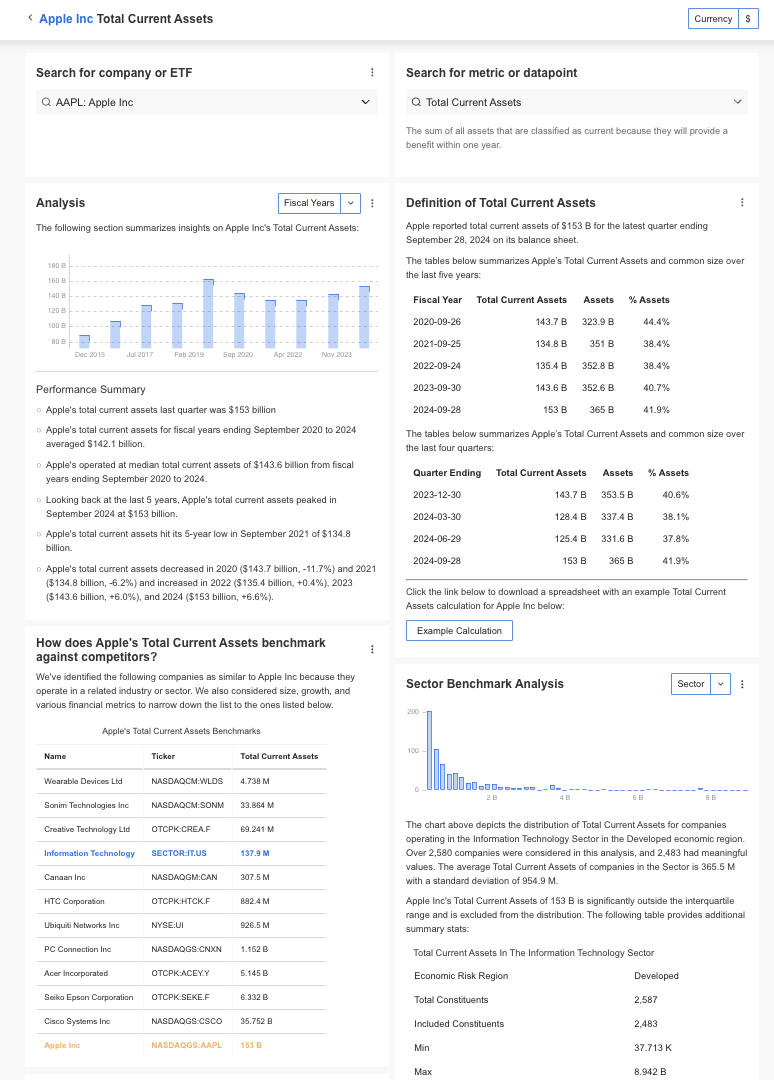
InvestingPro offers detailed insights into companies’ Total Current Assets including sector benchmarks and competitor analysis.
InvestingPro+: Access Total Current Assets Data Instantly
Unlock Premium Data With InvestingPro 📈💸
Gain instant access to Total Current Assets data within the InvestingPro platform
🛠 Access to 1200+ additional fundamental metrics
🔍 Competitor comparison tools
📊 Evaluate stocks with 14+ proven financial models
Total Current Assets FAQ
How do total current assets relate to current liabilities?
Total current assets are compared to current liabilities to calculate working capital. If total current assets exceed current liabilities, the company is likely able to meet its short-term financial obligations.
Can a company have high total current assets and still face liquidity problems?
Yes, if the company’s current assets include large amounts of inventory or receivables that are difficult to convert into cash quickly, it could still face liquidity issues despite having a high total of current assets.
What happens if total current assets are low?
If total current assets are low, it may indicate that a company is struggling to meet its short-term obligations. This could be a warning sign of financial distress or inefficiency in asset management.
How can companies improve their total current assets?
Companies can improve total current assets by increasing cash reserves, improving inventory turnover, or reducing outstanding receivables through better credit control and collection practices.
Are total current assets the same for all companies?
No, total current assets vary by industry. A manufacturing company might have a higher inventory balance, while a tech company might have more cash and receivables. Understanding industry norms is crucial for interpreting the figure accurately.




 App Store
 Google Play