


What is Net Change in Cash?
Net change in cash represents the difference in a company’s cash balance from one accounting period to the next. It’s a crucial figure found in the cash flow statement, giving insight into whether a company’s cash reserves have increased or decreased over a specific period.
This metric helps investors evaluate a company’s liquidity, financial health, and ability to cover obligations or invest in growth.
How to Calculate Net Change in Cash?
The formula for net change in cash is straightforward:

Net Change in Cash = Ending Cash Balance − Beginning Cash Balance
This figure is typically derived from the cash flow statement, which is divided into three main components:
- Operating Activities: Cash generated from the company’s core business operations.
- Investing Activities: Cash flow related to investments in assets or securities.
- Financing Activities: Cash transactions involving equity, dividends, or debt.
Each of these sections contributes to the net change in cash.

Example Calculation of Net Change in Cash
To illustrate how net change in cash works, let’s look at the financials of XYZ Corporation for fiscal year 2023.
At the beginning of the year, XYZ had $18.5 billion in cash. During the year, the company generated $85.3 billion from its core operating activities, a strong indicator of its business efficiency. It also saw a cash inflow of $2.8 billion from its investments, reflecting its investment strategy. However, the company used $79.6 billion in financing activities, primarily for debt repayment and stock buybacks, which impacted the cash reserves.
In total, XYZ’s cash balance rose by $8.5 billion, calculated by subtracting the outflows from financing activities from the combined inflows from operations and investments. The company closed the fiscal year with a total of $27 billion in cash and cash equivalents.
Calculation Summary:
- Beginning Cash Balance (2023): $18.5 billion
- Cash from Operating Activities: $85.3 billion
- Cash from Investing Activities: $2.8 billion
- Cash Used in Financing Activities: -$79.6 billion
- Net Change in Cash: +$8.5 billion
- Ending Cash Balance (2023): $27 billion
This example highlights how net change in cash reflects the overall cash movements within a company, helping investors evaluate its liquidity and financial management.
Why is Net Change in Cash Important?
Net change in cash is a critical indicator for investors because it highlights how well a company manages its cash inflows and outflows.
A positive net change suggests the company has increased its cash reserves, which may point to efficient operations, successful investments, or effective financing strategies. Conversely, a negative net change could signal issues such as declining sales, poor investment performance, or increased debt, which may warrant further investigation.
How to Interpret the Net Change in Cash?
Interpreting net change in cash requires analyzing the source of the cash movements. For instance:
- Positive net cash from operating activities generally indicates healthy business performance, suggesting that the company’s core operations generate more cash than they consume.
- Negative net cash from investing activities may signal that the company is expanding, perhaps by acquiring new assets, which could be a good sign depending on long-term goals.
Cash flows from financing activities give insights into how a company is raising capital, either through equity issuance or taking on more debt.
Key Factors Influencing Net Change in Cash
Several factors can affect a company’s net change in cash:
Profitability: A highly profitable company is likely to see a positive cash flow from operations, leading to an increase in cash reserves.
Capital Expenditures (CapEx): Significant spending on new equipment or facilities can reduce cash balances, even if the long-term goal is growth.
Debt Management: Paying down debt reduces cash, but can strengthen a company’s financial standing by lowering liabilities.
Dividend Payments: Companies that regularly pay dividends to shareholders may experience a reduction in their cash reserves, impacting the net change in cash.
How to Find Net Change in Cash?
InvestingPro offers detailed insights into companies’ Net Change in Cash including sector benchmarks and competitor analysis.
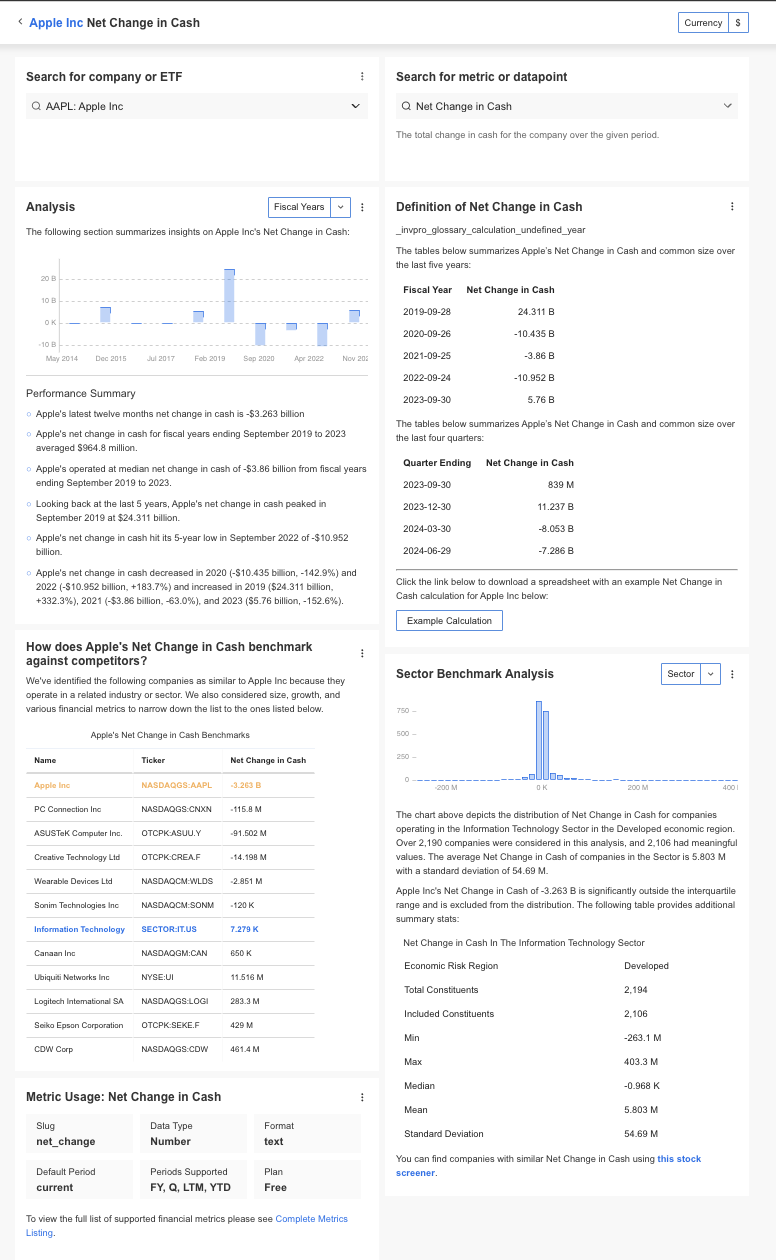
InvestingPro: Access Net Change in Cash Data Instantly
Unlock Premium Data With InvestingPro 📈💸
Gain instant access to Net Change in Cash data within the InvestingPro platform
✓ Access to 1200+ additional fundamental metrics
✓ Competitor comparison tools
✓ Evaluate stocks with 14+ proven financial models
Net Change in Cash FAQs
How is net change in cash different from net income?
Net income is the profit a company earns after all expenses, while net change in cash reflects the actual movement of cash in and out of the business. A company can be profitable but still face a negative net change in cash if large investments or debt repayments were made during the period.
Can a company have a negative net change in cash and still be successful?
Yes, a negative net change in cash can occur even if the company is expanding or investing heavily. It’s important to look at the reasons behind the decrease in cash to fully assess the company’s financial health.
How often is net change in cash calculated?
Net change in cash is typically calculated on a quarterly or annual basis, aligning with the company’s financial reporting periods.
Where can I find net change in cash?
Net change in cash is found at the bottom of a company’s cash flow statement, within its financial reports.
Why is net change in cash useful to investors?
It helps investors understand a company’s liquidity, operational efficiency, and overall financial management, offering clues on its potential for future growth or solvency issues.




 App Store
 Google Play