


What Is Interest Expense?
Interest expense refers to the cost incurred by an entity for borrowed funds. It represents the interest payable on any borrowings, such as bonds, loans, convertible debt, or lines of credit. Companies often take on debt to expand operations, invest in new projects, or acquire other businesses. The interest paid on this debt is recorded as interest expense.
How to Calculate Interest Expense

Interest expense is typically calculated using the formula:
Interest Expense = Principal Amount × Interest Rate × Time Period
For example, if a company borrows $1 million at an annual interest rate of 5%, the interest expense for one year would be $50,000.

Why is Interest Expense Important?
Interest expense is a critical component of a company’s income statement. It is deducted from operating income to calculate net income. The higher the interest expense, the lower the net income, which can impact earnings per share (EPS) and other financial metrics.
It is a crucial metric, as a high amount can significantly reduce a company’s profits. Rising interest rates can adversely affect businesses, particularly those with multiple or substantial loans. Companies with more assets feel the impact of interest rate hikes the most. For instance, firms with loans on vehicles, equipment, or property will experience the greatest strain.
Understanding Interest Expense
Understanding interest expense and its implications is essential for businesses to maintain financial stability and profitability. It not only affects a company’s bottom line but also provides insight into its debt management and financial stability.
Monitoring and managing these costs can help companies navigate economic fluctuations and make informed financial decisions.
Importance of Tracking Interest Expense
Monitoring interest expenses is crucial for businesses as high interest costs can significantly reduce profits and hinder growth. As interest rates fluctuate, businesses must assess how these changes impact their financial situation. An increase in interest rates can lead to higher interest expenses, leaving less money available for other important areas like employee training or product development.
Interest Expense vs. Interest Payable
It’s important to differentiate between interest expense and interest payable. Interest expense appears on the income statement and represents the total interest cost owed on loans. Interest payable, on the other hand, is the amount of interest that has accrued but has not yet been paid, appearing in the “current liabilities” section of the balance sheet.
Interest Expense on Financial Statements
Interest expense is usually a line item on a company’s income statement. On the balance sheet, if interest has accrued but is unpaid, it appears under current liabilities. Conversely, if interest is paid in advance, it is listed as a prepaid item under current assets.
Economic Influence on Interest Expense
The level of interest expense a company incurs is influenced by the prevailing interest rates in the economy. During periods of high inflation, interest expenses tend to increase as companies incur debt with higher interest rates. Conversely, during periods of low inflation, interest expenses generally decrease.
Impact on Profitability and Solvency Ratios
Interest expense directly affects a company’s profitability, especially for those with significant debt. High interest expenses can strain a company’s finances, particularly during economic downturns. Investors and analysts closely monitor solvency ratios, such as the debt-to-equity ratio and the interest coverage ratio, to assess a company’s ability to manage its debt.
Key Takeaways
- Financial Impact: High interest expenses reduce profits and limit funds for other business activities.
- Balance Sheet Placement: Unpaid interest appears under current liabilities; prepaid interest appears under current assets.
- Economic Influence: Inflation impacts the level of interest expense.
- Solvency Ratios: Debt-to-equity and interest coverage ratios are critical for assessing financial health.
Impact on Financial Ratios
Interest expense also affects several financial ratios, including the interest coverage ratio, which measures a company’s ability to pay interest on its outstanding debt.
The interest coverage ratio is calculated as:
Interest Coverage Ratio = EBIT / Interest Expense
In this formula, EBIT stands for Earnings Before Interest and Taxes. It is also known as Operating Profit.
A higher ratio indicates that a company is more capable of meeting its interest obligations from its operating income.
How to Find Interest Expense
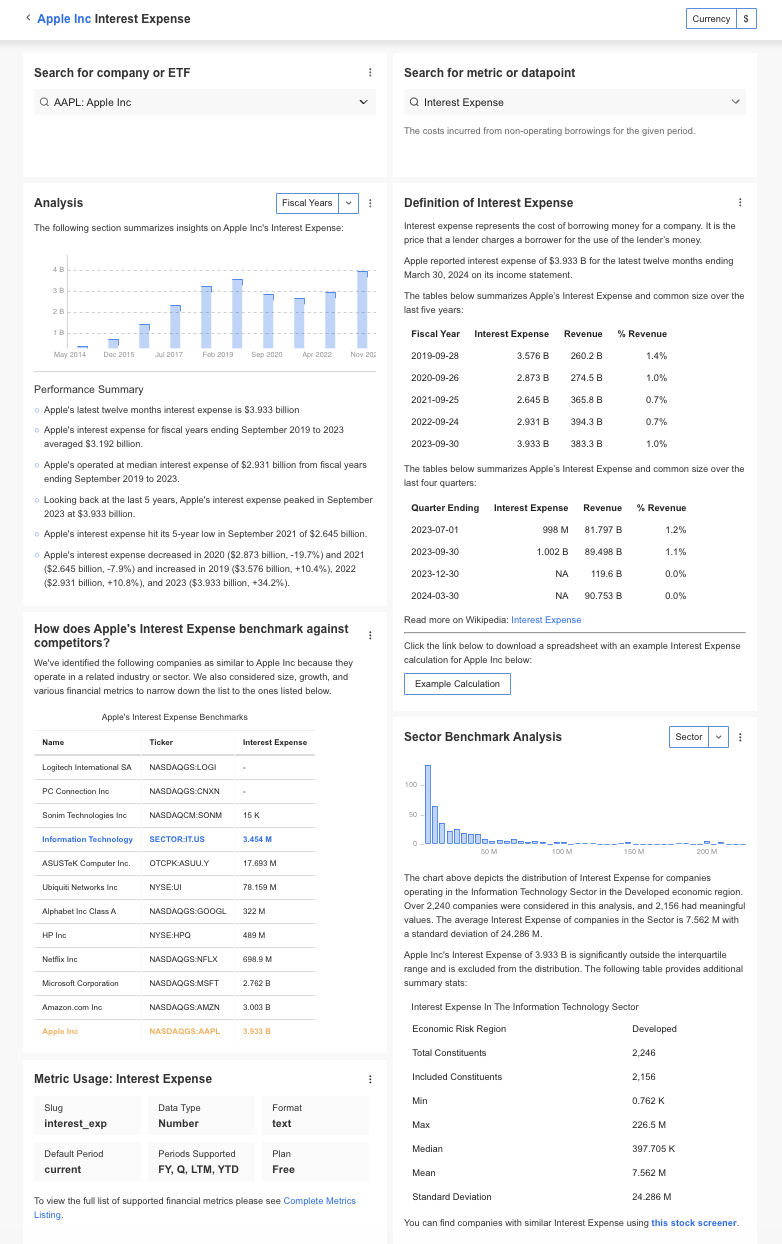
InvestingPro offers detailed insights into companies’ Interest Expense including sector benchmarks and competitor analysis.
Interest Expense: FAQ
What is the difference between interest expense and interest payable?
Interest expense is the cost incurred for borrowing funds over a period, whereas interest payable is the amount of interest that has accrued but not yet been paid.
How does interest expense affect taxes?
Interest expense is typically tax-deductible, reducing the overall taxable income of a company.
Can interest expense be capitalized?
Yes, in certain circumstances, such as during the construction of long-term assets, interest expense can be capitalized, meaning it is added to the cost of the asset rather than expensed immediately.
Why is managing interest expense important?
Managing interest expense is crucial for maintaining profitability and ensuring a company’s long-term financial health. High interest expenses can strain cash flow and reduce funds available for reinvestment.




 App Store
 Google Play