Investing.com

  • Academy Center
  • Markets
  • News
  • Analysis
  • Charts
  • Technical
  • Tools
  • Watchlist
  • Webinars
  • InvestingPro
      Academy
      • Stocks
      • Crypto
      • Trading
      • ETFs
      • Currencies
      • Analysis
      • Statistics
      • Stock Picks
      • Financial Terms
      • Global Stock Picks
      • InvestingPro 101
      • Tools

      Table of contents

      • What is Cost of Equity?
      • How to Calculate Cost of Equity?
      • Why Is Cost of Equity Important?
      • How to Interpret Cost of Equity?
      • Limitations of Cost of Equity
      • How to Find Cost of Equity
      • InvestingPro: Access Cost of Equity Data Instantly
      • FAQs

      Academy Center > Analysis

      Analysis Beginner

      Cost of Equity: Definition, Calculation, Importance

      written by
      Malvika Gurung
      arrow-top

      Financial Journalism

      Financial Journalist and Content Contributor at Investing.com

      B.Tech | Jaypee University of Engineering and Technology

      • linkedin logo
      See Full Bio
      | Edited by
      Rachael Rajan
      arrow-top

      Financial Markets Copyeditor - Investing.com

      Rachael has a Bachelor’s degree in mass media from Wilson College, Mumbai and a Master’s degree in English from Pune University.

      • linkedin logo
      See Full Bio
      | updated November 5, 2024
      A tarmac road with a yellow line that says 'Cost Of Equity', with the blog title to the right

      What is Cost of Equity?

      Cost of equity represents the return a company must offer investors to compensate for the risk of holding its equity. It is a crucial metric for evaluating the attractiveness of an investment and for corporate financial decision-making. Essentially, it is the rate of return required by shareholders to invest in the company’s equity rather than in risk-free securities.

      How to Calculate Cost of Equity?

      The cost of equity can be estimated using different models, the most popular being the Capital Asset Pricing Model (CAPM). The CAPM formula is as follows:

      Cost of Equity = Rf + 𝛽(𝑅𝑚 – 𝑅𝑓)

      where:

      • 𝑅𝑓  is the risk-free rate, typically the yield on government bonds.
      • β is the stock’s beta, which measures its volatility relative to the market.
      • 𝑅𝑚 ​is the expected market return.

      Why Is Cost of Equity Important?

      Cost of equity serves several vital functions. Some of them are noted below:

      Investment Valuation: Investors use it to determine if a stock offers adequate returns for its risk level.

      Corporate Financing Decisions: Companies use it to assess the cost of financing projects with equity versus debt.

      Performance Benchmark: It helps gauge whether the company is generating returns above the required rate, indicating effective management and attractive investment opportunities.

      How to Interpret Cost of Equity?

      The cost of equity is an important metric for companies, especially when they are working on determining the best way to raise capital. It can be understood as the expense that a company should consider returning back to investors based upon prevailing costs. 

      For example, if a company’s shares have a cost of equity of 8.5%, an investor in the company can expect a return of 8.5% post purchase.

      Limitations of Cost of Equity

      While cost of equity is a fundamental metric, it is essential to recognize its limitations. It is sensitive to assumptions about market returns and risk-free rates, which can fluctuate. Additionally, for companies in volatile or emerging sectors, estimating beta accurately can be challenging, affecting the precision of the cost of equity.

      Understanding the cost of equity is essential for both investors and corporate managers. It provides insight into the expected returns required by shareholders and informs critical decisions about financing and investment.

      How to Find Cost of Equity

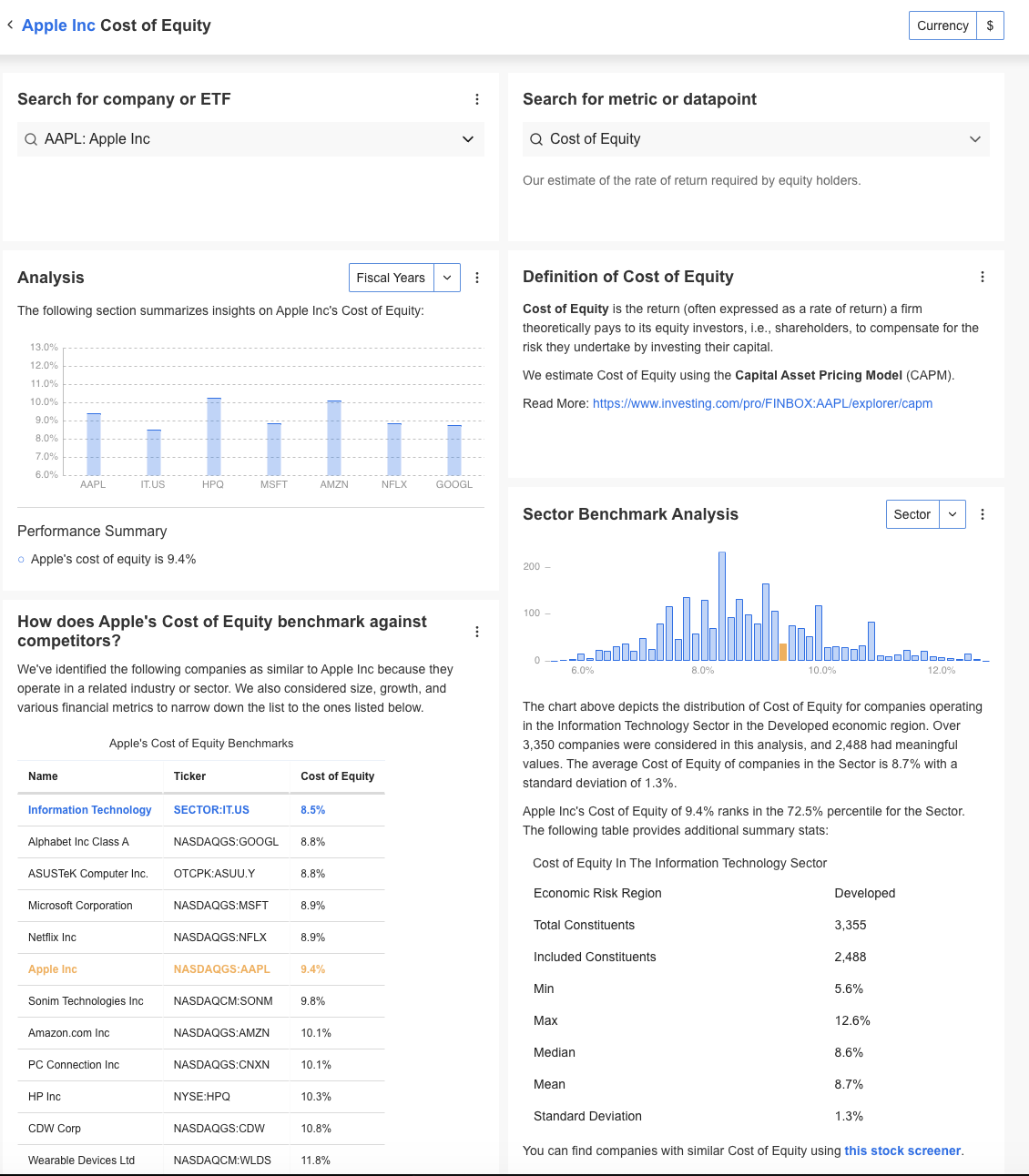
      InvestingPro offers detailed insights into companies’ Cost of Equity including sector benchmarks and competitor analysis.
      InvestingPro: Access Cost of Equity Data Instantly

      Unlock Premium Data With InvestingPro 📈💸

      Gain instant access to Cost of Equity data within the InvestingPro platform

      ✓ Access to 1200+ additional fundamental metrics

      ✓ Competitor comparison tools

      ✓ Evaluate stocks with 14+ proven financial models

      Outsmart the market with InvestingPro today!

      FAQs

      What is a good cost of equity?

      A good cost of equity varies by industry and market conditions, but it generally reflects a balance between acceptable risk and return. Lower values indicate lower risk or higher perceived stability.

      How does beta influence the cost of equity?

      Beta measures a stock’s volatility compared to the market. A higher beta increases the cost of equity, reflecting higher risk and expected returns.

      Can Cost of Equity be negative?

      While theoretically possible if a company’s beta is negative, a negative cost of equity is highly unusual and typically indicative of a calculation error or extreme market conditions.

      What is the difference between cost of equity and cost of capital?

      Cost of equity specifically refers to the return required by equity investors. In contrast, the cost of capital includes both equity and debt financing costs, providing a broader measure of the total funding cost for a company.


      Related Terms

      • What Is the Market Risk Premium? A Simple Guide for Investors
      • How to Find Value Stocks: A 4-Step Guide for the Intelligent Investor
      • What is the Capital Asset Pricing Model (CAPM)? A Complete Guide
      • How to Evaluate Quantum Computing Stocks: A Comprehensive Guide
      • What Is the Equity Multiplier? A Guide to Understanding Financial Leverage
      • How to Find Growth Stocks with Strong Fundamentals: A Practical Guide
      • How to Evaluate Cannabis Stocks: A Beginner's Guide to Technical and Fundamental Analysis
      • Cash Flow Quality: The Ultimate Guide to Finding Financially Healthy Companies
      • What Is a Dividend Reinvestment Plan (DRIP)? A Complete Guide
      • What is Technical Analysis? A Beginner's Guide to Reading the Market's Story

      Recent Articles

      How to Use Moving Averages in Stock Trading: Strategies for Entry and Exit Signals

      The stock market is a turbulent sea of constantly shifting prices, driven by news, sentiment, and volume. For new traders, the daily fluctuations can feel

      Step-by-Step Guide to Fibonacci Extensions in Stock Analysis

      For active investors, the challenge is not typically finding a good stock or an entry point; it’s knowing where to get out. When a stock

      Beginner’s Guide to Using Price Action in Stock Charts

      For many investors and traders, looking at a stock chart means navigating a confusing array of lines, squiggles, and colorful technical indicators like the RSI,

      How to Use Oscillators to Confirm Stock Trends

      As an investor, you’ve likely grappled with one of the most fundamental questions in the stock market: Is this trend real, or is it just


      Install Our Apps

      Scan the QR code or install from the link

      www.facebook.comApp Store www.twitter.comGoogle Play

      www.investing.com
      • Blog
      • Mobile
      • Portfolio
      • Widgets
      • About Us
      • Advertise
      • Help & Support
      • Authors
      Investing.com
      www.facebook.com www.twitter.com

      Risk Disclosure: Please be fully informed regarding the risks and costs associated with trading the financial markets, it is one of the riskiest investment forms possible. Currency trading on margin involves high risk, and is not suitable for all investors. Before deciding to trade foreign exchange or any other financial instrument you should carefully consider your investment objectives, level of experience, and risk appetite. Fusion Media may be compensated by the advertisers that appear on the website, based on your interaction with the advertisements or advertisers.

      Fusion Media does not endorse any product or service and does not assume any liability regarding your interaction with any third party displayed on this site, including the nature, quality, supply or fitness for a particular purpose of the product or service, or any damage caused as a result of the use of such product or service.


      © 2007-2025 Fusion Media Limited. All Rights Reserved
      • Terms And Conditions
      • Privacy Policy
      • Risk Warning
      • Do Not Sell My Information