


What is Cash from Operations (CFO)?
Cash Flow from Operations (CFO), also known as operating cash flow, is a key financial metric that measures the amount of cash a company generates from its core business activities. This figure is crucial for investors and analysts as it reflects the company’s ability to generate sufficient cash to maintain and grow its operations without needing external financing.
CFO is derived from the company’s income statement and reflects cash inflows and outflows related to day-to-day operations, excluding any capital expenditures or investments. It appears as the first section on a company’s cash flow statement.
How to Calculate Cash Flow From Operations?
The formula for calculating CFO follows the indirect method, which starts with net income and adjusts for non-cash items and changes in working capital.
The standard formula is:

CFO = Net Income + Non-Cash Expenses (e.g., Depreciation, Amortization) + Changes in Working Capital (Accounts Receivable, Inventory, Accounts Payable)
This method reflects how much actual cash was earned from operations, as opposed to net income, which includes non-cash items like depreciation and amortization.

Why is Cash Flow From Operations Important?
CFO is a key indicator of a company’s financial health and sustainability. Unlike net income, which can be influenced by accounting methods and non-cash items, CFO shows the real cash a company generates. This makes it a valuable measure for understanding whether a company can meet its obligations, pay dividends, or reinvest in its growth.
Companies with strong CFO are often considered more financially stable, while consistently negative CFO can be a red flag for investors.
How to Interpret CFO?
Cash from Operations (CFO) excludes long-term capital investments and income or expenses from investments, concentrating solely on the company’s primary business operations.
A positive cash flow from operations indicates that a company is effectively generating cash through its main business activities. This cash flow can contribute to discretionary free cash flow, which may be allocated to shareholder returns, financing deals, or capital expenditures.
On the other hand, a negative operating cash flow signals that the company’s core operations are losing cash, requiring additional funds from other business segments or external financing. This can result from short-term issues, such as inventory problems or one-off customer concerns, or long-term challenges like declining sales or weakened relationships with customers and suppliers.
Key Differences Between CFO and Net Income
While net income is a widely used metric, it includes non-cash items and may not accurately reflect a company’s liquidity. CFO, on the other hand, focuses solely on cash generated from operations. For example, a company might report a high net income due to deferred expenses or revenue recognition practices, but still face liquidity issues if its CFO is negative.
Limitations of CFO
While cash flow from operations (CFO) offers a clearer view of a company’s cash generation, it does have some limitations. Ideally, CFO would match net income if only cash revenues and cash expenses were involved. However, CFO adjusts net income – a metric influenced by management’s discretionary decisions and accounting practices.
One significant limitation is that CFO does not account for capital expenditures (Capex), which are often a company’s largest cash outflows. As a result, despite being less prone to accounting manipulation than net income, CFO remains an incomplete indicator of free cash flow (FCF) and overall profitability.
How to Find Cash from Operations?
InvestingPro offers detailed insights into companies’ Cash from Operations including sector benchmarks and competitor analysis.
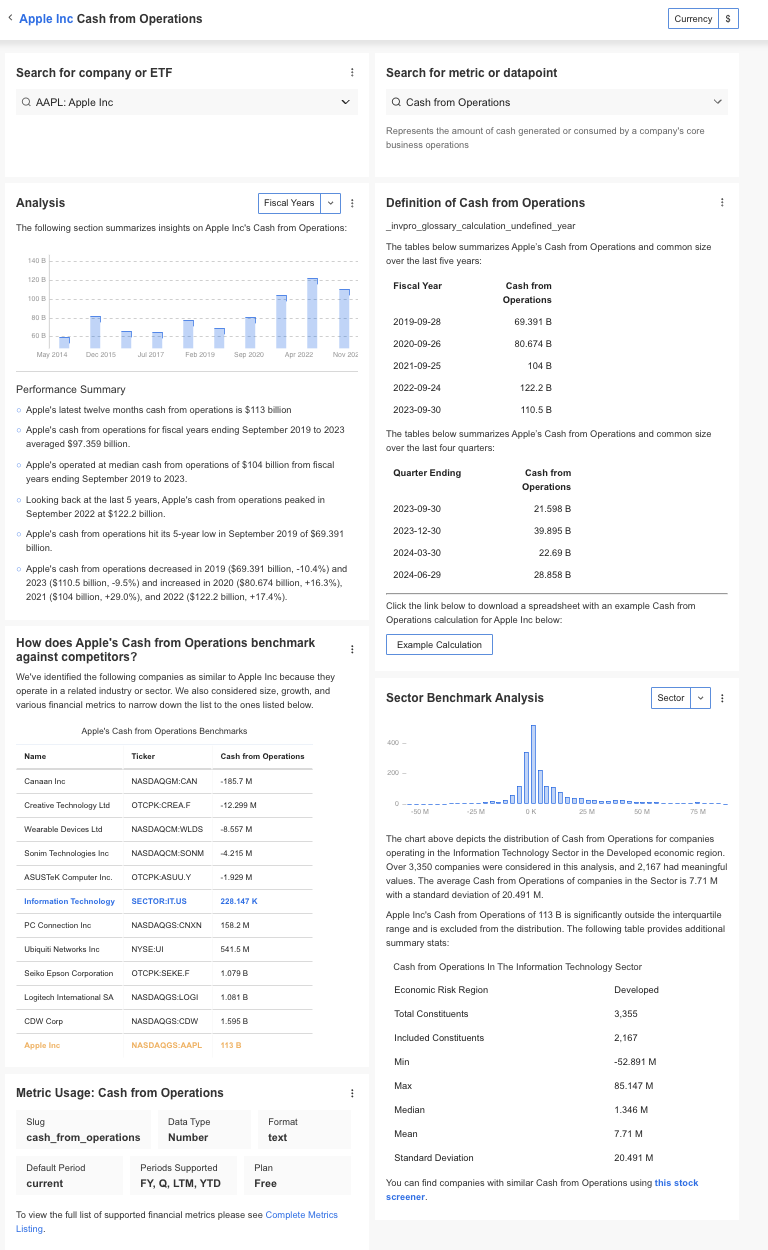
InvestingPro: Access Cash from Operations Data Instantly
Unlock Premium Data With InvestingPro 📈💸
Gain instant access to Cash from Operations data within the InvestingPro platform
✓ Access to 1200+ additional fundamental metrics
✓ Competitor comparison tools
✓ Evaluate stocks with 14+ proven financial models
Cash from Operations FAQ
How does Cash Flow From Operations differ from free cash flow?
CFO only accounts for cash generated from core business operations, whereas free cash flow deducts capital expenditures, showing the actual cash available to distribute to investors or reinvest.
Why is CFO considered more reliable than net income?
CFO provides a clearer picture of a company’s financial health by focusing on cash inflows and outflows from daily operations, free from the impact of accounting adjustments like depreciation and amortization.
What does it mean if a company has a negative CFO?
A negative CFO suggests that the company is spending more cash on its operations than it is generating. This could be due to operational inefficiencies or temporary business conditions but is often a sign of financial distress if it persists over time.
Is Cash Flow From Operations a better metric than earnings?
CFO is often considered a better indicator of a company’s true financial health, as it eliminates the effects of non-cash expenses and focuses on actual cash generation. While earnings provide useful information, they can be influenced by accounting techniques.




 App Store
 Google Play