


What is Cash Flow from Financing?
Cash flow from financing activities is a core component of a company’s cash flow statement, showcasing cash inflows and outflows related to financing transactions. This category of cash flow offers valuable insights into how a business funds its operations, supports growth, and repays obligations.
For investors, cash flow from financing provides a window into a company’s strategic decisions on debt management, equity financing, and shareholder value.
How to Calculate Cash Flow from Financing Activities?
The formula for cash flow from financing activities is straightforward.
Using the balance sheet and cash flow statement, cash inflows and outflows are calculated as follows:

Cash Flow from Financing Activities = Net Proceeds from Debt and Equity Issuance − Debt Repayments − Dividends Paid − Stock Buybacks
Each of these components requires a breakdown of cash inflows and outflows to yield a net figure, which appears on the company’s cash flow statement under financing activities.

Why is Cash Flow from Financing Activities Important?
Cash flow from financing activities is essential for assessing a company’s financial decisions, particularly in relation to capital structure and shareholder commitments. It is a valuable metric in identifying a company’s reliance on debt or equity, its approach to managing cash, and its plans for expansion or consolidation.
Investors and analysts closely evaluate a company’s cash flow from financing (CFF) to assess its financial health and approach to structuring capital.
Frequency of Cash Inflows
A company’s cash inflows from financing across multiple periods can reveal its reliance on external funding. If a company regularly issues new shares or takes on more debt, it may indicate that it’s unable to generate sufficient earnings to fund its operations independently. In such cases, positive cash flow isn’t necessarily favorable—it could be a cautionary signal of financial strain.
Preference for Capital Financing Methods
Understanding a company’s preferred financing options offers insight into its approach to capital structure. If a company frequently turns to stock issuance, it could signal potential value dilution for existing shareholders, often leading to a decline in share price.
Alternatively, a reliance on debt might suggest a burden of fixed liabilities, especially sensitive to rising interest rates. Ideally, a balanced capital structure seeks to lower the cost of capital by carefully managing debt and equity proportions.
Stock Repurchases and Dividend Payments
Evaluating stock buybacks and dividend payouts in light of net income provides another layer of analysis. When a company consistently earns substantial income, share repurchases can be beneficial, as they increase each remaining share’s value by reducing the outstanding share count. Similarly, dividend payments may be a positive indicator when earnings are robust.
However, if income is low, buybacks or dividends can raise concerns, as they may suggest the company is attempting to bolster its share price amid weak earnings.
Breaking Down Cash Flow from Financing Activities
Cash flow from financing activities primarily covers three areas:
- Issuance of Debt or Equity: Companies often raise funds by issuing shares or taking on debt. When a company sells new shares or secures loans, it generates cash inflows. These moves indicate either expansion plans or capital needs for ongoing operations.
- Repayment of Debt: Repaying loans or settling financial obligations results in cash outflows. Regular debt repayments reflect a company’s financial stability and creditworthiness, as well as its ability to handle obligations without jeopardizing cash reserves.
- Dividend Payments and Stock Buybacks: Companies distribute dividends or repurchase their own stock to return value to shareholders. While both actions reduce cash reserves, they demonstrate the company’s confidence in its financial position and commitment to shareholder returns.
How to Interpret Cash Flow from Financing Activities?
Positive Cash Flow from Financing
Positive cash flow indicates that a company is raising more funds than it’s spending on financing activities, generally through issuing debt or equity. This can signal growth intentions or a need for additional capital. However, continuous reliance on debt may suggest financial stress if the funds are not used for growth.
Negative Cash Flow from Financing
Negative cash flow in this section often results from debt repayments, dividends, or share buybacks. It suggests a company’s focus on reducing liabilities or returning value to shareholders, which can indicate financial stability but may limit funds for future investments.
Cash Flow from Financing Vs Operating and Investing Activities
To fully understand a company’s cash flow health, it’s essential to look at financing activities alongside cash flows from operating and investing activities:
- Operating Activities: Shows cash generated by core business operations, often considered a company’s main revenue source.
- Investing Activities: Reflects cash spent on or gained from investments in assets, equipment, or acquisitions, shedding light on the company’s capital expenditures and investment strategy.
Together, these categories give investors a holistic view of a company’s cash flow management and financial priorities.
How to Find Cash Flow from Financing?
InvestingPro offers detailed insights into companies’ Cash Flow from Financing including sector benchmarks and competitor analysis.
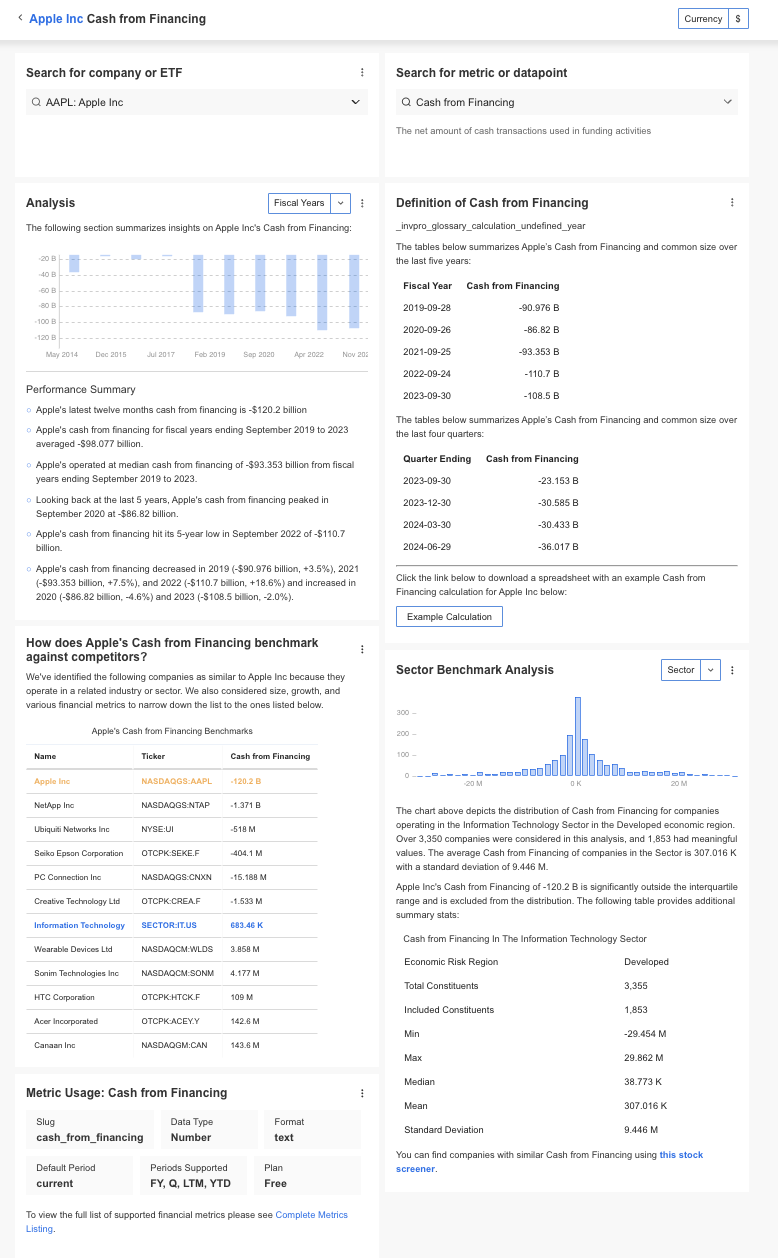
InvestingPro: Access Cash Flow from Financing Data Instantly
Unlock Premium Data With InvestingPro 📈💸
Gain instant access to Cash Flow from Financing data within the InvestingPro platform
🛠 Access to 1200+ additional fundamental metrics
🔍 Competitor comparison tools
📊 Evaluate stocks with 14+ proven financial models
Cash Flow from Financing Activities FAQs
Why is cash flow from financing activities important?
It reveals how a company funds its operations and whether it prioritizes growth, debt reduction, or shareholder returns, offering key insights for investors.
What does negative cash flow from financing activities indicate?
Negative cash flow often signifies debt repayment, dividends, or buybacks, suggesting a focus on debt reduction or shareholder returns, depending on the context.
Is positive cash flow from financing always a good sign?
Not necessarily. While it can indicate expansion, consistent reliance on debt might signal potential liquidity issues or an unsustainable growth strategy.
How do dividends impact cash flow from financing?
Dividends appear as cash outflows under financing activities, as they reduce cash reserves to reward shareholders, impacting the company’s cash position.
How can investors use cash flow from financing activities in decision-making?
Investors can gauge a company’s financial health by assessing its cash flow trends in financing activities, helping inform investment decisions based on debt, equity, and shareholder strategies.




 App Store
 Google Play